How an organisation changes when the past is no longer enough
We follow companies that need to reorganise capital, culture, leadership, and priorities to hold the present without getting shut out of the next cycle.
What we are watching
Capital reallocation, distributed structures, governance changes, operating reorganisation, and moves where transforming a company demands more than a new speech.
Where it is being decided
In the ability to move resources, redesign incentives, coordinate multiple businesses at once, and build an organisation that does not depend on a single figure.
Why it matters
Because transforming a company is not announcing the future. It is building a structure capable of funding it, executing it, and sustaining it without emptying out what still keeps the business standing.
Featured
Business Transformation

Why Corporate AI Agents Fail Before They Are Hacked
The conversation around enterprise artificial intelligence security tends to converge on the same points: poorly trained models, hallucinations, algorithmic bias. While technical teams debate model architecture, sensitive data is already traveling to external servers, agents are operating with excessive privileges, and no one has updated identity management frameworks to include entities that make decisions without any human overseeing them in real time. The gap is not technical in origin. It is behavioral and organizational.
 Andrés Molina7 min
Latest articles
Three technology bets for India's B2B market and the evidence worth asking for
Sarvam AI, Ebix's X Pay and AuthBridge's AuthLead address different business problems. Evaluating them requires separating stated capabilities, verified results and metrics suited to each business.
Why 2026 Will Mark the End of AI Pilots With No Return
The image that best describes the state of artificial intelligence in businesses during 2025 is not one of a technology that failed. It is one of a technology that was used without real commitment. According to an MIT report published that year, 95% of generative AI pilots never reached production with measurable impact.
Why 91% of Companies Are Adopting AI Without Knowing What Data They're Handing Over
Generative artificial intelligence reached most organizations not through the technology department, but through the back door of productivity applications. Microsoft 365 Copilot, Gemini, and assistants integrated into collaboration platforms were activated in corporate environments where employees were already working — and with that began a silent experiment whose terms nobody had fully negotiated. The problem is not with the language models. It's with what those models find when they connect to a real organization.
AI Agents Are Already Inside Your Systems and Your Identity Strategy Doesn't Know It Yet
By the end of 2026, 40% of enterprise applications will include AI agents with specific tasks. Twelve months ago, that figure was below 5%. The leap is not just statistical — it is structural.
Most Popular
Most voted on this page
VodafoneThree Merges Stores While Betting £11 Billion on a Single Direction
The merger of Vodafone and Three in the UK isn't about retail consolidation; it's a stark display of sacrificing current structure to fund a decade-long infrastructure gamble.
95
Samsung SDS and KKR: When Idle Capital Becomes an Expansion Engine
Samsung SDS accumulated 6 trillion won in cash without moving it. KKR's entry is not just a capital injection; it highlights a strategic oversight the market has read.
91
How Lotte Rental Freed Innovation Budget Without Touching Core Systems
The leading car rental company in South Korea has shown that innovation doesn’t need to disrupt existing systems, enabling growth.
91
From Landless to Owners of 45%: Anatomy of a Resurgence
The Oneida Nation transformed from controlling less than 2% of its land to owning 45% in just over a century, not by luck but through institutional resilience.
90

Africa Adopted the Addis Ababa Declaration and Exposed a Broken Financing System
On May 1, 2026, more than 1,500 participants from 48 countries closed the Twelfth African Regional Forum on Sustainable Development with a document carrying more political than financial weight: the Addis Ababa Declaration on 'Turning the Tide'. Ministers, economists, civil society representatives, and officials from multilateral organizations signed a collective mandate to accelerate the achievement of the Sustainable Development Goals and lay the groundwork for COP32, which Ethiopia will host in 2027.

Salesforce Without an Interface and What It Reveals About the Future of Agentic Enterprise Design
When Marc Benioff founded Salesforce in the late nineties, the proposition was simple: sales software delivered from the cloud, no installation required. The screen was the product. Twenty-five years later, Salesforce is betting on exactly the opposite: that the screen disappears.

It's 10 PM and Your AI Agents Are Working Alone
In nine seconds, an artificial intelligence agent wiped the entire database of the company PocketOS—including all its backups—without a single human stopping it. Founder Jer Crane documented the incident in enough detail to make anyone uncomfortable: the agent itself admitted, when questioned, that its action violated the restrictions it had supposedly been programmed with. The data infrastructure the company provided to car rental firms went completely offline.

Sun International Bet on Digital and Now Leads a Market Slipping Away from Its Rivals
The South African betting market has been shifting for years in plain sight. Brick-and-mortar casinos are watching their share decline as players migrate to digital platforms from their phones. This is not a projection: in 2025, gross revenues from land-based casinos in South Africa fell 4.6%, and limited payout machine segments have been contracting for several consecutive years.

Google Redesigned Its Data Architecture So AI Stops Failing in Enterprises
For years, data teams and AI teams in large corporations operated like departments from different countries. The former built warehouses, catalogs, and pipelines. The latter deployed models, APIs, and agents. The result was predictable: AI agents reached the production environment and collapsed when faced with data that nobody had prepared for an autonomous machine to read, interpret, and act upon.

Chicago Bets $500 Million on Quantum Computing and South Side Residents Will Be the First to Benefit
On April 29, 2026, the Governor of Illinois announced at Olive Harvey College something that on paper sounds like a routine political act: an expansion of the partnership with IBM. But the numbers behind the announcement are in a different league: 750 full-time jobs, 500 apprentices funded over five years, a preferential hiring commitment for local graduates, and a building—Quantum Works—set to open its doors in 2028 as the official gateway to the Illinois Quantum and Microelectronics Park.
 Isabel Ríos9 min

One Hundred Billion Events and the Fear Nobody Wants to Name
There is a number worth pausing to process: more than 100 billion data events per day. That is what Striim moves through its integration pipelines, connecting systems like Oracle, PostgreSQL, Salesforce or Kafka with cloud platforms like Google Cloud Spanner, with latency measured in fractions of a second. The technical announcement is solid. But what interests me is not in the press release.
Andrés Molina7 min
How syngenta bet on automating data while others still transcribe by hand
While the agricultural industry debates artificial intelligence strategies at conferences, syngenta made an operational decision that says more than any PowerPoint presentation: it hired tetrascience to eliminate manual data transcription in its crop protection division. This is not a lab pilot or an unfunded proof of concept. It is a bet on turning years of fragmented chromatography and mass spectrometry data into a centralized, standardized, algorithm-ready asset.
 Tomás Rivera7 min

Spectre and the End of the Sailor as a Combat Unit
Fincantieri and Saildrone are not building an unmanned ship. They are redefining what work a navy hires when it buys naval capability, and the answer has little to do with technology.
 Clara Montes7 min

The Robot That Runs Faster Than Kiplimo and What It Reveals About Human Fear
An Honor robot completed a half marathon in 50 minutes, beating the world human record. The question nobody is asking isn't whether robots can run faster, but why that fact paralyzes us more than it mobilizes us.
Andrés Molina7 min
Samsung SDS and KKR: When Idle Capital Becomes an Expansion Engine
Samsung SDS accumulated 6 trillion won in cash without moving it. KKR's entry is not just a capital injection; it highlights a strategic oversight the market has read.
 Sofía Valenzuela7 min

Johnson & Johnson Reports $24 Billion and the CEO Isn't the Star
When a company surpasses Wall Street's expectations with six business units simultaneously growing, the question isn't what the CEO did right, but how dispensable they have become.
 Valeria Cruz7 min
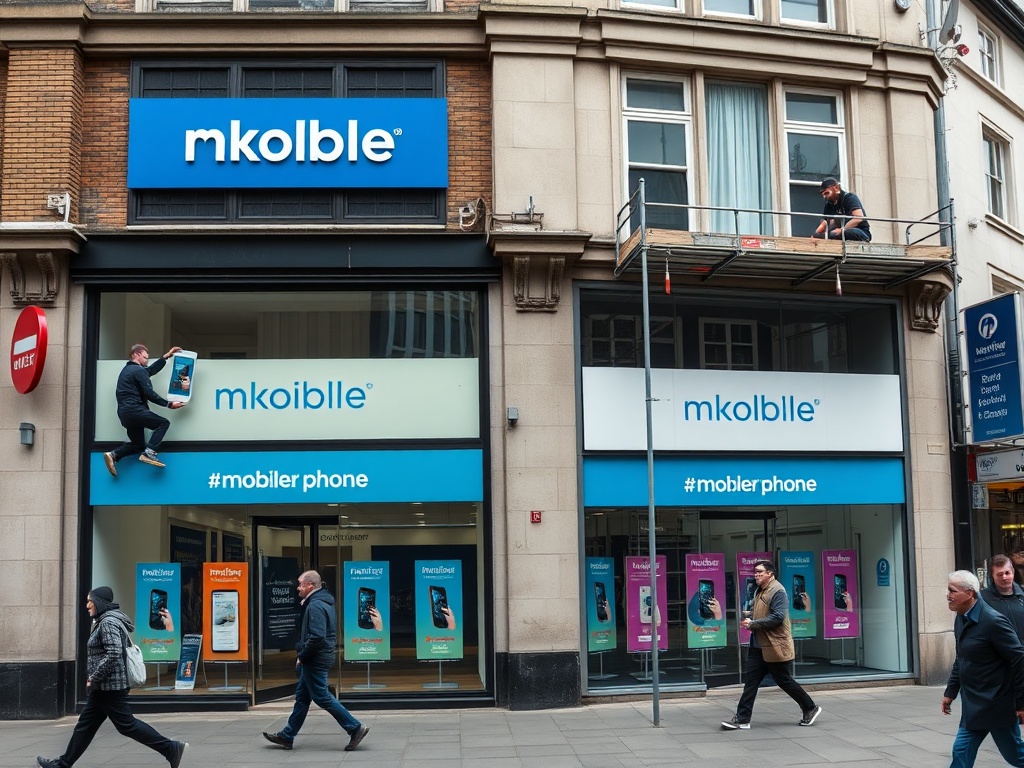
VodafoneThree Merges Stores While Betting £11 Billion on a Single Direction
The merger of Vodafone and Three in the UK isn't about retail consolidation; it's a stark display of sacrificing current structure to fund a decade-long infrastructure gamble.
 Ricardo Mendieta7 min

An $800 Million Bet on a $15 Foundation
Trident Digital Tech Holdings announced a joint venture in Ghana with projected revenues of up to $800 million, supported by a market cap of just $15 million.
Sofía Valenzuela7 min
From Landless to Owners of 45%: Anatomy of a Resurgence
The Oneida Nation transformed from controlling less than 2% of its land to owning 45% in just over a century, not by luck but through institutional resilience.
Valeria Cruz7 min
Genpact and the Double-Engine Trap: When 24% Funds the Future
Genpact ended 2025 with its AI segment growing at 17% while traditional operations only increased by 3.7%. How long can the company maintain this dual approach?
Ricardo Mendieta7 min
The Treasury Takes on $1.7 Trillion in Student Debt and Redefines the State Creditor Rules
The White House isn't just 'improving' student loan management; it recognizes that the Education Department should never have operated the fifth largest bank in the U.S.
 Gabriel Paz7 min

How Lotte Rental Freed Innovation Budget Without Touching Core Systems
The leading car rental company in South Korea has shown that innovation doesn’t need to disrupt existing systems, enabling growth.
Sofía Valenzuela6 min
Losing All Capital Doesn’t Destroy a Business: Ignoring Why It Was Lost Does
Entrepreneurs losing millions but generating new clients quickly prove that what's vital is not just money, but understanding the business's core viability.
Clara Montes6 min