
The Problem Nobody Wanted to Say Out Loud
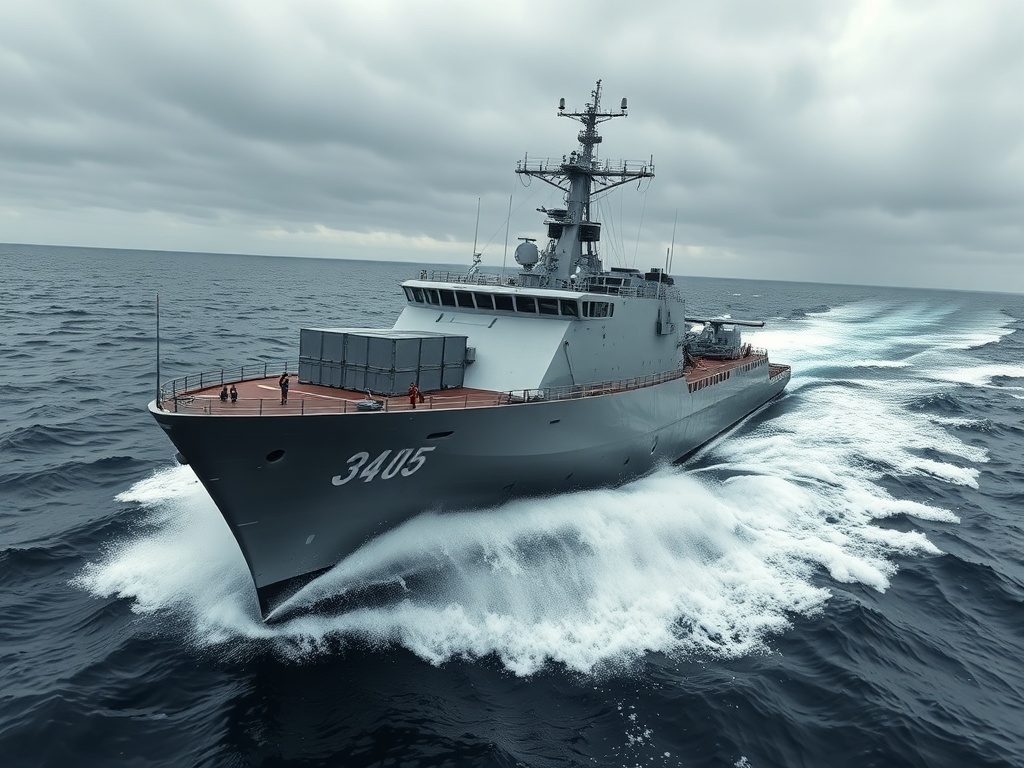
On April 20, 2026, at a naval exhibition in Maryland, two companies announced something that, presented in a press release, sounds like a routine technical advancement: a 52-meter autonomous vessel, 250 tons, capable of reaching 30 knots and carrying more than 70 tons of equipment. They call it Spectre. It will be built by Fincantieri Marine Group in Wisconsin. It was designed by Saildrone over two years.
But if one reads that press release with the cold detachment of someone who has audited defense models, the detail that stands out is neither the speed nor the tonnage. It is this: silent electric propulsion up to 12 knots for submarine hunting, and Caterpillar diesel engines producing 5,000 horsepower for attack missions. Two modes. Two completely different jobs. A single hull with not a single sailor on board.
That is not a product. It is the formal acknowledgment that the operational model that has dominated naval warfare for a century has a structural problem that no traditional shipyard could resolve without reinventing itself: the human being on board is, simultaneously, the most valuable asset and the most expensive bottleneck in the entire combat architecture.
Navies have spent decades over-engineering their platforms to protect their crews. More armor, more survival systems, more onboard life-support logistics. That accumulation of complexity drove the cost of vessels to levels that make deploying them in numbers economically unviable. A U.S. Navy destroyer costs between two and three billion dollars. Spectre does not have that problem, because Spectre has no sailors to protect.
What Fincantieri Is Really Selling
Fincantieri's CEO, Pierroberto Folgiero, chose his words with surgical precision in the announcement: "transformation from traditional shipbuilder to industrial systems integrator for the naval forces of the future." That phrase is not public relations. It is a declaration of competitive repositioning.
Fincantieri has 230 years of history, 18 shipyards around the world, more than 24,000 employees, and a catalog that includes everything from luxury cruise ships to submarines. A company with that kind of specific gravity does not need to announce autonomous vessels to appear modern. It does so because it detected something that defense analysts have been documenting for years without the major shipbuilders reacting: demand for naval platforms is fracturing.
On one side, the world's largest navies continue to require massive surface vessels, aircraft carriers, and high-complexity frigates. On the other, there is a growing operational need that those vessels cannot satisfy efficiently: persistent presence, long-range submarine surveillance, and the ability to saturate a theater of operations with multiple units simultaneously. Crewed vessels are too expensive for that second job. Too valuable to risk. Too slow to produce in series.
Spectre attacks that second job with a production architecture that the Wisconsin shipyards can repeat five times per year. It is not a technology demonstration. It is a manufacturing line. And that distinction changes the entire viability analysis.
Saildrone brings more than a decade of operating autonomous vehicles in extreme conditions, from the Arctic to the equatorial Pacific. It did not arrive at this project with a patent and a prototype in a garage. It arrived with real operational data from hostile environments, which is exactly what a navy needs in order to trust an unmanned system in a submarine warfare scenario. That accumulated experience is the asset that Fincantieri could not have built internally without decades of its own operations.
The Silent Logic Behind the Aluminum Hull
There is a technical detail in Spectre that deserves more attention than it received in the initial coverage: the concealed cargo deck that accepts two 40-foot containers, or up to five 20-foot containers, in mixed configurations. That is not a design indulgence. It is a modular architecture decision that transforms the vessel into a mission-agnostic platform.
Today it can carry submarine-hunting sonar. Tomorrow, long-range munitions. The day after, electronic warfare equipment. The same hull, the same propulsion system, the same production cycle in Wisconsin. Only the contents of the containers change. This modularity shifts the cost of adaptation away from the vessel and toward the payload, which is infinitely cheaper to modify than redesigning an entire platform from scratch.
From an operational economics perspective, that has a direct implication: allied navies that adopt Spectre are not buying a specific weapons system. They are buying adaptable response capacity, with an entry cost that does not require committing their acquisition budget for an entire generation.
The electric propulsion up to 12 knots for anti-submarine operations is not merely an acoustic tactical advantage. It is a signature reduction that allows the vessel to operate closer to the target without being detected first. In the context of modern submarine warfare, where the advantage belongs to whoever detects first, that capability carries an operational value that no crewed vessel can replicate with the same economy — because a crewed vessel operating in silent mode is still a vessel with hundreds of people generating thermal, mechanical, and electromagnetic noise.
The Shipyard as Competitive Advantage, Not as a Commodity
Production on American soil is not a minor logistical detail in this agreement. Given the current tensions surrounding domestic defense manufacturing, producing five Spectre vessels per year in Wisconsin is a political proposition as much as an industrial one. Fincantieri knows this and chose it consciously.
Navies that purchase defense systems are not only buying technical capability. They are buying supply certainty, industrial sovereignty, and the ability to scale production during a crisis without depending on vulnerable supply chains. A shipyard that can commit to five units per year, with locally sourced materials and a workforce under U.S. jurisdiction, resolves an institutional anxiety that no foreign manufacturer can eliminate by decree.
The first sea trials are scheduled for early 2027. That leaves a narrow window for the market to evaluate real-world performance before the first acquisition decisions arrive.