
Europe Demonstrates the First Semi-Industrial Cycle of Chemical Textile Recycling
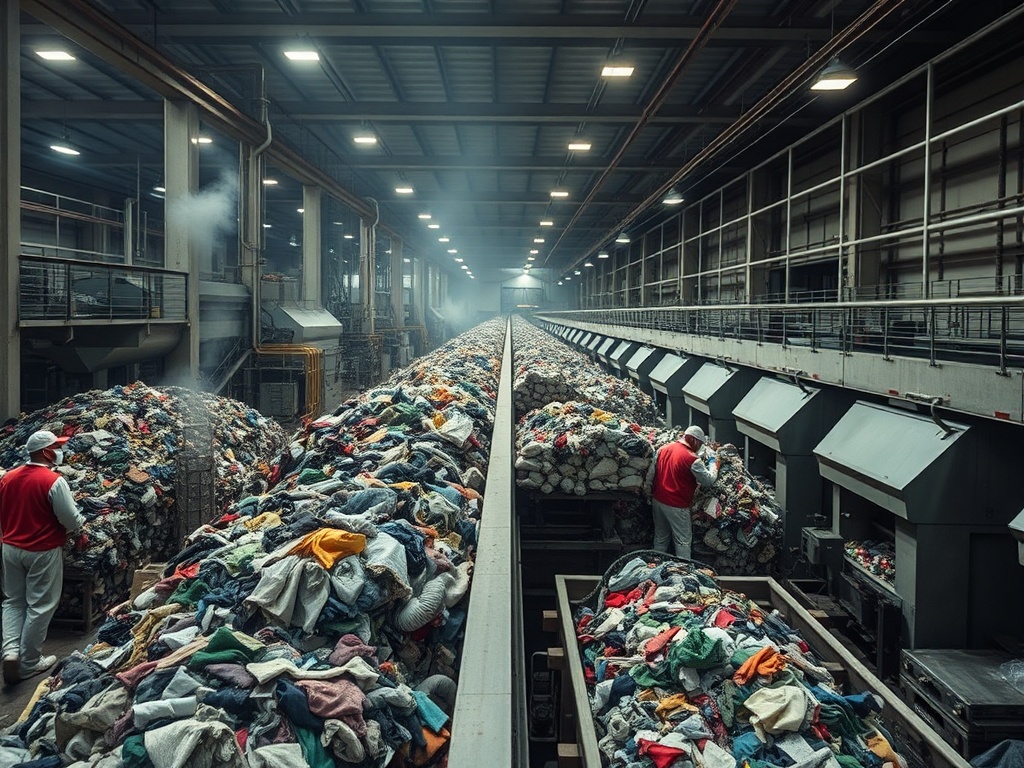
Europe generates more than five million tonnes of textile waste per year. The vast majority ends up in landfills or incinerators. Not because the technology to process it is lacking, but because converting it into useful raw material at a commercially viable cost had proved impossible to demonstrate beyond the laboratory scale. Until now.
On April 21, 2026, AXENS, IFPEN, and JEPLAN announced that they had completed a full semi-industrial demonstration cycle: post-consumer textile waste rich in polyester, collected and sorted in France, was shipped to Japan and processed at their joint unit to produce the base monomer that enables the manufacture of 100% recycled polyester. The volume processed is measured in tens of tonnes. The result is not an academic paper. It is a trial conducted with real waste, under real operating conditions, at a scale that investors and brands can read without any need for translation.
What This Result Changes in the Value Chain
Chemical recycling of polyester is not a new concept. Depolymerisation processes, which break down textile plastic to recover its base monomer, have been under development in controlled environments for more than a decade. The problem has always been the same: it works in the laboratory, but scaling up requires managing real waste, with contaminants, fibre blends, and variability of origin that no small-scale pilot can honestly simulate.
What AXENS, IFPEN, and JEPLAN have demonstrated is that this leap is technically feasible. The chain they built spans from the sorting of waste on European soil to the production of the monomer in Japan, at a volume sufficient to make a case before a board of directors or an investment committee. And that case carries weight because it directly attacks the bottleneck that has paralysed the industry: the preparation of waste prior to the chemical process.
Sorting mixed textiles is expensive, slow, and poorly profitable under current models. European projects such as that of Fashion for Good have worked to build sorting infrastructure for non-reusable waste, precisely because without that prior step, chemical recycling has no viable feedstock. The trial conducted by AXENS, IFPEN, and JEPLAN incorporated that variable from the outset: the waste was not prepared under ideal laboratory conditions, but sorted in France before shipment. That is what turns this announcement into an operational data point rather than a statement of intent.
From the perspective of the 6Ds framework, this process sits at the transition between the Deception phase — where the technology existed but was not performing at commercial scale — and active Disruption. The marginal cost of producing recycled polyester through this method, once the infrastructure has been amortised, has the potential to compress the prices of virgin polyester derived from petroleum. Not all at once, but in a sustained manner as plants are installed at full industrial scale.
The Geography of the Process Reveals a Strategic Tension
There is a detail in the design of this demonstration that deserves attention: the waste is sorted in Europe and processed in Japan. The transcontinental logistics are not an accident. JEPLAN has in Japan the semi-industrial demonstration infrastructure that AXENS and IFPEN do not yet possess in Europe. This division of labour makes sense for validating the technology, but it creates a dependency that the European market will want to resolve before scaling up.
The reason is as much regulatory as it is economic. The European Union is building a regulatory framework that incentivises the recycling of textile waste within its own borders. Transporting tens of tonnes of European waste to Japan for processing works as a proof of concept, but not as a sustainable long-term business model. The next logical move is to install processing capacity in Europe, where the majority of the waste is located and where fashion, sportswear, and luxury brands have their operations.
For brands with public commitments to reducing their footprint across their supply chains, this validation opens a concrete route. Incorporating 100% recycled polyester produced through chemical depolymerisation not only reduces dependence on virgin raw materials: it also cuts the emissions associated with Scope 3, which is where the major fashion groups face their greatest regulatory exposure in Europe. A process validated at semi-industrial scale is precisely the kind of evidence that a chief sustainability officer needs to negotiate internally the transition of their purchasing chain.
For waste managers and sorting operators in France and other European countries, the message is different but equally direct: their output now has a potential buyer with clear technical specifications. That changes the economics of sorting. Moving from managing waste as a cost to producing feedstock as an asset is not a minor shift.
The Licensing Model as a Real Vector for Expansion
AXENS has historically operated as a process technology provider, with a model centred on the sale of licences and the supply of catalysts and associated solutions. That model, applied to textile recycling, has a scalability logic that differs from that of building and operating plants directly. If the technology is licensed, geographical expansion does not depend on AXENS's balance sheet: it depends on local operators having the incentives to adopt it.
Those incentives are converging. Regulatory pressure in Europe on the textile sector is intensifying. The price of virgin polyester is tied to the volatility of oil markets. And brands in the highest-margin segments — sportswear and luxury in particular — need traceability and circularity arguments that their customers can verify. A monomer produced from post-consumer waste, with a documented chain of custody, is a brand asset, not merely a raw material.
What AXENS, IFPEN, and JEPLAN have done is move the technology from the Dematerialisation of the concept to operational validation. Recycled polyester ceases to be a sustainability narrative and becomes a technical specification that a plant can produce in a repeatable manner. That is the threshold that separates ideas from businesses. And crossing it, with real European waste and tens of tonnes processed, positions the three partners as the holders of the technical architecture upon which a substantial share of the European circular polyester market will be built over the coming decade.
The technology that converts waste into raw material does not democratise access to sustainable fashion on its own, but it does demonetise the dependence on petroleum as the sole source of synthetic fibre — and that redistributes pricing power throughout the entire chain.