
The Robot That Runs Faster Than Kiplimo and What It Reveals About Human Fear
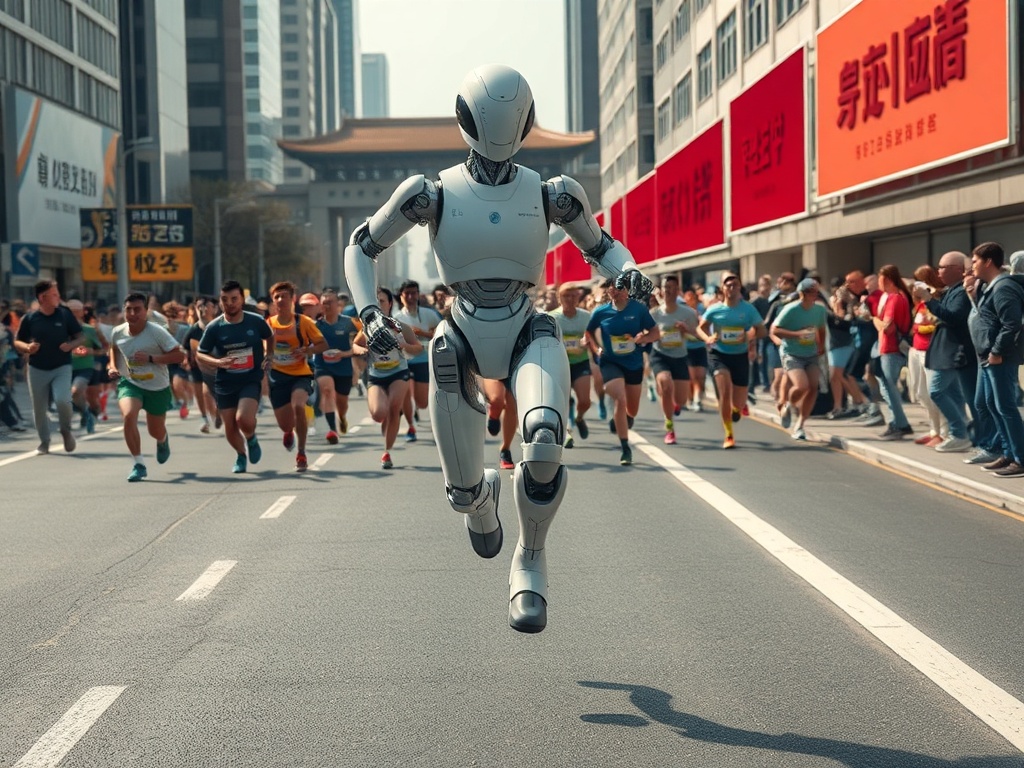
On April 19, 2026, on the streets of Yizhuang, in southern Beijing, a robot called Lightning crossed the finish line of a half marathon in 50 minutes and 26 seconds. To put it in perspective: the world record belongs to Ugandan runner Jacob Kiplimo, who in March 2026 completed the same course in 57 minutes and 20 seconds. Lightning did not just win the race. It arrived nearly seven minutes ahead of the best human on the planet at that distance, averaging approximately 25 km/h autonomously over the full 21 kilometers of the course.
The race, organized for the second consecutive time in Beijing, featured more than 100 humanoid robots competing in parallel lanes alongside approximately 12,000 human runners. A year earlier, in the inaugural 2025 edition, the winning robot took more than two hours and forty minutes to complete the same course, amid frequent falls and navigation failures. The performance leap between the two editions is not gradual: it is a rupture.
Honor, the manufacturer of Lightning, is known primarily for its smartphones. Its foray into humanoid robotics is not a whim of diversification: it is a signal of where capital is moving in China, where investment in robotics and embodied artificial intelligence reached 73.5 billion yuan (approximately 10.8 billion dollars) in 2025, according to data from a government agency. This is not a laboratory bet. It is an industry that already has a market price.
What the Stopwatch Does Not Measure
The most revealing aspect of the Beijing race was not Lightning's time. It was the reaction of the crowd on the sidewalks.
Among the spectators, a 25-year-old student described the scene as "pretty cool," but immediately added that he was worried about job losses. Another attendee, a 41-year-old woman, imagined robots doing household chores and caring for elderly people. A third spectator declared that he never would have believed it possible for a machine to surpass a human being in physical endurance. The sequence of these reactions matters more than any technical data about the robot: fascination, fear, resignation and, in some cases, hope. In that order.
That is not a sociological coincidence. It is the classic pattern I observe when a technology crosses the threshold from the abstract to the tangible. While robots existed in YouTube videos or demonstrations at innovation fairs, the emotional response was distant curiosity. When a robot runs down the same street where you train on Sunday mornings, fear changes direction: it stops being theoretical and becomes operational.
This is precisely what corporate leaders who are deploying robotics in their operations tend to ignore. They invest millions in improving the robot's speed, precision, and autonomy. But they invest almost nothing in reducing the anxiety of the people who will have to coexist with those machines — whether in a manufacturing plant, a hospital, or a logistics warehouse. The predictable result is internal resistance, low real adoption, and projects that work in the pilot phase but die during scale-up.
Habit is the most underestimated asset in any technological transformation strategy. An operator who has spent twelve years doing a task in a particular way does not resist the robot because they are irrational. They resist because their professional identity, their social network at work, and their sense of competence are all tied to that way of doing things. No efficiency metric speaks to any of that.
The Architecture of an Adoption That Has Not Yet Happened
What China demonstrated in Beijing is that it can build the machine. What it has not yet demonstrated — and what the experts cited by Reuters themselves point out — is that it can make that machine operate with efficiency equivalent to a human being in real manufacturing environments, where variables are unpredictable and the margin for error has a direct cost on the bottom line.
Running 21 kilometers on asphalt is a controlled environment with a single dominant variable: sustained speed. An electronics components factory, an industrial kitchen, or an elderly care facility are environments with hundreds of simultaneous variables, many of them ambiguous. The gap between these two scenarios is where the real implementation costs live — costs that no press release ever mentions.
For companies that are today evaluating the integration of robotics into their operations, that gap has a concrete financial translation: humanoid robots are, for now, assets with a high fixed cost and a return that depends on a level of software maturity that has not yet arrived at commercial scale. That does not invalidate the technology. But it does invalidate the narrative that the Beijing record is sufficient evidence to accelerate capital investments without an operational feasibility analysis broken down by specific verticals.
The leap from 2:40 to 0:50 in twelve months is spectacular. And precisely because it is spectacular, it generates a very specific cognitive distortion in executive committees: the tendency to extrapolate that improvement curve to every possible use context, ignoring the fact that each new environment resets the curve back to zero.
Speed Matters Less Than the Friction It Generates
The real strategic risk for organizations watching this race is not falling behind in the adoption of robotics. The risk is accelerating investment in hardware without having resolved the human architecture that must receive it.
When a company announces that it is incorporating robots into its operations, the first people affected are not the shareholders. They are the employees who read that headline on their phones during lunch. And what that headline activates in them is not curiosity about the technology, but an immediate assessment of their own risk position. That assessment, if it is not managed with precision and with honest information, becomes organizational friction that slows down exactly what the technology investment was meant to accelerate.
Leaders who understand this do not dedicate their entire budget to making the robot run faster. They dedicate an equally deliberate portion to building the narratives, the processes, and the spaces for participation that allow the people working alongside those machines to find a place within the new system — not outside of it.