
Maven Robotics raised $100 million without having a single physical robot
There is a scene that captures what Maven Robotics is building better than any investor presentation. It was 2024, the company had been in existence for a matter of weeks, and, in the words of its own CEO, Hamza Derbas, the only tangible thing they could show was "a cartoon of a robot and a team of people." A large-scale consumer goods company was in Silicon Valley meeting with four robotics firms to evaluate automation projects. Derbas managed to get himself onto the agenda.
What he did in that meeting was not sell technology he did not have. He asked permission to visit the client's factories and distribution centers. He observed how workers moved, identified the bottlenecks in material flows, and came back with a proposal that did not speak of robots in the abstract, but of a concrete problem with an end-to-end integrated solution: from the warehouse management system all the way through to truck loading. He won the contract. The four other competitors, all of which already had physical robots deployed in the market, were left out.
That episode is not just a sales anecdote. It is the entire thesis of the company compressed into a single negotiation.
What Maven's robots actually automate
In September 2026, Maven Robotics emerged from stealth mode with the announcement of a $100 million funding round, led by RoboStrategy and with participation from LocalGlobe, Vine Ventures, and XTX Ventures. The figure is not only large in absolute terms: according to deal-tracking data in the United States, this kind of Series A places in the 99th percentile among more than 27,000 rounds recorded for early-stage startups. For a company barely two years old and without a commercial product at the time of its first sale, the number is significant.
What do investors buy with that capital? Two years of work with real clients, verifiable operational metrics, and a product architecture that does not fit neatly into existing categories.
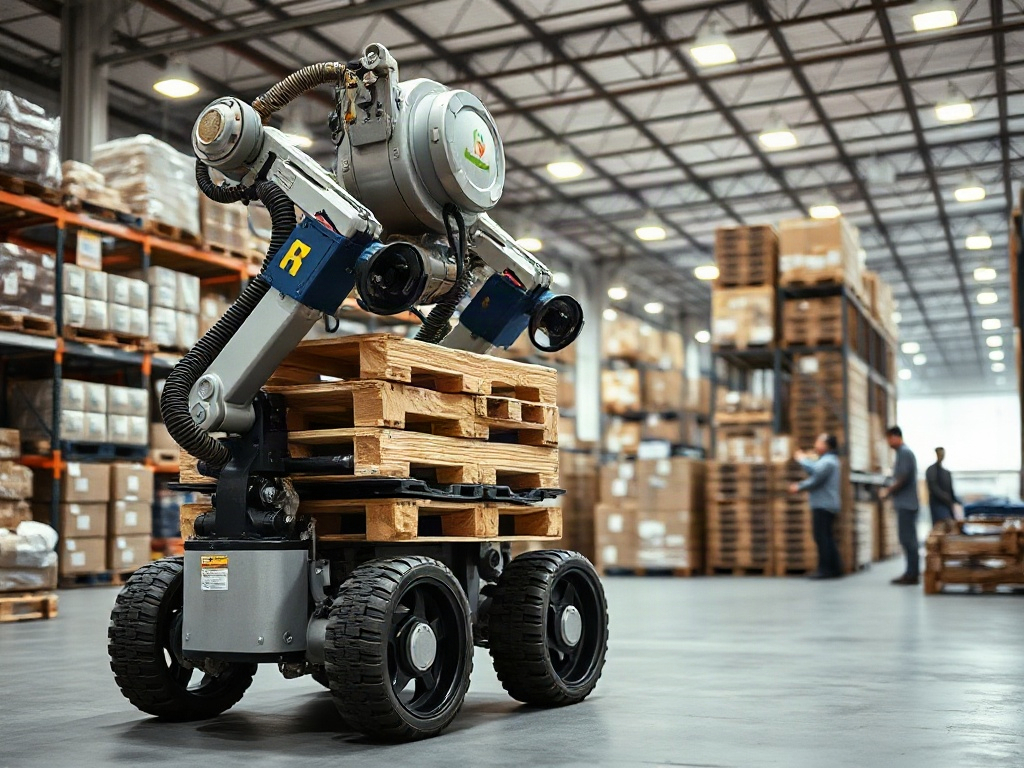
Maven's robots move on wheeled bases at speeds of up to 16 kilometers per hour, have two arms capable of lifting up to 30 kilograms, and use vacuum suction cups to handle boxes. Their primary task today is called "mixed palletizing": pallets carrying products from different factories arrive at a distribution center, and the robot must rebuild them in specific combinations for each destination store. It is not a glamorous task. But the global palletization market is estimated at $80 billion, and today it is executed almost entirely by human labor.
What makes the problem difficult, and at the same time valuable, is its variability. Retailers want to be able to change the product mix on their shelves within 48 hours based on real-time demand. That means the robot cannot simply reproduce a fixed pattern: it must read changing orders and execute them with enough precision that the supply chain does not break down. Maven says its units already operate 16 hours a day with an availability index of 99% or higher, with up to eight robots active in client facilities. That is modest in terms of scale, but it is significant in terms of operational credibility for a company that had not yet turned two years old at the time those numbers were published.
The capital from this round has a concrete destination: manufacturing 250 third-generation robots and beginning the design of a fourth-generation platform. The leap from eight units to 250 is not incremental — it is evidence that the company believes its systems are ready to stop being pilots and become stable operations at commercial scale.
The advantage that does not come from the laboratory
The founder profile at Maven does not fit the usual archetype of an academic robotics startup. Hamza Derbas comes from automotive engineering with a focus on electric vehicles, and before founding Maven he spent nine years at Apple within the company's special projects group, widely considered to be the autonomous vehicle development program that was dismantled in 2024. His brother Khalid, who serves as CFO, has a background in private equity. There are no robotics doctorates on the founding team's organizational chart, and that does not appear to be accidental.
Jack Pearson, the RoboStrategy investor who backed the deal, explained it precisely: Maven distinguishes itself through its grounding in industrial systems, not through a research culture optimized for learning or focused on a specific architecture. That difference matters more than it might appear at first glance.
Robotics companies that come from the academic world or from artificial intelligence research tend to build technical capabilities first and then search for the use case. Maven did exactly the opposite: it identified the workflow, understood the real operational constraints — including elevated temperatures in facilities, coexistence with human workers, and warehouse management software requirements — and then built a solution that fits those constraints. The result is a system that can be sold with a return-on-investment argument that industrial operations teams understand without the need for translation.
The continuous improvement methodology also comes from the automotive world. Maven uses data pipelines that return information from deployed robots within minutes or hours, and then runs cycles of retraining, evaluation, and redeployment. It is the same approach that autonomous driving programs used to iterate on their vehicles' behavior under real traffic conditions, now applied to materials handling in a distribution center. To accelerate data collection for new grasping skills, the company developed a pair of gloves shaped like pincers that allow human operators to emulate the format of the actuators they want to train their robots on. It is a pragmatic solution to a problem that laboratories typically address with expensive simulations and synthetic data.
Wheels versus legs and the economics of reliability
The most direct comparison that specialist media have drawn for Maven is Agility Robotics, the company planning to go public through a merger with an acquisition vehicle at an estimated value of $2.5 billion. Both companies target specific industrial workflows with an emphasis on operational safety. But the design difference is substantial, and Derbas addressed it without hedging: bipedal robots, he says, "make no sense for what they are doing," because they are complex, less reliable, and add costs that cannot be justified when the evaluation criterion is return on investment.
Maven's position is technically defensible. Wheeled bases have fewer joints susceptible to failure, can stabilize more easily on flat surfaces, are cheaper to manufacture and maintain, and do not require the dynamic balance systems that make humanoid robots so difficult to operate in uncontrolled industrial environments. The bet on humanoid form responds in part to versatility arguments, in part to the investment narrative surrounding physical artificial intelligence at this moment, and in part to the real possibility that next-generation physical AI models will favor platforms with human-like mobility. Maven is betting that this will not happen soon, or at least not before its wheeled systems have captured enough market share and operational data to become the de facto standard in warehouse logistics.
That bet has internal logic, but it also carries an implicit deadline. TechCrunch noted in its launch coverage that Maven's approach could be "the most viable path to putting robots in workplaces, or an opportunity to be displaced in one blow by the next powerful physical artificial intelligence model to emerge from frontier labs." Derbas responded with a formulation that defines the company's positioning: "We are not in the race for models. We are in the race to solve industrial work and make this task possible at the scale the world needs."
It is a smart response, but it does not close off the risk. The distinction between building model capabilities and solving concrete industrial problems can be sustained as long as the state of the art in generalist physical manipulation models is not robust enough to replace the task-by-task approach. If that threshold is crossed before Maven has consolidated positions in enough supply chains, the competitive advantage based on operational integration becomes more fragile than the size of the round suggests.
The boundary where the business model gets hard
Maven's roadmap beyond mixed palletizing reveals the structural tension the company will have to resolve in the next two or three years. The stated strategy is to advance task by task: identify an industrial problem of sufficient size, deploy robots to solve it, generate operational data, refine the capabilities, and then use that knowledge to attack the next problem. Hamza Derbas put it this way: "If you focus on solving problems and you choose problems of relevant size, each problem is a market worth several billion dollars. If you do that, there is enough data to dominate those skills."
The logic is sound for the current phase. Mixed palletizing is repeatable, has sufficient scale to justify the investment, and generates the kind of structured data that allows the system's performance to improve consistently. The problem is that the next tasks on the list — particularly materials handling for manufacturing — require grasping capabilities and spatial reasoning that, as the launch coverage itself acknowledges, "do not yet exist" at the necessary level. That means Maven will have to build a research culture it does not currently have, or acquire those capabilities externally, while managing an expanding operation and the expectations of investors who put $100 million into the promise of a general-purpose system.
The tension between industrial execution and capability development is not new in robotics, but it is rarely resolved cleanly. Companies that prioritize rapid deployment accumulate technical debt in their control systems and their AI models. Those that prioritize research take too long to reach the market. Maven is attempting to do both in parallel, with a small but operationally demanding customer base, and an implicit deadline that private capital markets will eventually make explicit.
What the Maven case reveals most clearly is not that wheeled robots are superior to bipedal ones, nor that operational integration is a more effective sales strategy than the general-purpose narrative. What it reveals is that at this moment in the industrial robotics market, the ability to connect an autonomous control system with the software infrastructure that already exists in the client's facilities — and to demonstrate operational availability metrics that logistics teams can present to their boards — is worth more than any demonstration of technical dexterity in a laboratory environment. That advantage is real for as long as it lasts. Maven's work over the next 24 months is to turn it into something more difficult to replicate.