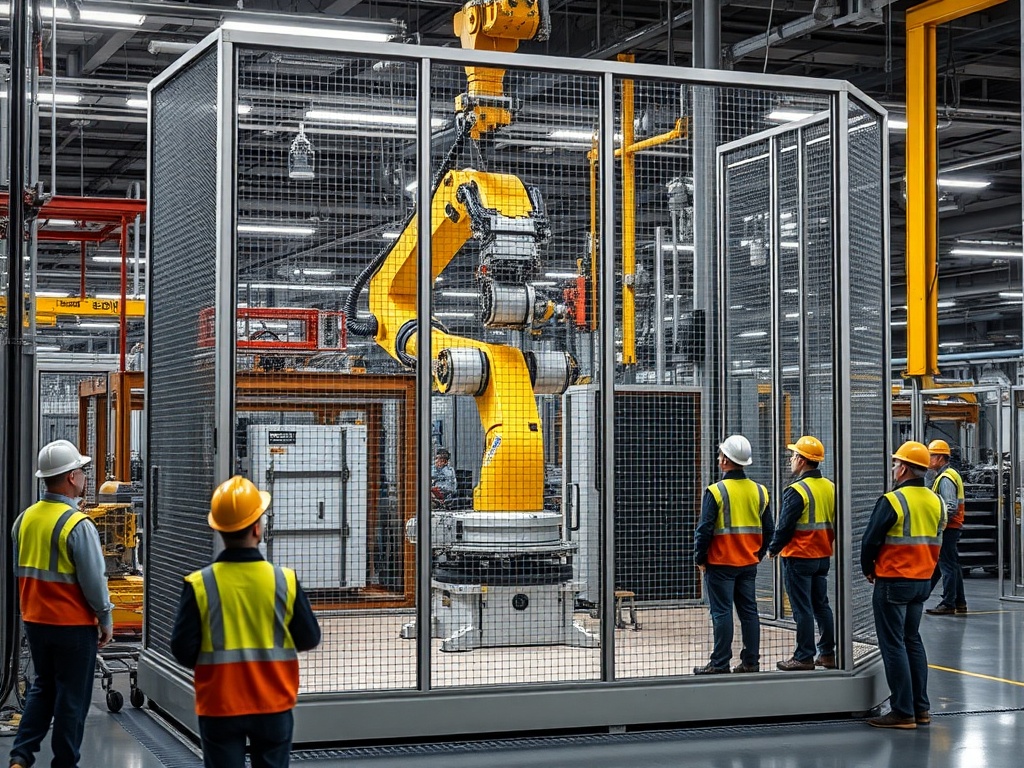

89% of Industrial Robots Are Still Caged — And Artificial Intelligence Is Not the Solution
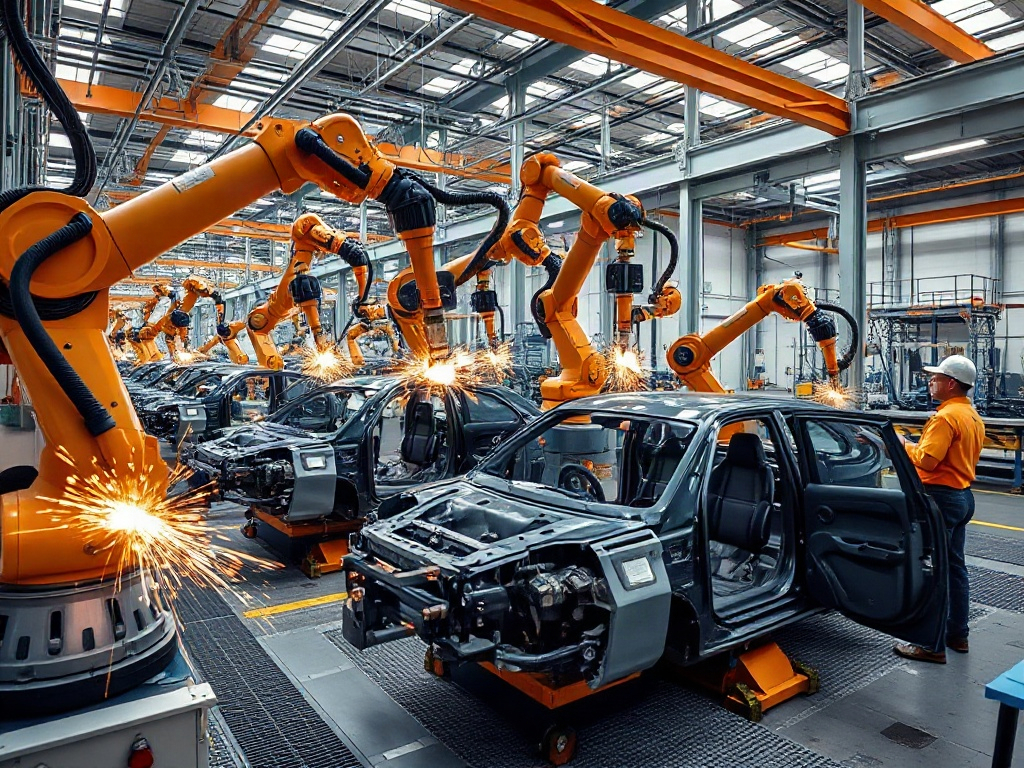
For decades, the image of the industrial robot remained unchanged: a powerful, fast machine with metallic arms, locked behind a steel cage while humans observed from the outside. That image is not a metaphor for backwardness. It is an engineering decision that persists because the available safety systems have not been able to sustain anything else.
The International Federation of Robotics reports that approximately 89% of industrial robots continue to operate inside physical cages. The collaborative robot market — those that in theory should work alongside people without barriers — closed 2025 at 2.9 billion dollars and is projected to reach 17.2 billion by 2033. Those numbers tell a story of accelerated adoption. What they do not say is that the majority of those "collaborative" robots continue to operate under space and supervision restrictions equivalent to their caged predecessors.
The bottleneck is not in the intelligence of the machines. It is in the capacity to demonstrate to a regulator, an insurer, and an operator that the robot will not fail in a way that nobody anticipated.
Knut Sandven, CEO of Sonair Robotics, makes the point with surgical precision: the standard laser sensors used today as the safety foundation in industrial environments were designed for a static world, one with controlled lighting conditions and predictable materials. They monitor a single horizontal plane at shin height. If a worker bends down to pick up a tool or reaches their arm above that invisible line, the sensor simply does not detect them.
That is not a minor bug. It is the structural reason why the cage remains standing.
The Illusion of the Robot That Already Knows
The dominant narrative in the industrial automation sector over the past four years has been, with minor variations, always the same: more cameras, better computer vision, more sophisticated perception models. If the system can "see" well, it can act well. And if it acts well, it is safe.
The problem with that logic is that it confuses perceptual capability with formal guarantee. Artificial intelligence systems operate on probabilistic models. They calculate the most likely response to a given stimulus. In most industrial contexts — parts classification, trajectory optimization, predictive maintenance — that is completely sufficient. A model that gets it right 99.7% of the time is extraordinarily useful.
But in physical safety, the remaining 0.3% has a name and a face. It carries legal, labor, and reputational consequences that no operations director wants to confront. And it has a regulatory architecture — standards such as ISO 10218 and ISO/TS 15066 — that demands something qualitatively different from "highly probable": it demands verifiable determinism.
A certified safety system is not one that almost always detects a person. It is one where the physics of the detection mechanism makes it possible to mathematically bound the worst-case response time and demonstrate that this time is below the threshold that causes harm. Sound waves travel at a known speed. They reflect in a predictable manner. That makes possible a guarantee calculation that no machine-learning-based vision model can currently offer with the same traceability.
Sandven points to it directly: "Very confident" and "proven" are not the same thing. The industry is learning that lesson in real time, with varying degrees of exposure depending on how much each party assumed that one was equivalent to the other.
What Certifies a Volume, Not a Plane
Sonair built its value proposition around a technical distinction that seems minor until it is examined in operation. Its ADAR — Acoustic Detection and Ranging — ultrasonic sensors monitor the workspace of a robot in three dimensions, not in a two-dimensional cross-section at floor level.
The difference is not cosmetic. A 2D system draws an invisible line on the ground. Whoever crosses it stops the machine. A 3D system defines a volume around the robot: above, below, to the sides, diagonally. It detects human presence at any point within that space, regardless of the worker's posture or height.
The company has just announced the first independent safety certification for a 3D ultrasonic sensor of this type. That is not merely an engineering milestone. It is a shift in the language that allows for a fundamentally different conversation with the industrial customer. It is no longer about convincing anyone that the technology "works well." It is about presenting a document signed by a certification body stating that the system meets the required safety integrity levels.
To understand why this matters from the buyer's side: a plant that wants to eliminate its physical cage needs to replace it with something that carries the same legal weight in a workplace safety audit. Until now, that something did not exist in 3D. The cage remained the only option with solid normative backing.
With an independent 3D certification in hand, the argument for keeping the cage becomes considerably harder to sustain. And the square meters of plant floor that cage occupies, the workflow it fragments, the installation and maintenance costs it generates — all of those factors shift from being accepted externalities to being unjustified inefficiencies.
The Power Lies in the Design Moment, Not in Deployment
Sandven points out something that deserves attention beyond the technical argument: the majority of robot manufacturers begin thinking about safety far too late. Safety is treated as a layer added at the end, once the system has already been defined. And when it is added at the end, the available options are limited, costly, or both.
From a systems architecture perspective, this is not merely a process error. It is a signal about who is in the room when design decisions are being made.
If the team building the robot is composed of motion engineers, perception specialists, and software developers, the conversation will naturally orbit around what the robot can do. Safety arrives later, when someone from the compliance team or the legal department raises their hand to ask whether the system passes the standards of the target market.
That sequence has predictable consequences: safety ends up encoded in the limitations of the product, not in its architecture. The robot ends up being capable of doing things that it cannot certifiably demonstrate it does safely. And that gap is precisely the bottleneck that keeps 89% of industrial robots behind their cages.
The solution Sonair proposes — a certified 3D safety layer, separate from the robot's artificial intelligence brain and built on deterministic physical principles — is not only an engineering response. It is an architectural response. It states that safety cannot depend on the quality of the AI model because AI models can fail, be updated, degrade, or behave unexpectedly when confronted with data distributions they did not encounter during training.
A safety system that fails when the AI model fails is not a safety system. It is an illusion of safety with excellent marketing documentation.
Trust Cannot Be Delegated to the Algorithm
The collaborative automation market has spent years describing its expansion with an implicit argument: as robots become more intelligent, trust in them grows naturally. That assumption deserves serious scrutiny.
Trust in high-consequence systems — and the operation of heavy machinery alongside people is, without question, a high-consequence system — is not built by demonstrating that the system fails rarely. It is built by demonstrating that when it does fail, it does so in ways that were already anticipated, bounded, and controlled. That is the difference between a modern aircraft and an autonomous automobile: not in the frequency of failures, but in the architecture for containing those failures.
Sonair is betting that the industrial market is ready to make that distinction. The six million dollars the company has raised to accelerate its deployment suggest that there are investors who share that reading. The independent certification it has just obtained is the most valuable asset of that bet: not because it resolves every safety problem in collaborative robotics, but because it establishes a verifiable language where before there was only implicit trust.
When 89% of industrial robots remain caged despite decades of promises about human-machine collaboration, the most honest diagnosis points to an architectural gap, not one of intelligence. Robots are not in their cages because they are inherently dangerous. They are there because the formal verification scaffolding that would allow them to be removed never had the adequate dimensions to describe the space where humans and machines share work. That is the structural crack that a 3D certification is beginning, for the first time, to close.