
Why Analysts Are Betting on a Gearbox Manufacturer Before the Robots Even Exist
There is a pattern that repeats itself every time an industry anticipates its own future: serious money does not flow toward the final product — it flows toward whoever manufactures the parts that product will need. That is what happened with semiconductors before the PC boom. That is what happened with batteries before electric vehicles filled dealership lots. Now, while images of humanoid robots circulate at technology fairs and conferences, four top-tier investment banks are pointing to a Chinese gearbox manufacturer that most readers have never heard of.
Shuanghuan Driveline Co., Ltd., listed in Shenzhen, sits at the center of that bet. Deutsche Bank, Bernstein, UBS, and Morgan Stanley cover it with buy recommendations or their equivalents. Their price targets range from 45 to 60 yuan per share. And the argument underpinning those valuations does not rest on current robotics sales, but on a structural position within a supply chain that does not yet exist at commercial scale. That deserves a more careful analysis than superficial enthusiasm allows.
The Component Nobody Mentions but Everyone Will Need
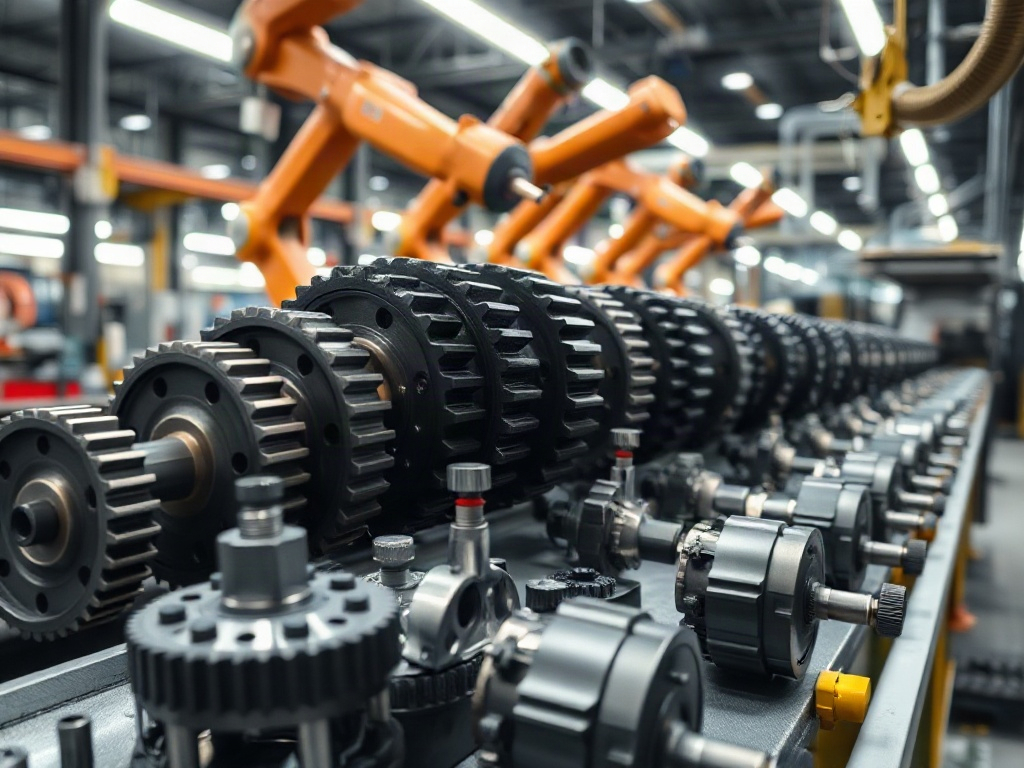
A humanoid robot does not move because it has artificial intelligence. It moves because it has actuators, motors, and between them, a mechanical component that translates the power of those motors into controlled movement. That component is called a reducer, and it is one of the most demanding physical bottlenecks in the entire sector. Its manufacture requires very tight tolerances, high-precision materials, and the capacity to produce them at volume without sacrificing consistency. It is not a part that can be improvised.
According to Deutsche Bank analysis cited by CNBC, Tesla has spent three years co-developing a new type of reducer with Shuanghuan. The component is designed for the hip joints of humanoid robots. That detail carries more weight than it might appear: Tesla is not known for committing engineering time to suppliers it considers dispensable or replaceable. When a company of that scale dedicates three years to a joint development effort, it is, in practice, creating a mutual technical dependency. This is not a transactional relationship; it is an architecture of shared knowledge that the market has not yet fully reflected in the share price.
Bernstein states it with surgical precision in its report: the market is underestimating Shuanghuan's robotics opportunity across three dimensions. The report, as cited by CNBC, does not specify all three explicitly, but the logic holds on its own. The first dimension is the existing business with Chinese electric vehicle manufacturers and Western clients such as BMW and Stellantis, which already generate cash flow. The second is exposure to Tesla and the humanoid robotics segment in the United States. The third is Shuanghuan's capacity to benefit from the movement of Chinese automakers — such as Xpeng or Xiaomi — that are expanding into robotics and already know Shuanghuan as a trusted supplier within their vehicle manufacturing chains.
That third dimension is the one that most reveals the actual architecture of the sector. It is not a long-term bet made in a vacuum. It is a bet on the transfer of social capital from one industry to another.
When the Automotive Supply Chain Migrates to Robotics
The observation that the automotive industry and humanoid robotics share suppliers is not new. Analysts at various banks have pointed it out repeatedly. But the mechanics of why that matters financially deserves to be developed in more detail than it usually receives.
Manufacturing high-precision reducers for robotic arms or hip joints is not fundamentally different from manufacturing high-precision transmissions for electric vehicles. The tolerance requirements, quality control processes, volume management, and the relationship with client engineering have far more in common than they have differences. Shuanghuan does not arrive in robotics from scratch: it arrives with manufacturing capacity at scale, an already-established relationship network, and technical understanding of the requirements its potential clients carry.
That has a value that does not appear on the balance sheet. In the language of network analysis, Shuanghuan occupies an intermediation position between two sectors that are converging. It is not the most visible robot, nor the most frequently cited in investor presentations. It is the node that connects existing precision manufacturing with the future demand for robotics. Those nodes tend to capture value in a manner disproportionate to their public visibility.
Fine Motion, the Shuanghuan subsidiary dedicated to gearboxes for robotics, illustrates that point with an uncomfortable number: it represented approximately 5% of Shuanghuan's consolidated revenues and net profit in 2025. In other words, the unit that analysts are valuing as the future of the business is still a small fraction of the present business. Shuanghuan plans an initial public offering for Fine Motion and will retain a controlling stake. The timing of that IPO and the price at which the market validates it will be the first real test of whether the robotics narrative has financial substance or is still a forward-looking argument with no anchor in actual revenues.
UBS adjusted its price target downward by 3 yuan following second-quarter results, citing sales pressure from BYD, one of its principal clients. That correction is informative: the majority of Shuanghuan's business remains automotive, and exposure to client concentration within that segment creates a specific fragility. The robotics narrative does not erase that fragility; it puts it in perspective as a medium-term revenue diversification argument.
Geopolitics as a Design Variable, Not a Residual Risk
There is an angle that analyst reports mention but that deserves more development: the decoupling between U.S. and Chinese robotics supply chains may benefit Shuanghuan in a non-obvious way. The conventional logic associates technological decoupling with losses for Chinese suppliers that depend on American clients. Bernstein inverts that logic in the specific case of reducers.
Reducers are pure mechanical components. They do not contain chips with processing capacity, they do not transmit data, they carry no embedded software that could be subject to export restrictions under national security arguments. They are, in the category of geopolitical regulation, functional equivalents of a precision gear. That places them in a distinct regulatory category from semiconductors, camera modules, or computer vision systems, all of which are under active scrutiny in the context of the technological decoupling between the two powers.
If humanoid robot manufacturers in the United States are seeking to reduce costs and maintain margins in a sector that still lacks a proven unit economy, reducers manufactured by a Chinese supplier with scale production capacity and technical co-development with Tesla represent exactly the type of component that can continue to be imported without triggering regulatory alarms. Morgan Stanley reinforces this reading by noting that, as humanoid deployment begins, the threshold of demand on component suppliers rises from product qualification toward reliability, consistency, manufacturing yield, scale, and cost. These are criteria that favor those who already manufacture to those exacting standards in another industry.
Shuanghuan's geopolitical position is therefore not a vulnerability that analysts are ignoring. It is, according to Bernstein's analysis, an arbitrage position: sufficiently integrated into the global manufacturing chain to be relevant to Western clients, and sufficiently distant from the sensitive categories of the technology war to avoid being the target of restrictions. That is a blind spot that the generalist market tends to have regarding Chinese industrial companies that do not manufacture chips or software.
What the Periphery of the Supply Chain Knows Before the Center Does
The pattern that emerges from this case is not exclusive to Shuanghuan or to robotics. It is a structure that appears every time a nascent industry depends on precision manufacturing in order to exist at all. The center of the public narrative — in this case the humanoid robot manufacturers such as Tesla, Figure, or the projects led by Xpeng and Xiaomi — attracts the attention, the most visible market valuations, and the volume of media coverage. The periphery of that narrative — the manufacturers of reducers, actuators, and motion transmission systems — operates outside the spotlight but captures value before the final product even exists.
Xpeng valued its robotics business at more than 6 billion dollars, approximately the same size as its electric vehicle business. This signals that the convergence between automakers and robotics is not speculative: it is being capitalized on by the sector's own players. But Xpeng's valuation rests on the expectation that its robots will reach the market with sufficient utility to generate revenues. Shuanghuan's valuation, by contrast, rests on the premise that those robots — regardless of who manufactures them or when they are sold — will need precision reducers. The first bet requires a complex narrative to materialize. The second requires only that the industry continues to develop, at whatever pace.
Fine Motion is the financial vehicle that Shuanghuan is preparing to separate that bet from the rest of its automotive business. Its IPO has no confirmed date according to available information, but when it occurs it will be the first instance in which the market must assign an explicit price to the robotics hypothesis, separated from automotive transmission revenues. That moment of accounting separation will reveal something that today's analyst reports barely hint at: how much of Shuanghuan's current price reflects automotive business with an implicit robotics premium, and how much of that premium has grounding in real contracts, volumes, and actual clients.
The answer to that separation is not yet available. But the architecture of the case already reveals something about where power forms in an industry that has not yet produced a mature product: not in whoever designs the most photogenic robot for a conference stage, but in whoever already manufactures the part that robot needs in order to bend, rotate, and operate without failure for thousands of hours. That capability is not built in months. And those who already possess it — even if no one mentions them in the headline — are the ones the value chain cannot easily replace.