
AMD Enters the Robotics Business with a Platform That Challenges Nvidia on Its Own Turf
Autonomous robotics has been promising a breakthrough for years — one that never quite arrives at industrial scale. Not for lack of algorithms or ambition, but because the hardware robots need to operate in unstructured environments demands a combination of processing capabilities that rarely comes integrated in a single accessible system: deterministic real-time control, low-latency AI inference, computer vision, and actuator coordination — all simultaneous, all without one component sacrificing another. That integration problem has been, for years, the bottleneck that turned robotics laboratories into graveyards of brilliant prototypes.
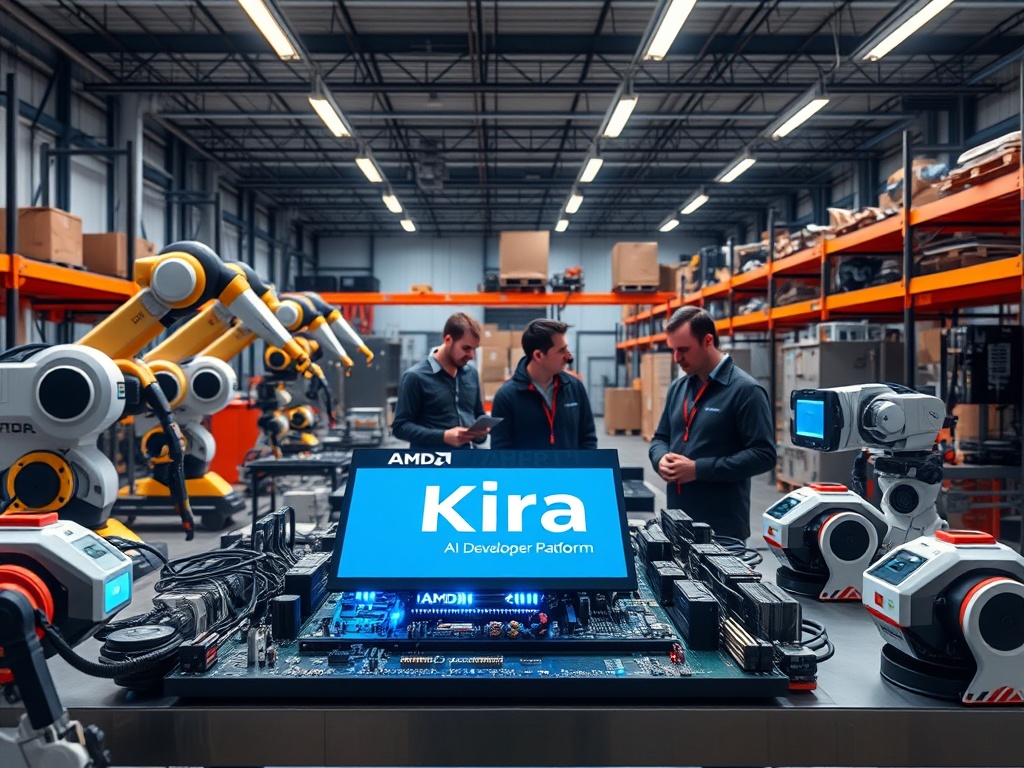
AMD has just bet that it can solve that equation with the Kria AI Robotics Developer Platform, announced at Advancing AI 2026 in San Francisco. This is not merely an embedded computing module. It is a declaration of intent about where AMD wants to compete over the next ten years, and about what incentive architecture it is building to hold that territory.
An Architecture Worth as Much as the Problem It Solves
The heart of the system is the Kria AI SOM based on the AMD Ryzen AI Embedded X100 Series processor, specifically the X199 model: 16 CPU cores with Zen 5 architecture, an integrated GPU delivering 60 TFLOPS at FP16, and an NPU with up to 50 TOPS of performance. Memory can reach 128 GB of LPDDR5X, in COM-HPC format — the open standard for high-performance computing modules. What makes the system different from other proposals is not the specification list, which any datasheet can present, but the decision to also integrate a Spartan UltraScale+ FPGA on the carrier board.
That addition is not decorative. FPGAs allow programmable logic in real time with latencies that general-purpose processors cannot guarantee. In an industrial robot or an autonomous warehouse vehicle, actuator control and response to external events cannot depend on an operating system with arbitrary interruptions. The FPGA resolves that problem. Placing it on the same platform as the CPU, GPU, and NPU is not an arithmetic sum; it is a design decision that eliminates the need for an external real-time control processor, simplifying the architecture and reducing points of failure.
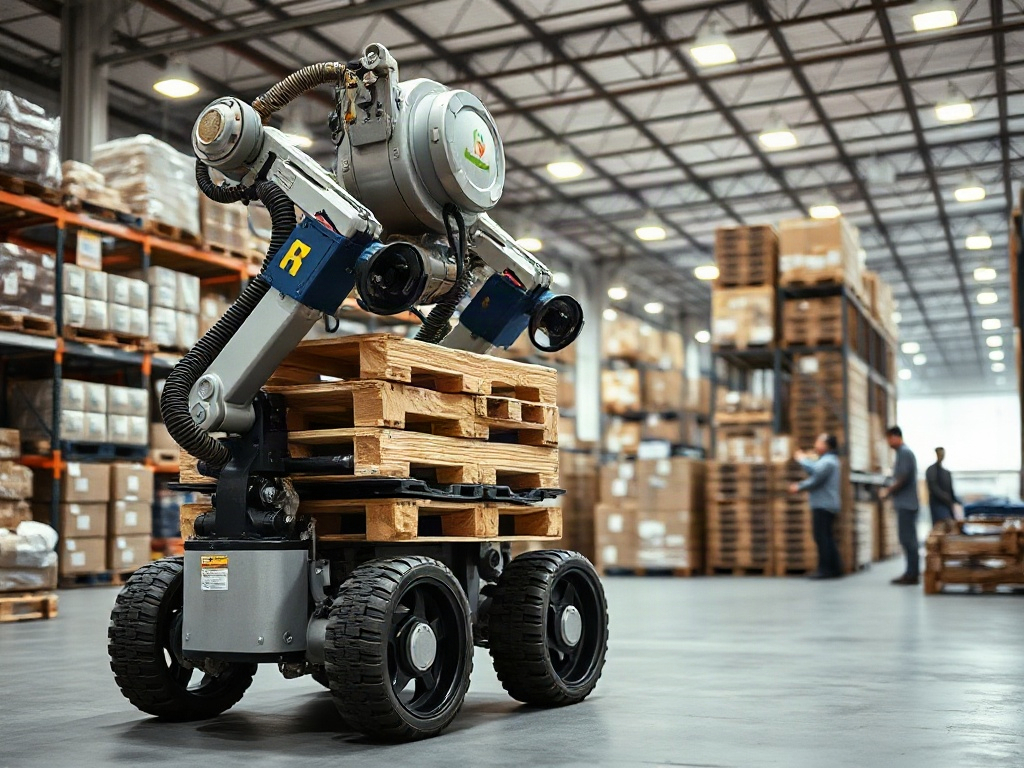
The result is a single module that can simultaneously run visual perception models on the NPU, execute route planning on the CPU, handle rendering or parallel computation on the GPU, and control servomotors with deterministic precision through the FPGA. For anyone who has tried to assemble that same functionality with components from different vendors, the reduction in operational complexity is immediate and measurable.
The Value Movement Behind the Open Design
AMD has chosen COM-HPC as the format standard and ROS 2 as the reference middleware for software. Both decisions speak of openness, but openness is not an ideological stance in this case: it is a competitive tactic with very concrete distributive consequences.
When a robot manufacturer chooses a closed platform — as historically occurred with several Nvidia Jetson systems in their early generations — it becomes tied to the vendor's lifecycle cycles, module prices, and discontinuation decisions. AMD, by building on an open standard like COM-HPC, offers the integrator a promise of mobility: if AMD raises prices or changes specifications unfavorably, the mechanical design and much of the software can migrate to another compatible module. That reduces initial adoption resistance, which is the primary obstacle for any new hardware platform.
The other side of that openness is that AMD needs the perceived value to reside in the silicon layer and in software integration, not in a proprietary coupling system. That is why the announcement includes the AMD Robotics Software Suite, ROCm compatibility, computer vision libraries, and validated reference designs. AMD is trying to ensure that the cost of exit is not technical lock-in, but rather the loss of the acceleration that its integrated stack provides. That is a more sustainable loyalty logic than forced lock-in, but also more demanding: it requires that the software improve continuously and that the partner ecosystem be dense enough to generate value that AMD alone cannot offer.
The construction of a Robotics Partner Network that AMD is simultaneously articulating — incorporating sensor manufacturers, simulation providers, functional safety specialists, and systems integrators — responds to that need. If partners have incentives to develop on Kria because the end-customer market is already there, and end customers choose Kria because partners have already developed for it, the kind of density is built that makes a platform difficult to abandon without anyone having signed an exclusivity contract.
What the Confrontation with Nvidia Reveals About the Distribution of Power in the Market
AMD has indicated that third-party tests show that the Kria AI Robotics Developer Platform outperforms the Nvidia Jetson AGX Thor in CPU capacity, number of concurrent agents, and real-time responsiveness. That kind of direct comparison, with a named competitor, is not a communication accident: it is a signal that AMD considers Nvidia to hold a sufficiently dominant position in AI robotics that defeating it in benchmarks is a sales argument in and of itself.
Nvidia arrived at AI robotics earlier and with greater software muscle. The Jetson ecosystem has years of adoption in academic laboratories, robotics startups, and some industrial manufacturers. CUDA and the AI frameworks that run on it have a developer base that AMD cannot ignore. AMD's bet with ROCm and native FPGA integration targets two segments where Nvidia has exposed flanks: customers who need deterministic real-time control — which GPU architectures do not manage well by nature — and integrators who want to avoid dependence on a single vendor with a history of elevated prices and short lifecycles in its embedded modules.
The X199 processor will be available in mass production in the fourth quarter of 2026, with committed availability through at least 2037. That lifecycle data point is not a minor technical detail: in the automated manufacturing and robotic logistics industry, production lines are designed with ten-to-fifteen-year horizons. An AMR manufacturer evaluating computing platforms needs to know that the module it selects today will still be available when its robot is on firmware iteration three, and that it will not have to redesign the carrier board because the vendor discontinued the chip. AMD is using that argument to compete in segments where Nvidia has historically had a shorter hardware replacement cadence.
The price of the developer platform has not been officially confirmed by AMD. Independent coverage estimates that the platform will be positioned in the range of five thousand dollars or more, comparable with Jetson's high-end development kits. If that is confirmed, AMD is not competing on price, but rather on technical value and on the promise of a more open and longer-lived ecosystem.
The Tension the Model Has Not Yet Resolved
The design has internal coherence, but there is a tension AMD cannot resolve by decree: the adoption of hardware platforms in industrial robotics is a slow and conservative process. Integrators do not change silicon vendors at the pace of software adoption cycles. A robot manufacturer that already has engineers trained on Jetson, adapted mechanical designs, and a calibrated supplier chain needs very specific reasons to move that human and physical capital toward another platform.
The AMD Robotics Software Suite and day-zero support are responses to that friction, but they are responses that require time to validate. The reference designs must demonstrate that they work in production environments, not just in laboratory demonstrations. The vision libraries must support the use cases that real integrators encounter, not the ones AMD selected for the kit. The Robotics Partner Network must grow to a point where there is sufficient supply of complementary solutions for an integrator not to feel like it is building alone.
The early-access customer sampling that AMD announced for July 2026 is the mechanism for generating those validations before general availability in the fourth quarter. If those customers produce documented use cases and publishers in the Kria App Store, AMD arrives at the general market with evidence. If they do not, it arrives with impressive technical specifications and an ecosystem promise that is still under construction.
There is a considerable difference between those two scenarios, and no hardware architecture — however well designed — can substitute for the adoption density that Nvidia has accumulated over years of presence in universities, robotics laboratories, and sector startups. AMD knows this. That is why the Robotics Partner Network and the App Store are not peripheral initiatives of the launch: they are the core of the value distribution model that determines whether the platform sustains itself or becomes yet another technically capable piece of hardware that developers end up ignoring because integrating it requires too much independent effort.
The incentive architecture AMD is building is sophisticated and has solid foundations. The question the market will answer over the next twelve months is whether that architecture arrives with sufficient partner density, sufficient field validation, and sufficient software execution speed for industrial integrators to perceive the cost of switching as justified. AMD has not yet won that argument, but for the first time, it has the components to present it with rigor.