RFK Jr. Goes All-In on Iowa and What It Reveals About the Power of Health Movements in American Politics
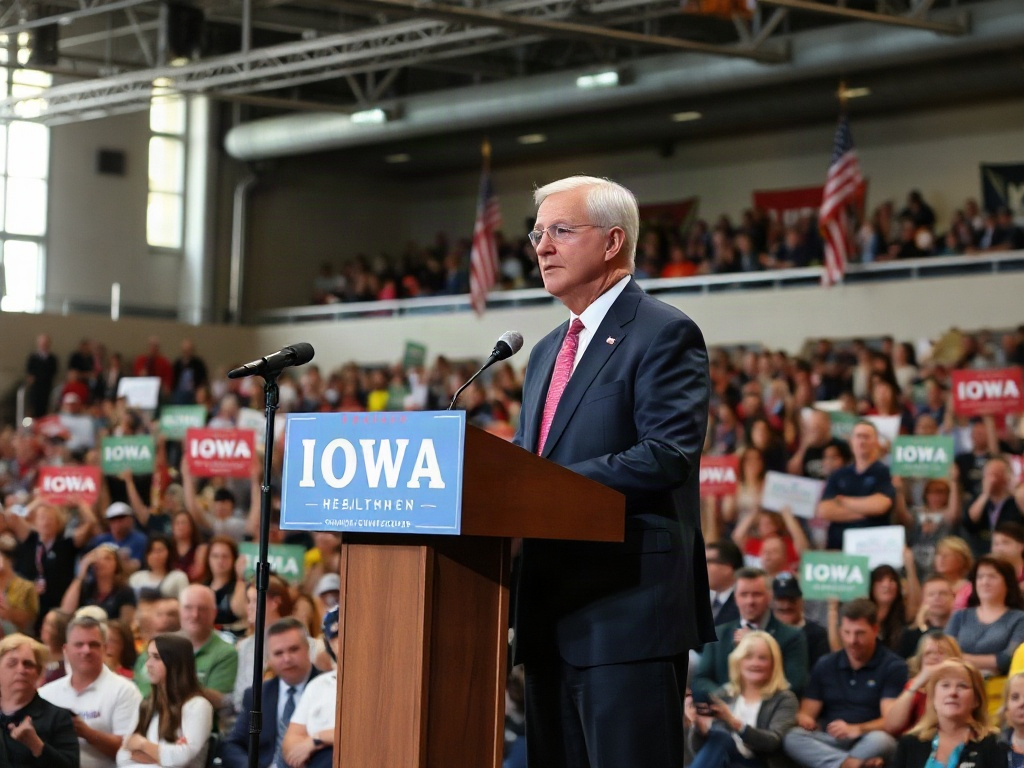
The scene has something deliberate about it: a federal Secretary of Health traveling to Des Moines to campaign for a state gubernatorial candidate, before more than a thousand people gathered at an events center in Clive, Iowa, less than a week before the November 3, 2026 elections. This is no symbolic gesture. It is the biggest electoral test the Make America Healthy Again movement has faced since emerging from the margins of the internet into the structural organs of the Republican Party.
What is happening in Iowa is not merely a governor's race. It is the first documented and funded attempt to convert a heterodox public-health agenda into territorial political power. And the result, whatever it may be, will generate information about how health-policy power moves in the United States over the coming years.
When a Health Movement Becomes an Electoral Machine
Zach Lahn won the Republican primary in Iowa in June 2026 with the backing of the MAHA movement, even as another candidate held the support of the president. That sequence matters: it means that Kennedy-aligned groups demonstrated the capacity to compete inside the Republican Party without depending on its most obvious gravitational center.
For the final stretch of the campaign, the financial infrastructure deployed was considerable. MAHA Action PAC, led by Kennedy ally Tony Lyons, committed $1.5 million in support for Lahn. MAHA PAC added another $150,000 in independent expenditures. And from October 21 through Election Day, the PAC executed a fifteen-day voter-mobilization operation that included door-to-door canvassing.
The total publicly reported amount exceeds $1.65 million concentrated in a single state race. To put it in perspective: this is not the kind of sum that moves a federal election, but it is sufficient to shift the margin in a competitive gubernatorial contest. The question political analysts are watching is not whether the money is enough, but whether it manages to activate a base that had not previously participated in an organized way.
Kennedy's speech at the rally was consistent with the framework the movement has been building since his departure from his independent candidacy: Iowa should help make the United States the breadbasket of the world "without degrading the soil or poisoning children." The language connects the state's agrarian identity with the environmental and food-health agenda that MAHA proposes as an alternative to the established medical and agro-industrial system. Lahn, for his part, was more explicit in placing the movement outside conventional politics, describing it as something that is "deeper than politics."
That combination of identity narrative and organized action describes something few health-focused political forces had achieved: articulating at the local level an agenda that blends environmental oncology, corporate concentration in agriculture, food safety, and criticism of pharmaceutical institutions—without making it sound like a party platform.
The Architecture of the Movement and Its Real Tensions
What Iowa allows us to observe clearly is a structural tension that MAHA has not yet resolved. The movement combines its visible leader's public credibility, networks of highly motivated activists, and now political capital. But its ability to translate those three elements into sustained electoral results depends on a variable no movement controls well: concrete adoption beyond its convinced core.
Accounts of the rally in Clive diverge depending on the source. Organizers reported more than a thousand attendees. Other coverage speaks of "hundreds." That difference is not trivial: it indicates that the real magnitude of the mobilization remains contested, and that the movement still lacks the kind of measurement infrastructure that distinguishes a mature political force from one still under construction.
Kennedy's participation as HHS Secretary adds a layer of institutional complexity that has not been resolved in the available sources. An active federal official campaigning for a state candidate occupies ambiguous terrain, where the resources of his office and his visibility as a movement leader can hardly be separated in practice, even if they are supposed to be in theory. That ambiguity is not an accidental anomaly: it is part of how movements that emerge within governmental apparatuses tend to operate.
Lahn's platform concentrated the most recognizable points of the MAHA ideology: breaking up agricultural monopolies, defending independent farms, opposing toxic pesticides, and criticizing "Big Agriculture." These are issues with genuine traction in Iowa, a state where concentration in the pork industry and the monoculture of corn and soybeans have generated economic and health tensions that predate the rise of MAHA by decades. The movement did not invent those fault lines; it identified them and gave them a political name.
What is interesting, from an adoption perspective, is that MAHA does not attempt to reconstruct the health-care system from the top down—in the manner of a federal legislative reform—but rather to accumulate power through governorships and state legislatures in order to generate regulatory change at the levels where agriculture, food, and public health are most directly regulated. It is a decentralized bet in a country where health policy is, structurally, a permanent field of federal-state competition.
What the Coming Days Will Reveal About Health Movements and Political Power
November 3, 2026 will not resolve questions about the American health-care system. But it will offer evidence about something more specific: whether an agenda built around food, soil, pesticides, and distrust of medical institutions can mobilize enough voters in a state with a real agrarian economy to alter the outcome of a competitive state election.
If Lahn wins, MAHA will have demonstrated that it can operate as an independent electoral structure within the Republican Party, with the capacity to sustain a primary against a presidentially backed candidacy and then convert that base into results in the general election. That would open the model for replication in other governorships and state legislatures, particularly in states with large agricultural sectors and rural electorates distrustful of the conventional medical system.
If Lahn loses, the information that remains is no less useful: it will show where the movement's real ceiling is when competing against a more established political machine, how much of its energy is online versus how much converts into physical votes, and whether the presence of a federal cabinet secretary at the rally had any measurable impact or was simply the narrative closing act of a campaign that failed to cross the threshold.
What can already be stated with the available data is that MAHA has completed a transition that few public-health movements had achieved in modern American politics: it has moved from being a coalition of critics of the medical system to being an electoral actor with financial infrastructure, its own candidates, and a territorial narrative anchored in local identities. That does not guarantee sustained power, but it does change the conditions under which pharmaceutical companies, agro-industrial firms, and state regulators will have to operate in the coming electoral cycles.
The shift that Iowa is measuring is not ideological in the classical sense. It is organizational: if an agenda that connects health, agriculture, and institutional distrust can reproduce the structure of a party within a party, then the markets that depend on that state-level regulation—from agricultural inputs to pharmaceutical compounds—will need to incorporate that political risk into their long-term models. Iowa is the first calibration case.