
Nestlé Recycles in Kedah, but What It's Building Is Something Else
There is a number that Nestlé Malaysia does not publicise in its official press release, but which says everything about its real strategy: 15,000 tonnes of solid waste diverted from landfills in a single year. That is not a public relations programme. That is collection infrastructure operating at scale, covering 260,000 households across nine cities with a target of 300,000 before the end of 2026.
On 20 May, Nestlé Malaysia and the Solid Waste and Public Cleansing Management Corporation of Malaysia, known as SWCorp, signed a memorandum of understanding to expand Project SAVE to the state of Kedah. The agreement was sealed during the community event Karnival Kitar at SMK Taman Selasih in Kulim, in the presence of Kedah's royal family. The ceremonial gesture is secondary. What matters is the mechanism being consolidated beneath the surface.
When Juan Aranols, CEO of Nestlé Malaysia, declared that the company's approach is one of voluntary extended producer responsibility, he was not using hollow corporate language. He was describing a strategic posture in relation to a regulatory framework that does not yet exist in Malaysia but is being tacitly constructed by initiatives precisely like this one.
An Alliance That Reorganises Who Controls the Recycling Infrastructure
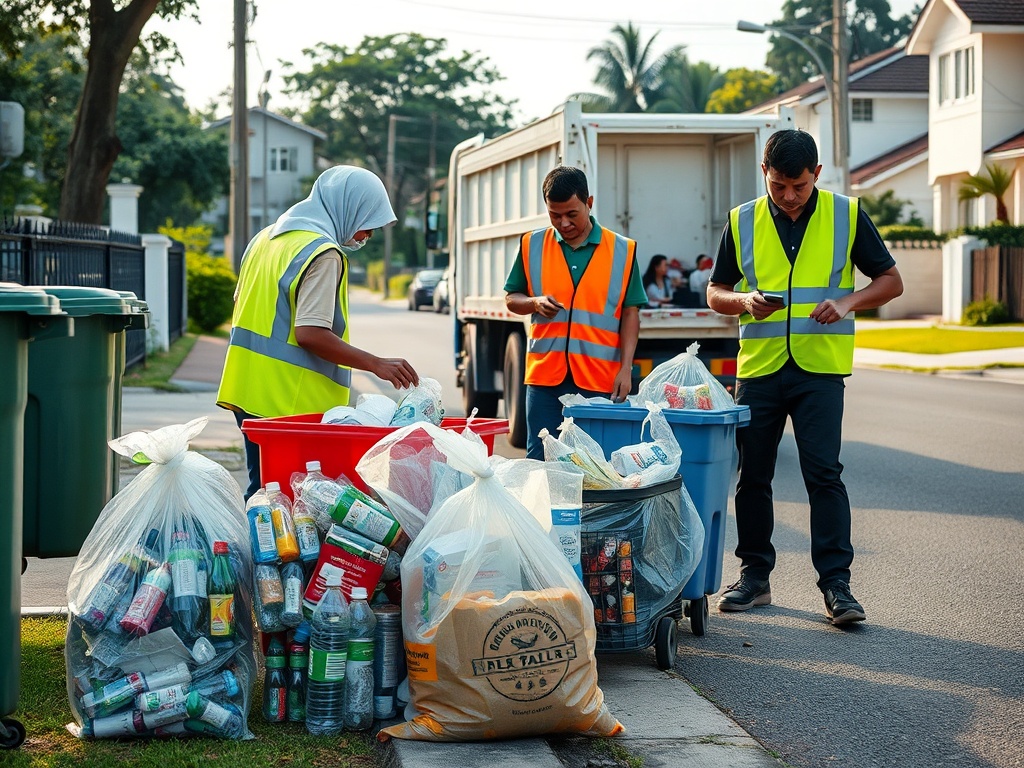
Project SAVE has been operating since 2020 with an apparently simple model: weekly door-to-door collection of dry and mixed recyclable materials, principally plastic, paper and metal. What is not simple is the institutional architecture that model requires in order to function at scale.
In Kedah, the expansion did not arrive directly. It began in 2025 with a pilot in Kulim, in collaboration with SWCorp, E-Idaman and ESH Resource. That pilot collected around 100,000 kilograms of recyclables, of which approximately 28,000 kilograms corresponded to plastics. In absolute terms it is not a spectacular figure, but it is sufficient to validate the logistics, identify operational bottlenecks and fine-tune the chain before broadening coverage.
That deliberate piloting process prior to the signing of the memorandum reveals a strategic acuity that many corporate actors do not possess: Nestlé is not announcing intentions, it is scaling a model that has already been proven to work in the field. The difference between declaring a commitment and building a functional reverse value chain is precisely that operational sequence.
But there is something deeper in the choice of partner. SWCorp is not a private company: it is a federal state body with a mandate over solid waste management in several peninsular Malaysian states, including Kedah. By formalising an alliance with SWCorp, Nestlé is not simply seeking a logistics operator. It is inserting itself into the institutional architecture of the country's waste management. That has implications that reach far beyond the tonnage collected in Kulim.
When Malaysia eventually designs a formal extended producer responsibility scheme for packaging, the actors already operating within the institutional system will hold a positional advantage in influencing how that framework is implemented, what the compliance thresholds are, and what counts as a recycling credit. Nestlé is building that institutional capital now, before regulation makes it compulsory to pay for it.
Plastic as a Feedstock Problem, Not Just an Image Problem
Reducing plastic pollution to a question of corporate reputation is a limited reading of the phenomenon. The scarcity of clean, sorted post-consumer material is one of the most serious bottlenecks facing the recycling industry in Southeast Asia, and Malaysia is no exception.
Recyclers need volume but they also need quality. Mixed and contaminated material arriving at processing centres drastically reduces the economic viability of recycling. Project SAVE's door-to-door collection model attacks precisely that problem at the source: if the household already separates the dry material before collection, the recycler receives an input of far superior quality to the material that comes out of municipal landfills.
That has concrete economic consequences for the value chain. Sorted post-consumer material can enter industrial circuits that mixed materials cannot reach. And to the extent that Nestlé can access, directly or indirectly, high-quality recycled content generated by its own collection programmes, it has a potential pathway toward using recycled content in its packaging that does not depend exclusively on volatile commodity markets.
SWCorp's CEO, Khalid Mohammed, did not frame the agreement in terms of image: he spoke of strengthening the recycling ecosystem and of domestic participation as a structural factor of the system. That narrative reflects a shared understanding that the problem is not simply collecting more waste, but building a complete chain that is economically self-sustaining.
The question that the available data still does not answer is what proportion of the material recovered by Project SAVE actually returns to Nestlé's production lines or those of its packaging suppliers. If that figure is marginal, the programme remains valuable but functions as a subsidy to the general recycling infrastructure, rather than as a genuine integration of the circular chain. If that figure is growing, the analysis changes substantially.
The Lesson That Project SAVE Reveals About How Real-Impact Programmes Scale
Five years of operation and 260,000 households covered across nine cities. At first glance, that pace appears modest for a company of Nestlé's size. The absolute scale of its operation in Malaysia implies a distribution that reaches millions of consumption points. Covering 260,000 households over five years is equivalent to moving at a deliberately gradual speed.
But that gradualism is not executive incapacity or a lack of ambition: it is the architecture of the programme. Each new city requires an operational agreement with local authorities, integration with existing collection schedules, household training and last-mile logistics adjustment. You cannot launch a door-to-door collection system in twenty cities simultaneously without the quality of the collected material deteriorating and the cost model becoming unmanageable.
The Kulim pilot is the clearest example: a full year of testing prior to the formal memorandum, with three identified operational partners and verified volume metrics. That sequence is not characteristic of a corporate communications programme. It is characteristic of an operation being designed to grow without losing efficiency.
What Project SAVE is demonstrating, with its modest but verifiable numbers, is that programmes with real impact that successfully scale are those that build local institutional capacity at every stage, rather than declaring global commitments and waiting for implementation to resolve itself. The mistake of many corporate sustainability programmes lies not in the ambition of the objective but in skipping the execution architecture that objective requires.
For the C-suite executive reading this case from outside Malaysia, the most relevant signal is not the number of tonnes recycled but the alliance strategy: a private company building operational capacity within the state apparatus of waste management, anticipating a regulatory framework that does not yet exist but that will inevitably arrive. When that framework arrives, Nestlé will not be adapting. It will be in the position of an actor that already has a functioning model and the data to prove it is viable. That, in terms of positioning relative to regulation, is worth more than any voluntary commitment drafted in a boardroom.