
Naseej and the UAE's Bet on Turning 220,000 Tonnes of Waste into a Value Architecture
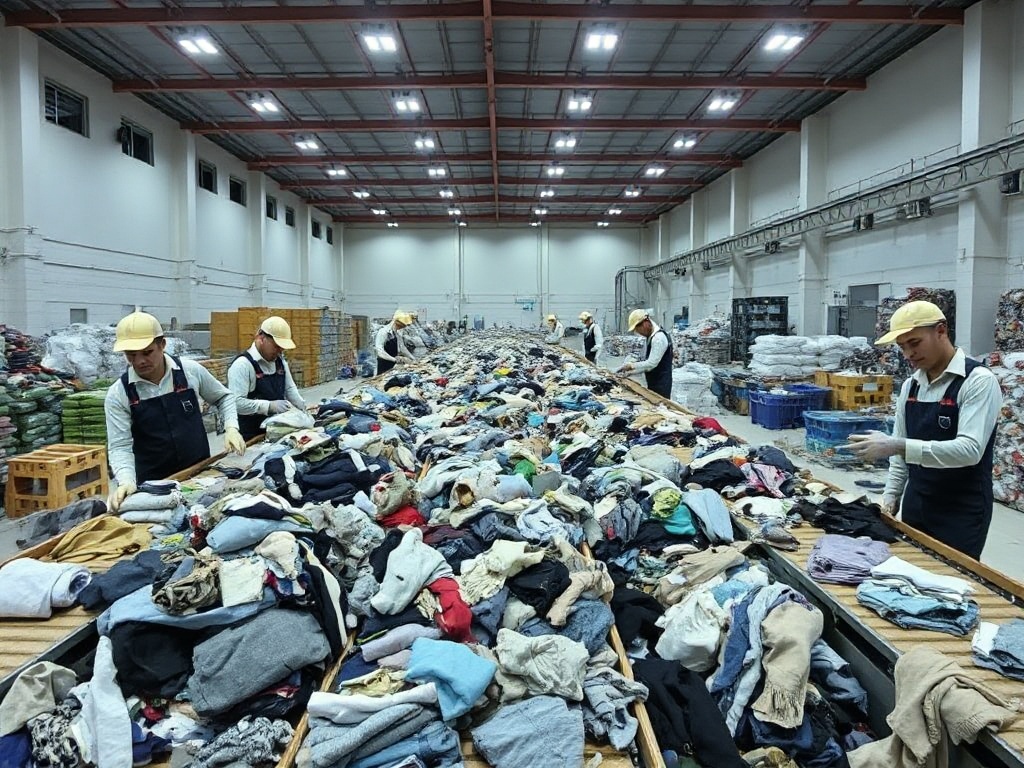
Fabric does not disappear when you throw it away. It accumulates. The United Arab Emirates generates approximately 220,000 tonnes of discarded textiles every year, a volume that until very recently flowed predominantly toward landfill with no national framework in place to intercept it. That changes with Naseej, the country's first integrated textile circularity initiative, launched in June 2026 under a presidential directive during an event held at Yas Mall in Abu Dhabi.
What makes this development worthy of serious analysis is not the announcement itself, nor even its ambition. It is the question that every initiative of this kind places before rigorous scrutiny: does it have sufficient economic architecture to sustain itself, or is it the type of programme that looks impressive at the inauguration and fades between political cycles?
What Naseej Builds — and What It Still Lacks
The Arabic name evokes the idea of weaving, of interlacing. The metaphor is not accidental. The initiative is designed as a coordination platform that connects manufacturers, retailers, recyclers, research institutions, regulators, and consumers across the entire textile value chain. It is not a one-off recycling programme or a communications campaign. It is, at least in its declared architecture, an attempt to redesign the metabolic logic of the UAE's textile sector from the origin of a product all the way through to its end of life.
The Minister of Economy and Tourism presented Naseej as a generator of investment opportunities, not merely as an environmental policy. That is a meaningful signal. When a government frames a circularity initiative in terms of capital attraction rather than regulatory compliance, it is communicating something about its preferred model of governance: it favours incentivising the private ecosystem over mandating it by obligation. That choice has direct consequences for the speed of adoption and for who ultimately captures the value that is generated.
The UAE has an unusual private investment profile for this type of project. According to the Agility Research & Strategy report cited in coverage by Sourcing Journal, close to three-quarters of the country's high-net-worth investors expressed interest in businesses with a sustainability focus, and more than half incorporate ethical policies as a criterion in their investment decisions. That data point is not decorative. It suggests that local capital is available and predisposed, which partially reduces the dependence on public financing to scale the collection and recycling infrastructure that Naseej will require.
That said, the gap between intention and execution in textile circularity is notoriously difficult to close. The infrastructure for sorting mixed fibres, the reverse logistics from consumer to processing point, and fibre-to-fibre recycling technologies all require fixed capital investment, tolerance for long lead times and, crucially, a consistent volume of recovered raw material. Without guarantees of a minimum flow of recovered material, no private recycling operator can build a viable business case. Naseej will need to resolve that coordination problem before the pilots it announces can be scaled.
The Underlying Market and Its Financial Logic
The UAE's textile and apparel sector is not marginal. Exports reached USD 4.52 billion in 2023, and projections estimate that the domestic textile market will grow from USD 15.08 billion in 2024 to USD 20.93 billion in 2029. These are figures that place the Emirates among the most dynamic textile consumption markets in the region, and they define both the scale of the waste problem and the magnitude of the value that could potentially be recovered.
When analysing the economics of textile circularity, the incentive structure is asymmetric from the outset. The cost of disposing of textiles falls almost entirely on the municipal waste management system, while the value of recoverable materials goes uncaptured. What Naseej proposes, in essence, is to reorganise that structure so that part of the recovered value economically justifies investment in recovery infrastructure. This is the same argument that underpins the design of Extended Producer Responsibility schemes in Europe, although in the Emirati version the preferred lever appears to be the attraction of private investment rather than direct regulatory obligation.
The difference is not trivial. Extended responsibility schemes require brands to finance the end-of-life management of their products, thereby internalising the cost of circularity into the sale price. A model based primarily on investor incentives may generate infrastructure more quickly in the short term, but it leaves open the question of who absorbs the costs when the infrastructure exists and is commercially sound, yet the volumes are insufficient to cover operating expenses. Historically, that gap ends up being covered by public subsidy or corporate voluntarism — neither of which is a particularly robust mechanism under pressure.
The reported objective of reducing per-capita waste from 2.2 kg to 1.76 kg by 2041 — an 18 per cent reduction — sets a 15-year horizon. That provides margin to build infrastructure and change behaviours, but it also means the initiative will need to survive multiple political and economic cycles before reaching its central target. The credibility of that commitment depends directly on how many concrete investment decisions are taken in the next 24 to 36 months, before institutional inertia dilutes the momentum generated at launch.
Why Naseej's Geography Matters More Than It Appears
The UAE is not a dominant textile manufacturer on a global scale. It is a node of trade, re-export, and consumption. That position in the chain has a direct implication for Naseej's scope: the country can influence the end-of-life management of textiles within its territory, but it has limited leverage over upstream design and production, where the durability, recyclability, and material composition of products that ultimately reach its consumers are determined.
This does not invalidate the initiative. It means that Naseej must be especially effective at the nodes where it has genuine jurisdiction: collection points, sorting infrastructure, mechanisms for active consumer participation, and linkages with international buyers of recovered material. A textile correctly sorted in Abu Dhabi can feed a recycling chain in Asia or in Europe, and that transforms the UAE into a potential supplier of secondary raw materials for markets that face growing regulatory mandates on recycled content.
That is where the most interesting financial lever lies — one that Naseej has not yet articulated publicly, or at least not explicitly in the available coverage. If the UAE builds sufficient sorting and traceability capacity to certify the origin and composition of its recovered textile material, it can access a premium market for certified secondary fibres that is today dominated primarily by European operators and a handful of Asian players. The value lies not only in diverting waste from the local landfill; it lies in converting that waste into an exportable input with a market price.
Circularity as a Strategic Position, Not an Environmental Gesture
The launch of Naseej under a presidential directive, with coordinated coverage in international specialist media such as Sourcing Journal and with a consumer-facing event held at an Abu Dhabi shopping centre, is not a coincidence of timing. It is a deliberate signal directed simultaneously at three distinct audiences: the international investors evaluating the country's regulatory framework, the global brands operating in the Emirati market that need to anticipate future circularity requirements, and the local population being asked to adopt new consumption and disposal behaviours.
The fact that those three audiences receive the same message with the same political impetus behind it is a governance advantage that few countries possess. Most textile circularity initiatives originate from the environmental regulator and take years to reach the consumer or the investor with sufficient force. Naseej launches from the top with broad signalling capacity, which accelerates the formation of expectations across all actors in the system.
The symmetric weakness of that starting point is that programmes launched with high political visibility generate pressure for rapid and visible results, even though the logic of textile circularity demands longer timeframes than political accountability cycles typically allow. If Naseej cannot show concrete metrics of recovered material within its first two or three years, it risks being catalogued as a national branding initiative rather than an operational platform for sectoral transformation.
The most honest indicator of Naseej's success will not be the number of collection points inaugurated, nor the tonnes of clothing donated in awareness campaigns. It will be whether, in five years, there are private textile recycling operators that have made capital investment decisions based on the material flow guaranteed by the platform. When the private sector bets its own money on the volume projections generated by a public initiative, that is what distinguishes a genuine value architecture from a well-drafted declaration of intent.