
Australia invests $17.8 million to recycle solar panels before the problem becomes unmanageable
Western Australia has spent years leading the adoption of rooftop solar energy at the residential level. That, which sounds like a success story of the energy transition, has just revealed its less comfortable face: when you install panels at a massive scale, you are also programming a wave of waste that will arrive with clockwork precision. The Western Australian government has just announced an investment of 17.8 million Australian dollars in the Remade in WA programme, and the most superficial reading describes it as an environmental initiative. The more honest reading says something else: the state is attempting to build end-of-cycle infrastructure before the accumulation of panels in landfills becomes a political and economic problem of far greater cost.
The decision is not a green gesture. It is an infrastructure wager with an identifiable economic logic, though also with several points of fragility that deserve to be examined with a certain degree of coolness.
The problem nobody calculated when installing the panels
For more than a decade, residential solar incentive programmes in Australia were measured by the number of households adopting the technology. That was the correct metric for that stage. What almost nobody quantified with the same rigour was the contingent obligation accumulating in parallel: every panel installed has a useful life of around 25 years and, at the end of that cycle, it becomes solid waste with potentially problematic components.
Environment Minister Matthew Swinbourn framed it with unusual honesty for an official statement: historically, solar panels in Western Australia have ended up in landfills. This is not a problem of intention but of architecture. A system of collection, transport and processing that closed that cycle never existed. Mass adoption was built on a final disposal infrastructure that simply did not exist.
The foreseeable result is that the first panels installed in the region are now reaching the end of their useful life, and the volume will grow exponentially as the more recent cohort of installations matures. Without local processing capacity, there are two options: landfill or export to recycling facilities in other states or countries, with the logistical costs and material value losses that this implies.
The Remade in WA programme allocates 13 million dollars to the collection, transport and processing chain of panels from both households and solar farms. A further 3 million is directed towards supporting local governments in the collection of lithium batteries embedded in household devices and electric mobility vehicles. The remaining 1.8 million covers the operational deployment of the programme. The budget distribution leaves no doubt about the priority: the identified bottleneck is in the panels, not the batteries, although the battery problem adds an additional risk component that the minister himself pointed out: damaged lithium batteries have a tendency to catch fire within ordinary waste streams.
What is inside a panel that justifies the 13 million
One of the companies that will participate significantly in the programme is Cyber Computer Recycling Solutions, based in Canning Vale, whose chief executive Shibu John described the dismantling process with a level of detail that is revealing about the underlying economic logic.
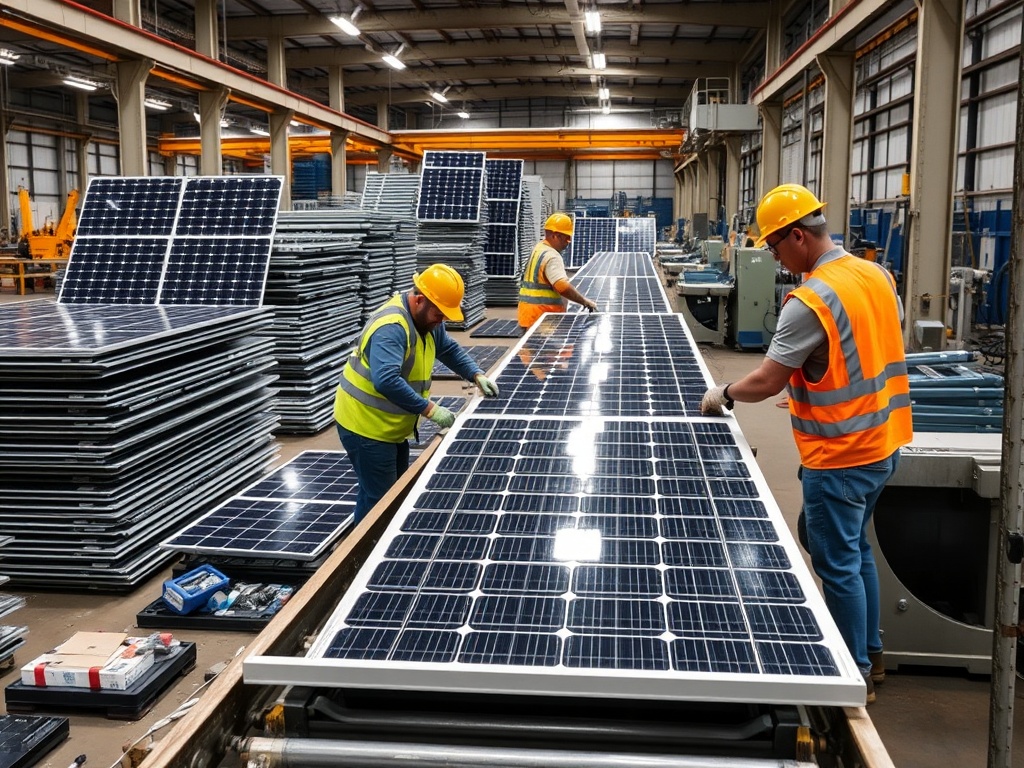
The process operates in four sequential stages: a robot removes the electrical component, a second machine recovers the aluminium, a third extracts the glass and a fourth separates silver, silica and copper. The end result, according to John, is that the material can be completely reused instead of ending up in a landfill.
That sequence matters because it defines the economic viability of the model. A solar panel contains between 10 and 15 kilograms of tempered glass, between 1 and 1.5 kilograms of aluminium in the frame, and small but commercially relevant quantities of silver and copper in the conductors. Silver, in particular, is a material with significant market value. If material recovery can generate sufficient revenue to offset part of the operational cost of processing, the model has an economic logic of its own beyond the state subsidy.
The company has announced a monthly processing capacity of around 5,000 panels, with a policy that differentiates between households, which will not pay a fee, and businesses, which will be required to do so. That pricing structure is not arbitrary: residential panels arrive in small and irregular volumes, which makes their collection costly. Panels from solar farms or commercial installations arrive in larger and more predictable batches, which allows a charge for the service without destroying participation. It is a cross-subsidy reasonably designed to maximise the material capture rate without excluding the residential segment, which is precisely the one that, if abandoned, may end up depositing panels in the nearest landfill.
However, there is an architectural question that the programme still does not answer clearly. The 13 million subsidy is aimed at establishing the infrastructure. It is not designed, at least according to available information, as a permanent operating subsidy. This means that the business model of the recycling operators will eventually have to sustain itself on the income generated by the sale of recovered materials and the fees charged to the commercial sector. If the price of silver or aluminium falls significantly on the international market, or if the volume processed does not grow at a rate that makes the operation profitable, the infrastructure built with public money could end up underutilised.
Minister Sanderson and the circular economy as job creation
Energy Minister Amber-Jade Sanderson added a dimension to the announcement that deserves separate attention. Beyond the environmental argument, she described the programme as a job creator and cited the circular economy — including food waste, landfills and electronic recycling — as an engine for generating employment in Western Australia.
That framing is not merely rhetorical. It has implications for understanding why the government is willing to invest 17.8 million in recycling infrastructure rather than, for example, requiring panel manufacturers to cover end-of-life disposal costs through an extended producer responsibility scheme.
The circular economy generates local employment because it cannot offshore its operation: the panels have to be collected, transported and processed where they are. That makes it a geographically anchored activity, which makes it attractive to governments seeking local labour. The employment argument also makes the programme politically more robust than if it were presented solely as environmental expenditure, because it simultaneously responds to two priorities.
That said, the circular economy as an employment engine works well when the value chain is sufficiently integrated locally. If the recovered materials — aluminium, glass, silver — end up being exported without additional processing within the state, the added value that remains in Western Australia is less than the official discourse implies. This is a structural risk of any recycling programme that is not accompanied by local manufacturing industry capable of absorbing the recovered materials as inputs.
The cost that does not appear in the 17.8 million budget
There is an element that the programme's figures do not capture and that is relevant for calibrating its real ambition: the gap between the announced installed capacity and the potential volume of waste that will be generated in the coming years.
If Western Australia has one of the highest solar adoption rates in Australia, and the panels installed in the first half of the 2000s and early 2010s are beginning to reach the end of their cycle during this period, the flow of panels to be processed could grow several orders of magnitude above the 5,000 per month that the announced company has set as its initial target. The infrastructure being funded now is a starting point, not a scaled solution.
That does not invalidate the investment. Building the first local processing infrastructure is the prerequisite for any subsequent expansion. But it does signal that the programme must be understood as the first piece of an architecture that, to be functional over a ten-year horizon, will require additional investment — likely private — or regulatory mechanisms that compel producers to finance part of the take-back system.
International experience points in that direction. In the European Union, the Waste Electrical and Electronic Equipment directive extended its scope to photovoltaic panels precisely because it became clear that the voluntary market would not generate sufficient infrastructure to handle the expected volume. The extended producer responsibility mechanism transfers the disposal cost to the manufacturer, which in turn creates incentives to design products that are easier to dismantle. The Australian programme, as described, does not include that regulatory component. Public investment finances the infrastructure, but there is no indication that manufacturers are being required to contribute to the system or to redesign their products to facilitate recycling.
That is, possibly, the most important limitation of the announced model. Not because what is being done is wrong, but because without a mechanism that internalises the cost within the production chain, the end-of-cycle cost will continue to fall on the state, municipalities and, ultimately, taxpayers.
What this programme reveals about the life cycle of the energy transition
Western Australia is confronting, in accelerated fashion, a tension that will reproduce itself in any geography that has bet intensely on solar energy: the success of deployment creates the problem of end-of-life management. Both phases are causally connected, but they are financed and governed in completely different ways.
Deployment was financed through consumer incentives, installation subsidies and guaranteed purchase prices for the energy generated. End-of-cycle management, until now, had neither financing nor infrastructure. Remade in WA is the first serious attempt to build that second half of the cycle, and its most enduring value lies not so much in the 17.8 million spent as in the fact that it establishes institutional precedent: the state formally recognises that the energy transition includes the problem of waste and that it cannot be left to the logic of the market without support.
What remains fragile is the economic sustainability of the model without a permanent subsidy. Long-term viability depends on three variables that the programme does not directly control: the price of recovered materials on commodity markets, the growth in the volume of panels to be processed, and the eventual introduction of regulation that obliges manufacturers to participate in the take-back system. If all three align positively, Western Australia will have built a photovoltaic material recycling industry with its own economic logic. If any one of them fails, the public infrastructure will be left operating below capacity or with an undeclared permanent operating subsidy.
That is the real wager behind the 17.8 million: that arriving first to build the infrastructure is worth more than waiting for the market to build it alone, because by that point the landfill will already have accumulated decades of waste that is difficult to reverse.