
Why India's Energy Transition Is Fracturing Within Its Own Supply Chain
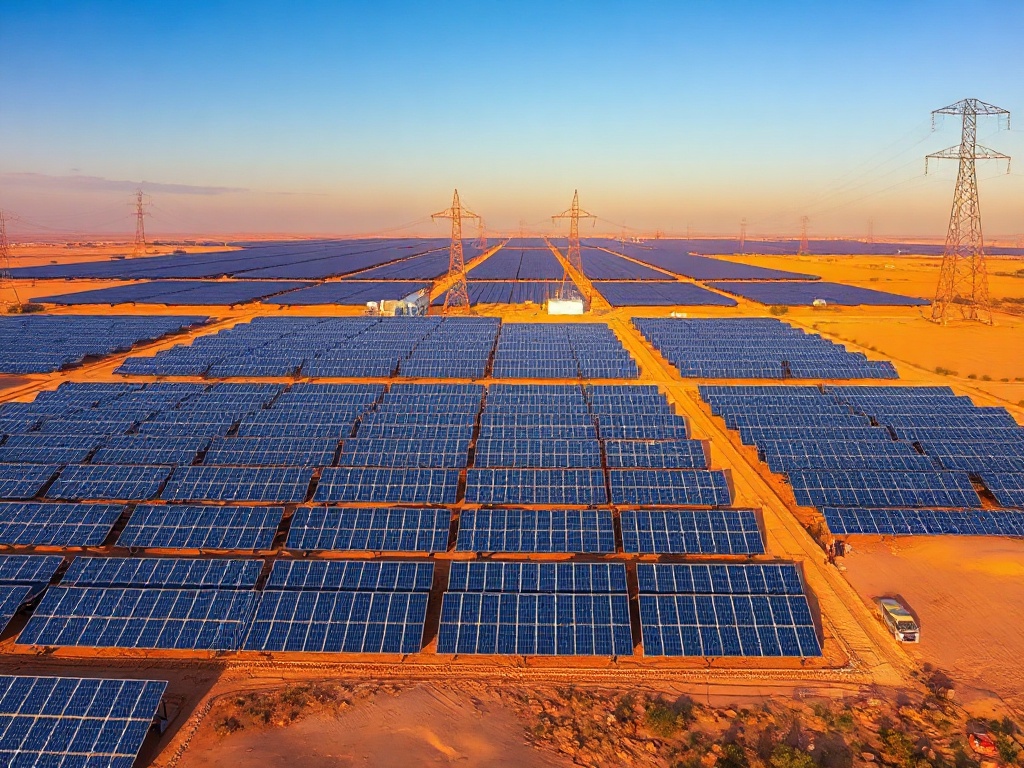
India has spent more than a decade constructing the narrative of a great energy transformation. Installed renewable capacity figures advanced so rapidly that the country reached its target of 50% non-fossil capacity five years ahead of its committed deadline. The announcement travelled through headlines around the world as evidence that the most populous economy on the planet had understood the urgency of the climate crisis. But there is a crack those headlines did not cover: non-fossil electricity generation remains stuck at around 25% of the total, and the industrial sector that manufactures the materials from which that renewable infrastructure is built — the steel for wind turbines, the aluminium for panels, the cement for structures — remains one of the most polluting engines in the country.
That gap between installed capacity and real emissions is not a technical detail. It is the structural fault that determines whether India's energy transition produces genuine climate impact or simply produces a well-measured narrative.
The Problem That Does Not Appear in Investment Decks
India's heavy industry accounts for close to a quarter of the country's greenhouse gas emissions, according to data cited in an analysis published in June 2026 by The Economic Times. The World Resources Institute India calculates that in 2019 the industrial sector emitted 803 million metric tonnes of CO₂, and that 73% of those emissions came from energy consumption. Without additional decarbonisation policies, the same WRI projects that those figures could triple by 2050 and represent up to 50% of national emissions.
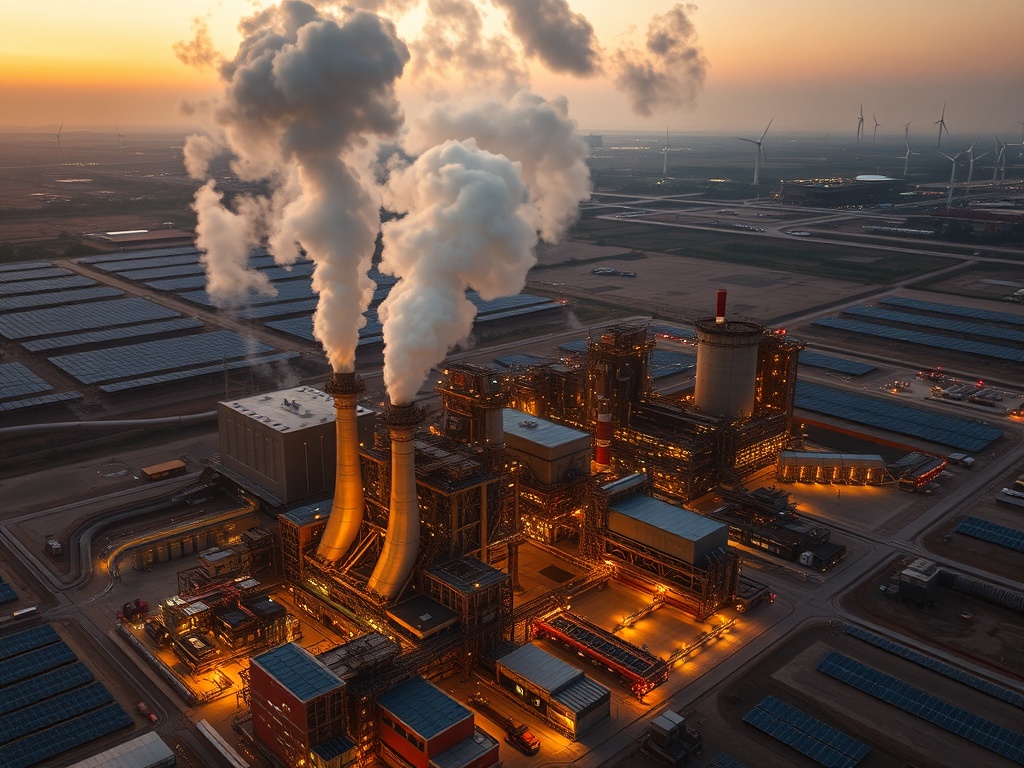
The pattern is familiar in emerging markets with high rates of urbanisation: demand for materials grows faster than the system's capacity to produce them with lower emissions. Every new wind turbine requires steel. Every solar park requires aluminium and cement. If those materials continue to be manufactured using coking coal, the net emissions balance of all renewable infrastructure is contaminated at its source, before it generates a single clean kilowatt-hour.
This is where the variable that rarely appears in sustainability conference decks emerges: the carbon footprint embedded in the construction materials of the energy transition itself. It is not a problem of political intention or technological lag; it is a problem of value architecture across the entire industrial production chain. And if that problem is not resolved, India can keep adding renewable gigawatts while its industrial emissions scale in parallel.
The analysis by Subhrakant Panda, former president of FICCI, formulates this with precision: the deployment of renewable energy can accelerate, but if the materials required to build that infrastructure are produced through carbon-intensive processes, industrial emissions will grow alongside the very expansion of clean energy. The contradiction is not theoretical. It is mathematical.
When Carbon Becomes a Barrier to Market Entry
The most significant shift of the past two years is not in technology nor in voluntary corporate commitments. It is in the incentive structure of international trade. The European Union's Carbon Border Adjustment Mechanism — known by its English acronym, CBAM — operates as an implicit tariff on the emissions embedded in imported products. For Indian exporters of steel and aluminium, this is no longer a future threat. It is a cost that activates as a function of the carbon intensity of their production process.
The commercial logic is straightforward: a steel producer who can demonstrate lower embedded emissions per tonne gains a concrete competitive advantage in the European market. A producer who cannot demonstrate this pays more to access the same market. And if other trading blocs adopt similar mechanisms — which analysts consider likely — the cost differential between clean production and conventional production widens progressively.
For India, this has a strategic implication that extends well beyond sustainability understood as corporate reputation. Its industrial exporters face a structural cost decision: invest now in reducing process emissions, or absorb the cost of carbon as a permanent friction in accessing advanced markets. The first path requires capital. The second erodes margins in a predictable and growing manner.
Grand View Research estimates that the decarbonisation market in India generated $73 billion in 2024 and could reach $177.6 billion by 2030, with a projected annual growth rate of 16%. If those numbers are approximately correct, this is not a corporate sustainability niche. This is a market with sufficient scale to attract institutional capital, to define competitive positions, and, over time, to separate the producers who survive the transition from those who do not.
The Inventory of Frictions Slowing Industrial Decarbonisation
The gap between the theoretical argument in favour of decarbonisation and its effective adoption in industry is not one of conviction. It is one of operational friction. The Climate Policy Initiative identifies several layers: the complexity of industrial processes, the presence of long-lived assets already financed with conventional technology, international competition in markets where price remains the dominant variable, and the high cost of capital for transformation projects that take years to mature.
The sum of those frictions explains why the intentions declared in corporate ESG reports do not automatically translate into measurable emission reductions. A blast furnace has a useful life of decades. Replacing or reconverting it ahead of schedule carries a cost that does not disappear under regulatory pressure or sustainability discourse. It requires long-term financing with conditions compatible with the project's time horizon — something the global financial architecture for industry still does not provide at the required scale. The CPI calculated that global climate finance for mitigation activities in industry reached just $9 billion in 2021–22. Against an industry that needs to triple its decarbonisation capacity by 2050, that figure is not a starting point. It is a symptom of the mismatch between the narrative and the available capital.
On the public policy side, India introduced the Carbon Credit Trading System, which subjects more than 740 industrial installations to emission intensity reduction targets. This is a step that transforms decarbonisation from a voluntary aspiration into a measurable regulatory obligation. The shift towards performance regulation — rather than broad sectoral commitments — is precisely the kind of signal that private capital needs in order to model returns with greater certainty. Without that type of signal, industrial decarbonisation projects compete at a disadvantage against other assets where regulatory risk is lower and the return horizon is shorter.
Industrial Decarbonisation Is Not a Problem of Available Technology
What distinguishes the current moment from the debates of five years ago is that the technical alternatives already exist with sufficient maturity to be evaluated economically. Green steel, manufacturing powered by renewable energy, circular production models, and carbon capture in industrial processes have ceased to be laboratory promises. Their costs remain higher than those of conventional production in many segments, but the trend is converging: coking coal prices are rising, the costs of clean technologies are falling, and the regulatory costs of carbon are increasing.
The WRI estimates that a package of policies implemented from 2025 onwards could substitute up to 50% of fossil fuels in industry by 2050 and reduce cumulative industrial emissions by approximately 42% between 2020 and 2050. A carbon-neutral scenario could imply an emission reduction of 70% in the sector. Those numbers are not achieved through the deployment of renewables in the electricity sector. They require process transformation: green hydrogen instead of coking coal in steel production, electrification of industrial heat, energy management systems using artificial intelligence, and a circular economy that reduces dependence on virgin materials.
Artificial intelligence applied to industrial energy management deserves specific mention because it tends to be underestimated relative to more visible technologies. Real-time energy consumption optimisation systems can reduce operational waste without modifying the underlying production process. They do not replace the deep technological transition, but they generate measurable returns over shorter timeframes, which makes them more financeable in the context of constrained capital for industry.
The structural problem is not the absence of technical solutions. It is that industrial decarbonisation requires patient capital, long-term regulatory certainty, shared infrastructure — hydrogen networks, carbon storage facilities — and coordination between sectors that have historically operated in isolation. None of those elements can be provided by the market alone, nor within the timeframes that the climate urgency demands.
The Clean Supply Chain as a Strategic Position, Not a Values Declaration
The narrative of The Economic Times article concludes with an assertion that is worth examining from a commercial perspective: India could become a global hub for low-carbon manufacturing if it builds clean industrial supply chains alongside its renewable energy infrastructure. The proposition has genuine competitive positioning logic, though the road between the assertion and operational reality is full of variables that the discourse tends to compress.
A low-carbon manufacturing hub is not built with commitments or with installed renewable capacity. It is built when producers can demonstrate, with verifiable and audited metrics, that the carbon footprint of their products is competitive at international scale. That requires reliable measurement systems, standards recognised by destination markets, technical capacity to report embedded emissions across the entire chain, and financing mechanisms that make investment in clean process technologies profitable.
The distance between the strategic assertion and that operational architecture is precisely where it is decided whether India seizes the window or loses it. The countries that first establish credibly verifiable low-carbon supply chain standards will hold a first-mover advantage of months that becomes years when investment cycles in industrial plants have horizons of ten to fifteen years. The argument is not moral. It is one of timing and of who arrives first with the measurement, certification, and production infrastructure that global buyers will begin to demand systematically.
India has the scale to make that move with global impact. What it still does not have — and what the analysis of its own industrial bodies acknowledges — is the capital, the coordination infrastructure, and the regulatory density sufficient to execute it at the speed that the climate calendar and the European CBAM are imposing. The Carbon Credit System with 740 regulated installations is a real step, but it covers a fraction of the industrial base that needs to be transformed. The signal is correct. The scale is not yet there.
India's energy transition is not decided by the figures for installed renewable capacity. It is decided by whether the materials that make that capacity possible are produced with a carbon footprint that global markets can buy, and by whether the country builds the financial, technical, and regulatory architecture to demonstrate that before others do so first.