When Abu Dhabi Finances the Refinery That Is Supposed to Stop Being One
There is a well-constructed paradox at the center of the agreement that Essar Energy Transition Fuels and IRH Global Trading announced in June 2026. A company that carries "energy transition" in its name has just closed a $500 million facility to secure crude supply and the commercialization of refined products at its Stanlow refinery in the northwest of England. Its counterpart is a trading subsidiary of a group headquartered in Abu Dhabi that invests in critical minerals for decarbonization. The headline of the operation speaks of transition. The mechanics of the deal speak of hydrocarbons. That tension is not an editorial accident: it is the structure of the historical moment the industry is traversing.
To understand why this deal matters beyond its headline figure, one must read two things simultaneously: what the operation claims to be and what it materially does.
---
A Refinery With One Foot in Each Era
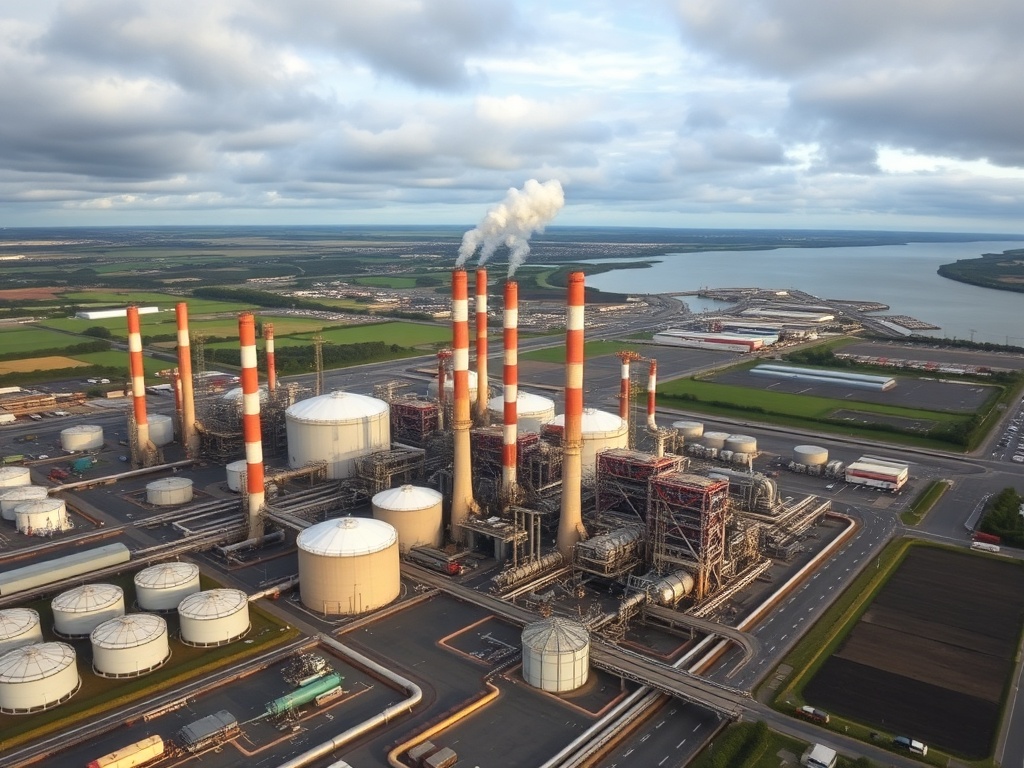
Stanlow is not just any refinery on the European energy map. Owned and operated by Essar since 2011, it is one of the United Kingdom's principal production centers for gasoline, diesel, and aviation fuel. In recent years, Essar has invested heavily in repositioning the asset: $130 million in a major maintenance program completed in 2025, improvement plans equivalent to $350 million annually in operational efficiency, approvals for what it describes as the largest hydrogen production center in the United Kingdom within the HyNet North West cluster, an industrial carbon capture project under development, and, more recently, a step forward in the construction of a sustainable aviation fuel plant based on methanol.
The group launched in 2023 Essar Energy Transition (EET) with a declared investment program of $3.6 billion across the United Kingdom and India. The name of the vehicle, the size of the program, and the chosen geography all point in an unambiguous direction: the company is not betting that Stanlow will remain a crude oil refinery indefinitely. It is betting that Stanlow will become the nucleus of a distinctly different energy infrastructure.
But infrastructures are built while existing assets continue to operate. And assets that operate need crude, working capital liquidity, and product commercialization channels. That is where the agreement with IRH Global Trading comes in.
The $500 million facility covers exactly that: crude supply to feed the refinery and commercialization of refined products toward the markets. It is not financial debt in the strict sense, but rather a structure that ties financing to the physical flow of commodities, allowing Essar to diversify its crude sources, optimize its working capital, and access sales channels without depending on traditional banking lines. In operational terms, it converts fixed and relational financing costs into a more flexible structure, tied to volume and to the actual operation of the refinery.
This has a clear financial logic in the current context. Global crude markets remain volatile, and European refiners face double margin pressure: on one hand, competition from newer refineries in the Middle East and Asia with lower cost structures; on the other, environmental regulations that increase the cost of operations and discourage investment in conventional capacity. Having a trading partner that guarantees access to crude and product offtake reduces exposure to that volatility without immobilizing its own capital in inventories or hedging. Essar gains operational resilience in the short and medium term, which is precisely the time it needs to execute the long-term transformation.
---
Gulf Money and the Logic of the Bridge
The choice of IRH Global Trading as counterpart is not a minor detail. International Resources Holding, the parent company of IRH Global Trading, is a subsidiary of the 2PointZero group, headquartered in Abu Dhabi. Its declared business model is an integrated critical minerals platform for the energy transition: from exploration to distribution, with a focus on copper, cobalt, nickel, manganese, graphite, rare earths, tin, tantalum, and tungsten. In its own narrative, it is a transition company.
But IRH Global Trading operates as a liquidity provider and energy trading entity. The extension into crude oil and refined products for a British refinery is not an internal contradiction for the company: it is the logic of the large commodity trading houses, which have historically moved between asset classes where they can offer liquidity, market access, and structured financing. What IRH is doing is replicating, from a different origin and with a transition narrative, the model that the market knows from actors such as Vitol, Trafigura, or Gunvor: entering as a crude supplier and product buyer, tying financing to the physical flow, and capturing margin at both ends of the chain.
What makes the geographic origin of the capital relevant is the broader pattern it signals. Abu Dhabi is not betting solely on oil remaining profitable indefinitely. It is betting on being the provider of capital, liquidity, and market access for energy infrastructures in transition, whatever fuel flows through them. In that sense, the deal with Essar is not a bet on crude oil: it is a bet on Stanlow's infrastructure as a relevant node in the energy system of northwest England, now and throughout the transition. Gulf capital is buying a position in the logistical and financial chain, not just in the barrel.
This matters for reading the geopolitics of money in the European energy transition. It is not only the major investment banks or private equity funds that are financing the industrial transformation of the continent. It is entities with access to commodity flows, trading expertise, and sovereign or quasi-sovereign liquidity that are taking position in the assets that will be operating over the next twenty years as the region decarbonizes. That position is not neutral: whoever finances the crude supply and the commercialization of products has influence over the terms under which the refinery operates, which markets it reaches, and with what margins.
---
The Tension the Deal Does Not Resolve
Prashant Ruia, chairman of Essar Energy Transition, described the agreement as "strategically important for our Stanlow refinery in the UK." The phrase is correct and at the same time underscores the underlying tension: the operation is important for the refinery that Stanlow is today, not necessarily for the low-carbon energy hub that Stanlow aspires to be tomorrow.
There is nothing wrong with that tension. It is, in fact, the material condition of any serious industrial transition. Transformations of this scale do not happen all at once. They require existing assets to keep generating cash flow while new capacity is being built, operators to maintain access to financing during the period of greatest uncertainty, and investors and commercial partners to accept accompanying a story that still has a conventional chapter pending. The $500 million deal is, in that sense, exactly what it claims to be: a mechanism to sustain present operations while the next phase is being built.
What the agreement does not resolve is the question of whether the scale and pace of Essar's transition program are sufficient for Stanlow to complete that evolution before external conditions force it. European refineries are operating under structural pressure that is not going to ease: stricter emissions regulation, demand for transport fuels that has peaked or is peaking in several markets across the continent, and competition from imports originating at refineries with lower costs. The time window for executing the transformation is not defined by Essar: it is defined by the market and by the United Kingdom's climate policy.
In that context, the trading facility with IRH buys operational time and financial flexibility. It is a legitimate and probably necessary instrument. But its usefulness depends on the investment program in hydrogen, carbon capture, and sustainable fuels advancing at the pace Essar has declared. If investment in transition is delayed and the crude facility is renewed cycle after cycle, the agreement ceases to be a bridge and becomes a way of extending the life of the conventional asset beyond its long-term viability.
---
What Changes When Trading Finances the Transition
There is a structural displacement that this agreement makes visible, regardless of the specific outcome for Essar. The financial architecture of European refineries is changing shape. For decades, the dominant model was bank financing plus access to crude markets through independent traders plus proprietary working capital lines. That model assumed refiners with solid balance sheets, stable access to credit, and long-term relationships with crude suppliers.
The conditions that sustained that structure are eroding. European banks have reduced their exposure to fossil fuel assets under pressure from regulators and investors. Refining margins are more volatile and less predictable. And refiners that are executing transition programs face the dual challenge of financing present operations and future investment simultaneously, with cash flows that do not always cover both needs at the same time.
Into that vacuum, structures like the one Essar agreed with IRH are entering: integrated facilities that combine raw material supply, product commercialization, and working capital financing in a single instrument, offered by entities with access to global commodity markets and sufficient liquidity to operate at scale. They are, in essence, a way of replacing the function previously fulfilled by commercial banks with the function fulfilled by large commodity operators.
That substitution has implications that go beyond Essar or Stanlow. When the crude supplier is also the working capital financier and the product buyer, the negotiating position of the refiner changes. Dependency becomes concentrated in a single actor. The refinery's margins become, in part, a function of the terms that actor is willing to offer. And the refiner's ability to shift toward different crude sources or toward different product markets is constrained by the structure of the agreement.
The fact that IRH Global Trading is a relatively new counterpart in this space and that the agreement is framed within an energy transition narrative does not change that mechanics. It would change it if the structure of the agreement included explicit incentives for Essar to accelerate its decarbonization investments, if the financing were tied to climate performance metrics, or if IRH were to take a position in Stanlow's transition projects. None of that appears in the public communication. What appears is a crude and products agreement for $500 million, described in the language of transition.
That gap between narrative and mechanics is, in itself, informative. It signals the real state of the financial architecture of the industrial energy transition in Europe: it still depends, to a large extent, on the same physical commodity flows that it is supposedly trying to leave behind. The actors who control those flows, including those headquartered in Abu Dhabi with names that evoke critical minerals, are positioned to capture value on both sides of the transition. Not because they are hypocrites, but because that is what entities with capital, liquidity, and market access do when European refiners need all three at the same time.
The industrial energy transition is not going to be financed by entities that have no interest in the assets they are transforming. It is going to be financed by entities that hold a position in those assets and that calculate when and how to maximize the value of that position throughout the change. Essar knows that. IRH does too. The $500 million agreement is the form in which that calculation becomes visible.