
Why Community Composting Threatens the Municipal Organic Waste Business
In Castlemaine, a town of 10,000 inhabitants in central Victoria, Australia, a group of volunteers has built — without any public funding — an organic waste collection system that covers more than 650 households, has processed nearly 50,000 buckets of kitchen and garden waste, and has generated enough political pressure for the local council to slow down the implementation of a mandatory government programme. This is not a story about environmental activism. It is a story about who controls the flow of a resource that state governments and large waste management companies are beginning to value in terms of contracts, margins, and market position.
Australia generates approximately 14.6 million tonnes of organic waste per year. The Victorian government has mandated that all households in the state have access to four differentiated bins — general waste, mixed recycling, glass, and the so-called FOGO (an acronym for food organics and garden organics) — before 1 July 2027. The State wants those organics out of landfill not only for climate reasons — the methane they produce as they decompose is a greenhouse gas significantly more potent than carbon dioxide — but because organic waste represents raw material for compost that can be sold. FOGO, in the words of sector specialists, is not rubbish: it is a value chain that someone is going to control.
The question that the Castlemaine case places on the table is not whether community composting is good for the environment. It is whether this model can structurally compete with the institutional system, and what happens when it does.
When the Community Captures the Resource Before the System Does
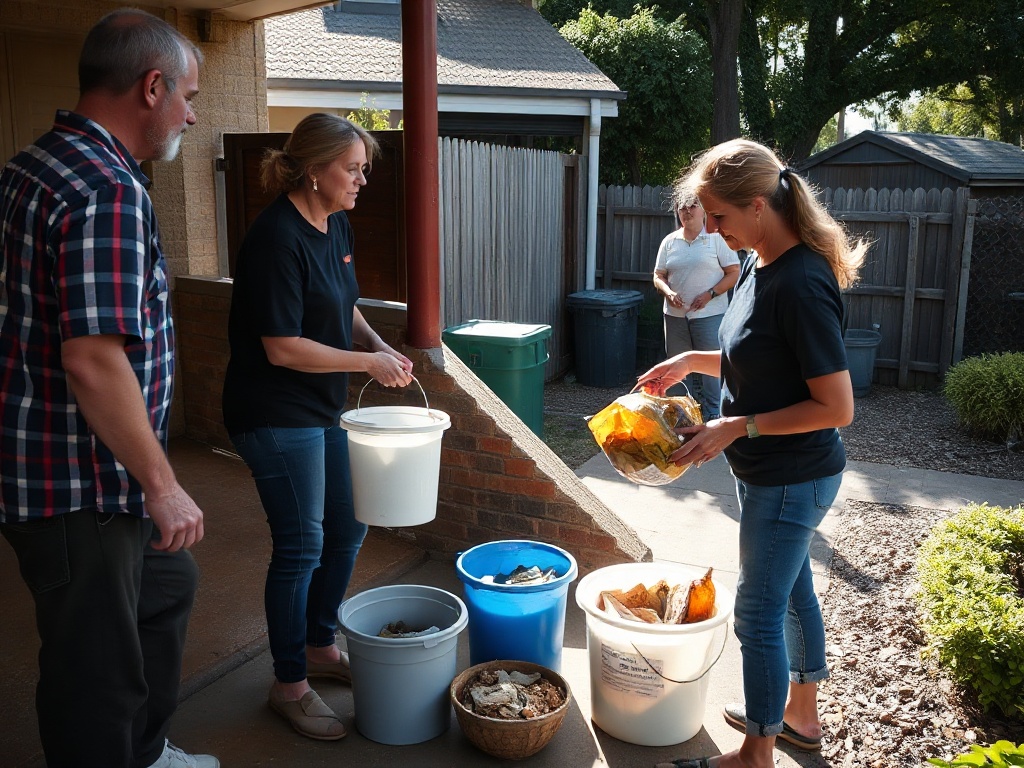
The group Yimby Castlemaine — whose name plays on the acronym "yes, in my backyard" — was founded in 2020 and built its operation from scratch with a deceptively simple architecture: volunteers assigned by neighbourhood collect buckets of organic waste from participating households, replace them with clean lined buckets, take the material to their own homes, weigh it, record the data in a database, and compost it. The resulting product travels back to the community as a soil amendment.
What looks like a neighbourhood initiative has metrics that justify a more hard-headed analysis. More than 50 active composters. More than 650 households covered. Approximately 50,000 buckets processed. A petition with more than 1,000 signatures that led the Mount Alexander council to reconsider the pace of implementation of the state's FOGO programme. That is not a residents' association. It is an operation with the capacity to exert political influence over decisions concerning public infrastructure.
The point of friction arose when the council announced in 2025 the imminent introduction of the FOGO bin as part of the provincial mandate. Yimby responded with what, translated into business language, was a market retention campaign: it argued that the already existing community system was more efficient, better adapted to the territory, and more capable of returning nutrients to the local soil than a centralised industrial system. The petition explicitly requested a pause — "go slow on FOGO" — so that the council could evaluate the data before committing to a collection model that involves contracts with operators of considerable scale.
Here the variable that does not appear in the visible narrative emerges: FOGO is not just a public service, it is a business. Large waste operators — companies such as Cleanaway or Veolia — compete for long-term municipal contracts to collect and process organics. The resulting compost is sold to agriculture and landscaping. When a community manages its own organics and returns them locally, that tonne of waste exits the flow that feeds those contracts. Yimby Castlemaine, without explicitly intending to, is acting as a reducer of the volume available to the commercial system.
The Value Architecture That the State Cannot Replicate
The institutional FOGO system has a clear logic: centralise collection, scale up processing, generate a standardised product, and sell it. It is a linear chain in which value is captured at the extremes: the municipal contract and the sale of the compost. What it loses in that chain is precisely what makes Yimby sustainable: the active participation of the waste producer, the proximity between generation and utilisation, and the absence of logistical friction between both ends.
A typical FOGO programme operates with contamination rates that can exceed 20% of the material received — plastic bags, non-compostable packaging, incorrectly sorted materials — which reduces the quality of the final compost and increases processing costs. Community systems with high citizen involvement report significantly lower contamination rates because the person who delivers the waste has a direct relationship with whoever receives it and with the final product. The social embarrassment of contaminating a neighbour's bucket is a more effective quality control mechanism than any municipal education campaign.
This difference is not anecdotal. It determines the value of the final product. Compost produced by community systems with high participation can reach quality standards superior to the average industrial compost, which opens up different markets: urban vegetable gardens, local food producers, community gardens, restaurants with an interest in input traceability. These are small markets, but ones with a willingness to pay more for verified origin and quality.
The structural problem of Yimby is the same as that of any model based on volunteering: it does not scale in a predictable way. The 50 composters who today cover 650 households cannot cover 6,500 with the same structure. The labour variable is unremunerated, which means the model has an operational ceiling determined by the availability and effort tolerance of its participants. When volume exceeds that ceiling, the system will have to choose between professionalising — which implies fixed costs and the need for stable income — or ceding territory to institutional FOGO.
That bifurcation is the strategic moment that the Mount Alexander council is managing without naming it as such. If it yields to Yimby's petition and designs a hybrid model that integrates the community system as a first level of treatment before diverting surpluses to FOGO, it can reduce the volumes it needs to process industrially and thereby negotiate smaller contracts or more favourable conditions with operators. If it ignores Yimby and implements FOGO in full, it regains control of the flow but will likely lose citizen participation in source separation, which deteriorates the quality of the processed material.
The Model That the Waste Market Is Not Yet Looking At
What the Castlemaine case anticipates is not the disappearance of institutional FOGO. It is the emergence of a market segment that large waste operators have ignored because their business models were designed for scale, not for granularity.
Digital platforms that connect households with nearby composting sites — the article mentions Peels as an Australian example — represent the most direct attempt to capture that intermediate space between the purely voluntary model and the mass municipal system. The logic is recognisable: aggregation of dispersed supply, reduction of logistical friction, generation of participation data that can be converted into waste diversion reports with value for municipalities, corporations with sustainability commitments, or voluntary carbon credit markets.
The emerging value chain works as follows: a household that composts its organics locally prevents that fraction from reaching landfill, which represents a measurable reduction in methane emissions. If that reduction is quantified using a certified methodology, it can generate voluntary carbon credits. Aggregated at the scale of a neighbourhood or municipality, those credits represent an income stream that could partially finance the operation, compensate volunteers, or subsidise equipment. No Yimby Castlemaine programme currently operates under that logic, but the conceptual infrastructure to do so already exists.
What is missing is not technology or regulation. It is someone to connect the dots: the measurement system that Sustainability Victoria already recommends — weighing incoming and outgoing material, recording data in databases — with the carbon certification protocols that exist for small-scale projects, and with income distribution mechanisms that make the model sustainable without relying exclusively on volunteering.
The municipality that designs that architecture first will have a contractual advantage over its peers: it will be able to demonstrate waste diversion rates above the average, with lower investment in collection infrastructure, backed by auditable data. That is not environmental philanthropy. It is a negotiating position vis-à-vis private operators and vis-à-vis the state funding programmes that reward performance in the circular economy.
What Castlemaine has demonstrated, without intending it as a business experiment, is that the most expensive friction in organic waste management lies not in processing but in source-level sorting. Whoever resolves that friction with genuine participation — not with communications campaigns — controls the quality of the resource and, with it, the margin that resource can generate downstream. The systems that manage to convert that participation into something economically sustainable, without depending on the indefinite goodwill of fifty neighbours, will be the ones that define how this flow is managed over the next two decades.