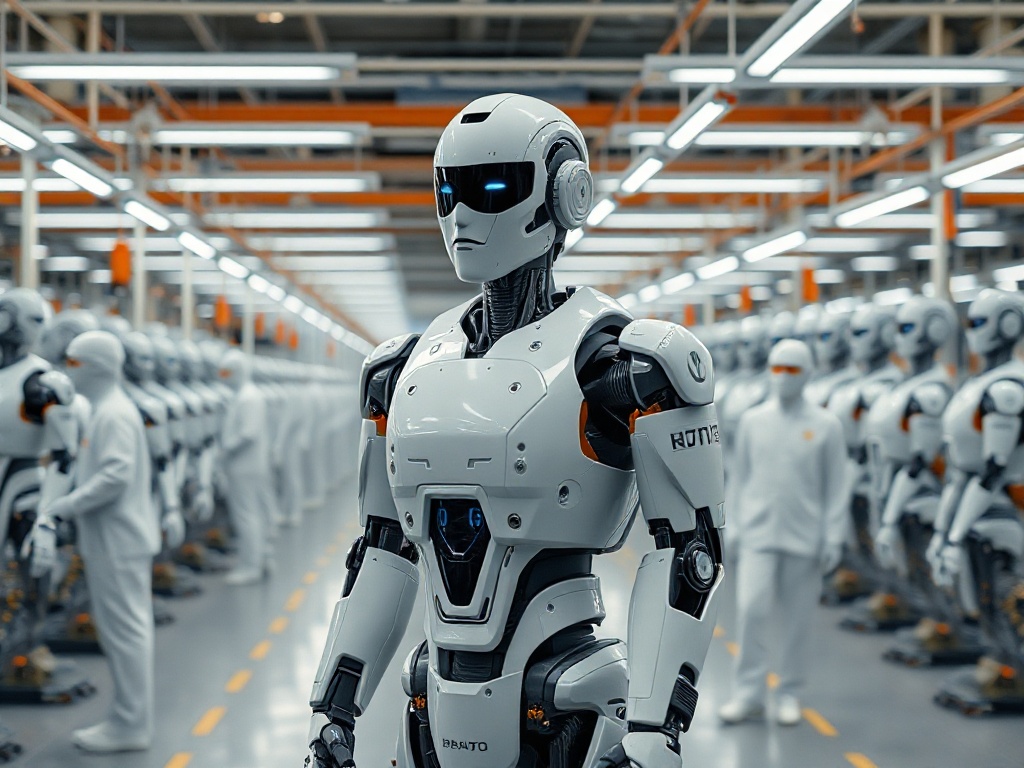

Chinese humanoid robots dominate the market but live off the mirage of demand
More than 13,000 humanoid robots dispatched in 2025. Eighty-five percent of that volume manufactured in China. Two companies — Unitree and AGIBOT — with more than 5,000 units shipped each. The numbers, read on their own, paint a picture of an industry in full expansion. Read more carefully, they describe something different: a productive capacity running far faster than real demand, sustained largely by state purchases, research laboratories, and public demonstrations designed to look like commercial traction.
The humanoid robotics sector in China has spent two years generating headlines about backflips, robot waiters, and machines directing traffic. What those headlines fail to explain with sufficient clarity is the distributive mechanics behind the boom: who is buying, why they are buying, and whether that demand structure can sustain the scale that companies are projecting.
The model that grows because the State buys, not because the market asks
Morgan Stanley estimates that in 2025, more than 2 billion yuan — around 295 million dollars — was placed in humanoid robot orders in China. A significant portion of those orders came from state-owned enterprises that directed them toward power plants, data centers, and entertainment environments. These are not buyers who evaluate return on investment in classical terms: they are actors responding to guidelines from the Communist Party's 2026–2030 five-year plan, which explicitly includes humanoid robots as a strategic frontier technology.
That does not make the market illegitimate, but it does alter the type of signal it emits. When the State is the primary customer, orders reflect industrial policy priorities rather than operational viability. Companies do not need to demonstrate that their robot works well in a disordered environment to secure a contract; they need to demonstrate that they are aligned with the national technological development narrative. The result is a cycle where demand validates production without validating the product.
Matrix Robotics, headquartered in Shanghai, illustrates that tension well. Its flagship robot, the MATRIX-3, is priced at around 99,000 dollars per unit. The company recorded approximately 1,000 orders from coffee chains and hotels, but at the time of the report had only manufactured a few hundred units. Its founder and chief executive officer, Allan Zhang — a former Tesla employee — stated that the company could deliver 5,000 units in 2026 depending on order volume. That conditional is the real structure of the model: projected capacity dependent on demand that has not yet materialized autonomously.
EngineAI, based in Shenzhen, sells its basic version for 180,000 yuan — approximately 26,600 dollars — and positions it for security guard and museum guide roles. Its brand head declared that "the next step will be to move toward more real scenarios." That phrase, delivered publicly, is more revealing than it appears: it describes a company that is not yet operating in real scenarios, but preparing to do so.
The gap between what the robot does and what the customer needs
Samm Sacks, a researcher at the think tank New America specializing in Chinese technology, articulated the problem with precision: most humanoid robots are still performative rather than functional. They are designed for highly structured and predictable environments. They fail in disordered contexts, which are exactly the environments where economic value would be greatest.
The unit economics confirm that reading. With an average price of 46,000 dollars per unit in 2025 and an operational autonomy of only two to three hours per charge, the return calculation for any industrial operator is difficult to close. A robot that works two hours, requires constant supervision, and costs what a high-grade vehicle costs does not compete well against a non-humanoid robotic arm of single functionality, which is cheaper, more durable, and perfectly suited to the production line that already exists.
Chibo Tang, from venture capital firm Gobi Partners — which invests in robotics companies — was even more direct: "The use cases for these robots are still so limited that without demand and without that market scale, these companies cannot really go to mass production." The paradox Tang describes is structural: to lower costs you need scale, to achieve scale you need demand, and to generate demand you need a product that works well under real conditions. That circle does not close with subsidies or state orders.
Eric Guo, founder of AI² Robotics based in Shenzhen, pointed to another bottleneck that rarely appears in financial projections: data. For a humanoid robot to learn to perform tasks beyond a simple function, it needs large volumes of data collected across varied scenarios, in public and private environments, with a reasonable level of complexity. Building that dataset at scale, Guo warned, could take years. Without that data, the artificial intelligence model operating the robot does not improve quickly enough for the product to stop being demonstrative.
Unitree reports 250 million dollars in revenue while the sector accumulates consolidation risk
The most revealing contrast in the sector is that of Unitree. The company reported revenues of 1.7 billion yuan — around 250 million dollars — in 2025, with a profit of 278 million yuan — 41 million dollars. Those are solid numbers for an early-stage robotics company. Together with AGIBOT, Unitree shipped more than 5,000 units in 2025, while American rivals such as Figure AI and Tesla sent only a few hundred units or fewer.
That operational advantage is real, but it must be read in context. Chinese prices are on average 20% lower than those of foreign competitors thanks to integration with the local supply chain. Some models sell for under 6,000 dollars. That price compression is a competitive strength against Western rivals, but it is also a signal that part of the value generated in production is being transferred to the buyer — or to the State that incentivizes the purchase — before the company can capture it in a sustained manner.
Morgan Stanley projects that China will nearly triple shipments in 2026, reaching approximately 28,000 units. Omdia estimates that annual shipments of advanced robots could surpass one million units by the early 2030s. For those projections to be fulfilled, the average price would have to fall from the current 46,000 dollars toward the 21,000 dollars that Morgan Stanley projects for 2050, and the functional capacity of robots would have to grow in parallel. Those are two conditions that reinforce each other, but neither is guaranteed by the current dynamics of the sector.
The Chinese government itself issued public warnings in 2025 about the risk of a bubble in the industry, citing the lag in commercialization and real applications. With more than 140 active manufacturers and more than 330 models registered with the Ministry of Industry and Information Technology, consolidation is not a possible scenario; it is a process that is already being anticipated institutionally. When the government that finances the expansion also warns about its excesses, it is describing a market where productive capacity has outrun real absorption capacity.
What measures the value of the robot is still not the robot
The most useful analysis is not how many robots were shipped but who bought them and for what purpose. State purchases in power plants and data centers represent a customer that does not demand a level of performance comparable to that of a private operator in a competitive environment. Academic and corporate laboratories acquire them for research, not for production. Coffee chains and hotels use them primarily to generate visual content and technological signaling toward their own customers.
None of those uses is useless, but none represents the scale that justifies the sector's valuations. The sum of those fragmented orders creates a volume of shipments that looks like a market, but in reality is a collection of experiments funded by different logics — political, academic, and marketing-driven — that converge on the same product without necessarily validating the same thesis.
Wang Xiaogang, co-founder of SenseTime and chairman of ACE Robotics, works precisely on that gap: his company collects human data in factories, retail, and offices to train robots in complex functions. The implicit bet is that whoever builds the broadest and most varied training dataset will end up holding the advantage in functional performance that is currently lacking. It is a correct logic, but it is also a long-term wager in a sector that today faces valuation pressure, overproduction risk, and a demand base that still depends on decisions not guided by economic return.
The relevant distributive question is not whether China won the humanoid robot production race — it did, clearly. The question is whether the model with which it won distributes value in a way that can be sustained when the State reduces its weight as a buyer and the private market has to make the purchase decision without industrial policy incentives. That moment has not yet arrived, but the tension between installed capacity and autonomous demand already defines the structure of the sector. The current mirage is not that the robots do not exist; it is that the demand sustaining them still does not have the mechanics of a market that functions on its own.