
Chicago Bets $500 Million on Winning the Quantum Race Before a Clear Winner Exists
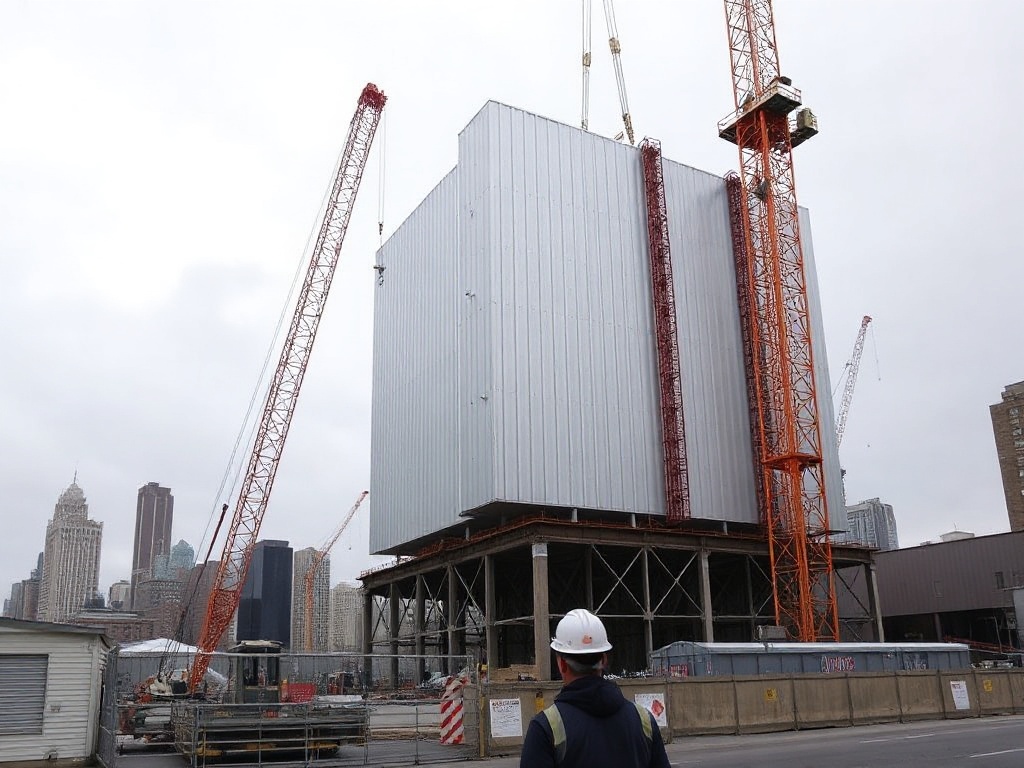
There is an image that neatly captures what is happening on Chicago's South Side: where steel furnaces from the U.S. Steel South Works complex once stood, cranes are now lifting a 65,000-square-foot silver aluminum building. Inside, when it is ready, what PsiQuantum describes as the largest intermediate-scale test system the company has ever built will be up and running. Outside, Governor Jay Robert Pritzker is calling all of this "the next Silicon Valley."
The question an incentives analyst must ask is not whether the technology is going to work. It is whether the value-sharing architecture underpinning this system can remain coherent long enough for the technology to become useful. Because between the political discourse and the building under construction there is a considerable gap, and inside that gap live all the incentives that can make this model thrive or fragment before a single commercially profitable qubit exists.
The Funding Model and Its Internal Tensions
PsiQuantum arrived in Chicago backed by a capitalization that few hardware startups can show. The company closed its Series E round above $1 billion, has accumulated a valuation of $7 billion, and received from the federal government a proposal for $100 million under the CHIPS and Science Act in exchange for a minority stake. The State of Illinois committed $500 million to develop the Illinois Quantum and Microelectronics Park, including $200 million for a shared cryogenic plant that will serve multiple tenants.
Viewed from the outside, it is an impressive stack of capital. Viewed from inside the system, something more delicate is at work.
The State is not simply subsidizing a startup. It is building shared infrastructure for a park that needs several strong tenants to justify its scale: IBM, Pasqal, Diraq, Quantum Machines, and Infleqtion are also present or announced. But PsiQuantum is the anchor. If PsiQuantum does not succeed in producing a fault-tolerant quantum computing machine at the scale of one million qubits, the entire economic argument of the park weakens proportionally.
This creates a structure in which the State of Illinois has already absorbed long-term risk without having control over the most critical technical variable. The $200 million cryogenic plant exists because PsiQuantum needs it. If PsiQuantum's photonic model turns out to be the second to arrive, or the third, or the one that arrived but arrived too late, Illinois will have financed infrastructure whose value depends on the success of a private company that can perfectly well fail. There is nothing illegal or irresponsible about that. But it is a transfer of risk that the "shared value" discourse does not always make visible.
The Technological Bet That Distinguishes PsiQuantum — and Also Exposes It
PsiQuantum is not competing in the same game as IBM or Google. Those companies built functional superconducting qubit systems, have them operating in the cloud, generate modest revenue today, and are scaling gradually. PsiQuantum chose a different route: quantum photonics based on individual photons as qubits, manufacturing through GlobalFoundries using conventional semiconductor production lines, and a direct leap toward fault tolerance at production scale without monetizing noisy intermediate-scale systems along the way.
That decision has a powerful internal logic. Victor Peng, the company's interim CEO with a prior career at AMD, has described the position as follows: companies that sold low-scale systems soon encountered scalability limitations that forced them to redesign from the ground up. PsiQuantum prefers to sell nothing until it has something that truly works.
The advantage of that strategy is that, if it works, they arrive first at the only market that generates sustainable commercial value: that of machines capable of solving problems that classical computers simply cannot. The disadvantage is structural and runs in both directions. First, without early revenue, the company depends entirely on external capital continuing to be abundant and patient. With more than $1 billion raised and a technical horizon that extends at least until the second half of the decade, that patience needs to be sustained for several more years. Second, photonic architecture is far from being the only one with scaling potential: Quantinuum's trapped qubits, neutral atoms, and IBM's own superconductors remain credible competitors that carry considerably more accumulated operational history.
The most relevant filter that exists today for measuring technical credibility in the sector is DARPA's Quantum Benchmarking Initiative. PsiQuantum has advanced through multiple rounds of that process, which signals something important: the United States government, which has its own incentives not to waste resources on technology with no future, considers that PsiQuantum's approach merits continued evaluation. That is not the same as validation, but it is not a minor distinction either.
What makes PsiQuantum different within the photonics field is its access to manufacturing at scale. By fabricating silicon photonic chips with GlobalFoundries, the company does not depend on academic production lines or artisanal processes. If the architecture works, it has a pathway to mass manufacturing that other photonic bets do not. And there is a collateral benefit that the interim CEO has explicitly noted: intellectual property in silicon optics also holds value outside of quantum computing, specifically in the transition of data centers from copper interconnects to optical ones. That is a different, more mature market with revenue closer in time.
What Illinois Bought — and What It Cannot Yet Know
Pritzker has been explicit about his political motivation as well as the technological one. Illinois trained Marc Andreessen and Eric Bina at the University of Illinois Urbana-Champaign, where they built the Mosaic browser, and watched them leave for Silicon Valley without the state doing anything to retain them. YouTube had co-founders from that same university. Several members of what is known as the "PayPal Mafia" also passed through Illinois institutions. The governor's argument is that this time the institutional infrastructure exists to retain talent: the park, the universities, the Duality accelerator, the 33,000 degrees in fields relevant to quantum computing that Illinois universities awarded in 2024.
That argument carries weight. The Chicago region has academic and institutional assets that few cities can show: the University of Chicago, the University of Illinois at Urbana-Champaign, Northwestern, Argonne National Laboratory, and Fermilab. The Chicago Quantum Exchange, created in 2017, has spent nearly a decade building connections between those nodes. It is not an ecosystem built from nothing for an inaugural photo opportunity.
But there is a difference between having the ingredients and having designed a mechanism that makes key actors want to stay inside the system. The comparison with the Stanford Research Park of the 1950s is tempting, but that park took decades to generate the returns that are today taken for granted, and it functioned in a context of massive military spending and a labor market without coastal competition for talent. Chicago today competes with San Francisco, Boston, New York, and increasingly with Raleigh-Durham and Austin, all of which are active in the same race.
What the State of Illinois bought with $500 million is not technological certainty. It is the possibility of being in the game if quantum computing becomes what its proponents claim. It is a costly option, structured as though it were a won bet. The difference between those two things is not rhetorical: it determines how much political pain can be absorbed if the timeline extends five more years beyond what was anticipated, or if a competitor with a different architecture arrives first.
The Timeline and the Mechanics of Institutional Patience
PsiQuantum has concrete signs of progress. The building is going up. The funding round is closed. The federal funds have a signed letter of intent. The park has more than one tenant. None of these things are cosmetic.
And yet, the horizon toward a one-million-qubit machine with real fault tolerance remains blurry. The company's own timelines, adjusted after construction began, suggest that the first utility-scale system could extend further than earlier communications had implied. In the quantum hardware sector, that is not surprising: deadlines slip. But for a system that requires patience from the state, the private investor, and the park's secondary tenants simultaneously, the question of how long that coordinated patience can last has no answer in any press release.
The most revealing mechanism to observe over the next two to three years will not be technological progress, though that matters too. It will be whether the park's secondary tenants — those who are not PsiQuantum — find sufficient value in the shared infrastructure to remain committed. If the park functions as a node with multiple active technologies and several organizations generating applied knowledge, the shared value argument has real mechanics behind it. If the park functionally becomes the project of a single company using public infrastructure as a shield against capital risk, the distributive model begins to show its fragility.
The difference between those two scenarios is not decided by the governor. It is decided by whether the park's design makes participation sufficiently valuable for the actors whose name is not on the largest building.
For now, the building continues to rise on what was once a steel plant. The steel left decades ago. What comes next has not yet arrived. And the value of what Illinois has built will be measured, in the final analysis, not by the size of the building, but by how many distinct actors decide that staying inside the system is worth more than leaving it.