
The memory that robots don't yet have still defines how much the ones you already bought are worth
There is a gap that most executives in logistics and manufacturing have not yet calculated. Their robot fleets see with millimeter precision, navigate with increasing autonomy, and execute repetitive tasks with a consistency that no human operator can match. But at the end of every shift, they forget everything. Each work session begins from zero, as if the robot had never set foot in that warehouse before. That forgetting is not a minor technical detail: it is the reason why the return on investment in industrial robotics remains more fragile than vendors admit in their sales presentations.
In June 2026, MIT publicly presented DAAAM — an acronym for Describe Anything, Anywhere, at Any Moment — a research framework that attempts to solve exactly that problem. The system allows a robot to build a three-dimensional map of its environment as it moves through it, associate natural language descriptions with the objects it encounters, and subsequently answer questions about what it saw, where things were, and when events occurred. It is not a commercial product or a platform ready for integration. It is a demonstration that the problem has a technical solution, and that signal matters more than it appears at first glance.
The results in comparative testing are significant: depending on the type of query, DAAAM improved accuracy by between 21% and 53% compared to previous methods. In navigation tasks using natural language instructions, the system successfully completed assignments approximately 28% more frequently than competing methods. None of this will arrive in a production warehouse tomorrow. But the direction it points to does change the way in which the architecture of any robotic fleet planned for the next five years should be conceived.
---
What the robot remembers changes what the robot is worth
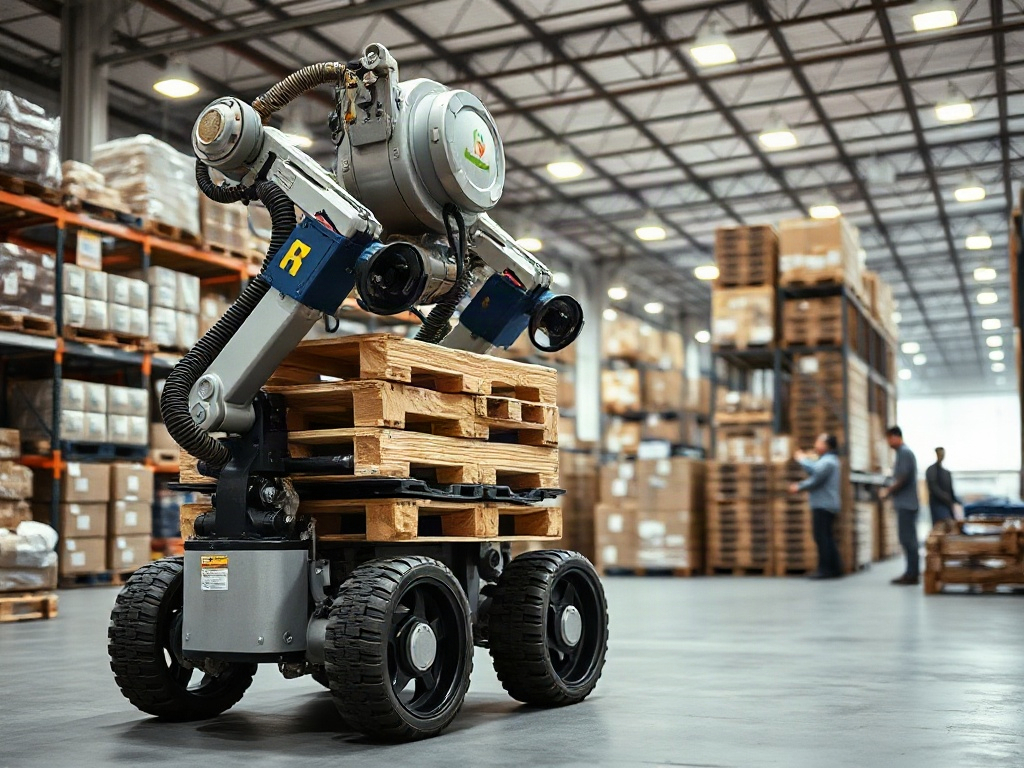
The International Federation of Robotics reported sales of nearly 200,000 professional service robots in 2024, with growth of 9%. Transportation and logistics led with 102,900 units, more than half of the entire market. These robots operate in environments that change several times per shift: pallets that move, aisles that become blocked, configurations that are reorganized according to the day's volume. And the vast majority of them remember nothing of what they encountered the week before.
The mental model through which robotics has been sold until now is that of the precision tool: the robot performs a specific task well, in a repeatable fashion, without fatigue. That model has value, but it is a bounded value. A robot that detects a pallet blocking aisle seven and navigates around it is useful. A robot that records that this same aisle was blocked three times in a single week, always after the night shift, and can report that in language that a supervisor can understand, is not simply more useful: it is an entirely different category of product.
The difference is not one of speed or dexterity. It is a difference in the capacity to convert isolated observations into accumulated operational intelligence. And that capacity has, until now, been completely absent from the segment of physical robots. Not because it is technologically impossible, but because the field concentrated its energy on perception and control — what the robot sees and what it does with what it sees — without investing equivalently in what it retains between one session and the next.
DAAAM builds what its creators call a 4D scene graph: a database that records objects, three-dimensional locations, natural language descriptions, and timestamps. The fourth dimension is time. The system can answer "where was the red cart yesterday afternoon?" not because someone explicitly programmed it to do so, but because the information is indexed in a way that allows it to be retrieved through queries in ordinary language. Luca Carlone, the MIT professor who leads the project, expressed it with a phrase that captures the structural problem of the sector: "If we want robots to work alongside humans, they must speak the same language. The robot must be able to reason about time and space in the same way that we do."
---
Why this is an adoption problem before it is an engineering problem
This is where technical analysis proves insufficient to understand what will actually happen in the market. Robotic memory is not going to fail because engineers cannot solve the challenges of storage or spatiotemporal indexing. It will face an adoption friction that has psychological and organizational roots far deeper than the complexity of the system itself.
The first obstacle is trust in the record. If a vision model incorrectly labels a metal cart as medical equipment, and that error is stored as memory, the system begins to act with a certainty that has no real foundation. The robot does not hesitate: it remembers with conviction something that was never true. That is qualitatively different from the point-in-time error of a sensor, which occurs and is corrected in the same instant. An error embedded in memory propagates, repeats itself, and becomes increasingly difficult to detect because it is no longer tied to a present observation that could contradict it. The MIT team is already working on an extension called UQ-DAAAM that incorporates uncertainty markers, so that the system can signal when a stored description may not be reliable. But that mechanism will need to become comprehensible to operators who are not MIT researchers, and that leap in complexity carries real costs.
The second obstacle is less technical and more political: surveillance as a by-product. A robot that remembers objects also remembers the people who use them, the movements they make, and the patterns they establish. In a warehouse, this could translate into individual performance metrics obtained without explicit consent. In a hospital, into records of patient movement. In an office, into documented work habits that no one has authorized. Companies that have already implemented cameras and analytics systems in work environments are familiar with the tension they generate. Robotic memory amplifies that tension, because the robot is not fixed at a point on the ceiling: it moves, observes from multiple angles, and accumulates information over months.
This is not an engineering problem in the domain of privacy. It is a problem of perceived legitimacy. And the history of technology adoption in workplace settings consistently shows that when workers feel a tool monitors them more than it assists them, resistance becomes organizational and political rather than individual. Unions, works councils, and legal departments enter the picture long before the system has had the opportunity to demonstrate its operational value.
---
The architecture that is missing is not hardware but memory infrastructure
Google DeepMind with RT-2, NVIDIA with its platforms for humanoid robots, and Amazon with Vulcan have advanced along the dimensions of perception, action policy, and physical manipulation. These are bets on the brain and the body of the robot. What DAAAM points to is that a third dimension is missing — one that none of those projects has resolved in any systematic way: memory as infrastructure.
And that distinction has market implications that extend well beyond robotics as a hardware category. If robotic memory matures as a product, what will emerge will not primarily be a robot component but rather a software layer sold as infrastructure to entire fleets. That layer requires storage for persistent three-dimensional maps that grow over time, search engines optimized for spatiotemporal queries in natural language, permissions systems that determine what may be remembered and what must be forgotten, compression mechanisms to keep memory manageable without losing operationally relevant records, and audit trails that allow companies to demonstrate compliance to regulators and trade unions alike.
That is, in its functional architecture, far closer to an enterprise data platform than to a robotic hardware component. The most likely business model is not to sell memory as a feature of the robot, but as a subscription service tied to the fleet. And that changes who wins in this market. Robot manufacturers with greater capacity for vertical integration in software will have an advantage over those that depend on third parties for that layer. Those who build the governance infrastructure first — determining what the robot remembers, for how long, under what conditions, and with what access controls — will hold a position that is difficult to displace, because the data accumulated over months of operation becomes an asset with intrinsic value of its own.
---
Forgetting was a feature, not a defect. That is about to change
For years, the fact that robots did not retain anything between sessions was treated implicitly as a pending technical limitation awaiting resolution. But in practice it functioned as a containment mechanism: if the robot does not remember, it cannot accumulate errors, cannot accumulate records pertaining to people, and cannot generate privacy liabilities. From a risk management perspective, forgetting was convenient.
Robotic memory eliminates that convenience. What is gained in operational intelligence is lost in simplicity of management. And the organizations that choose to adopt it will need to simultaneously build both the technical capability and the institutional framework to govern it: who controls what the robot remembers, under what circumstances that memory may be consulted, by whom, and for what declared purposes.
The real friction of adoption will not reside in the system's learning curve or in the cost of integration. It will arise at the moment when the legal department, the union, or the regulator asks what exactly that robot does with what it observes during an eight-hour shift, and the company does not have a prepared answer ready with sufficient lead time. Organizations that arrive at that conversation with a clear policy on memory governance will face a significantly less turbulent path to adoption than those that arrive with an impressive technical demonstration and no control protocols whatsoever. In this case, the technology is advancing faster than the institutional architecture needed to sustain it, and that gap is precisely where the real risk of the coming years is concentrated.