The $200 Million Argument
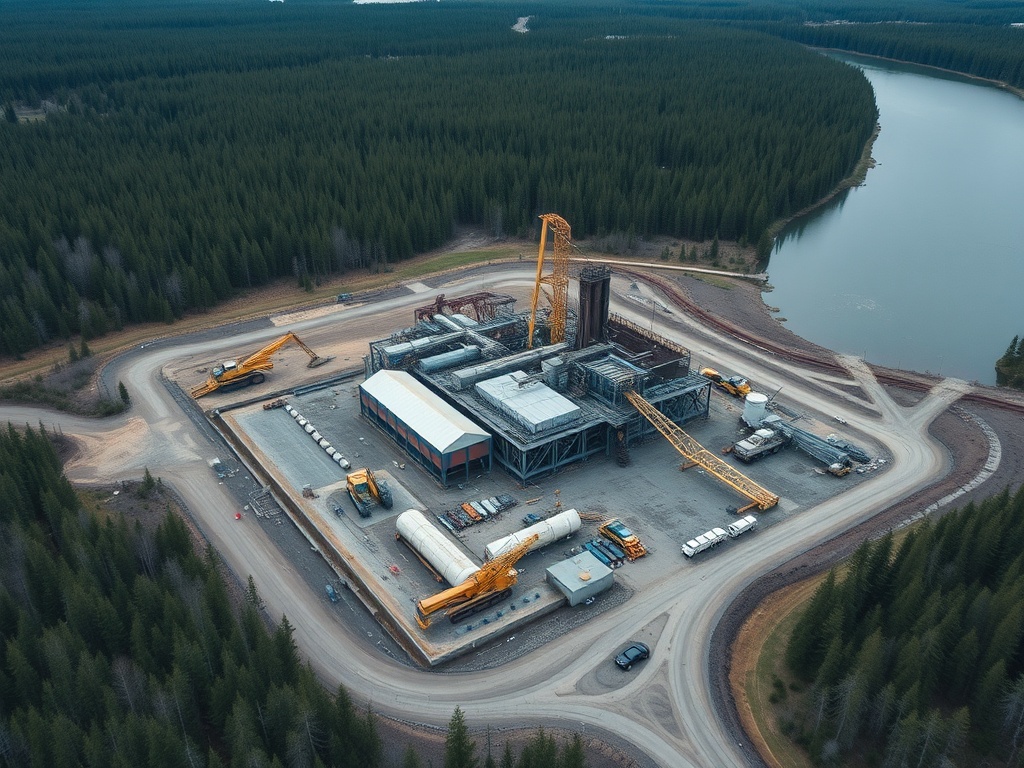
On April 8, 2026, Rock Tech Lithium and BMI Group announced from Toronto a partnership structure of up to CAD $200 million to construct a lithium converter in Red Rock, Ontario, about 100 kilometers east of Thunder Bay. The agreement is not a memorandum of understanding or a letter of intent: BMI Group is taking the role of anchor limited partner, while Rock Tech Lithium retains operational control as the general partner. In other words, the capital comes without diluting technical leadership.
This structure is not accidental. The separation between who provides capital and who makes technical, commercial, and strategic decisions is precisely the mechanism that allows Rock Tech Lithium to preserve the integrity of its operational model while absorbing external funding at scale. For the coming months, the scheme outlines an initial program of up to CAD $30 million in non-dilutive financing, structured so that every dollar contributed by Rock Tech Lithium is matched by BMI Group and by government funding sources. This covers feasibility studies, advanced engineering, environmental permits, and early-site development, with a final investment decision targeted for late 2026.
What makes this agreement operationally interesting is not the total amount, but the entry point. A company that already has its engineering design validated, a twin plant in Guben, Germany, fully permitted and designated as a Strategic Project under the EU's Critical Raw Materials Act, and over CAD $65 million invested in that prototype is not starting from scratch. It is replicating. And replication is cheaper, faster, and more predictable than innovation.
Why Canada, and Why Now
Lithium is not scarce on the planet. What is scarce is the installed capacity to convert it into battery-grade material within jurisdictions that North American electric vehicle manufacturers can use without triggering tariff sanctions or geopolitical risks. More than 60% of global lithium refining currently occurs in China. This is not background information: it is the structural pressure driving this agreement.
Canada possesses the combination of mineral resources, industrial infrastructure, and preferential access to North American markets that no other country can offer simultaneously with the same regulatory risk profile. Red Rock, on the industrial site already controlled by BMI Group near Thunder Bay, is not a speculative bet on virgin territory. It is a logistical decision based on existing assets, significantly compressing permitting and construction timelines, which are often the bottleneck that derails critical mineral infrastructure project schedules.
The financial architecture of the agreement reflects that very logic. The fixed development costs are shared between private capital and government funds, turning a capital-intensive investment into a shared-risk structure. This is not industrial philanthropy; it is the mechanics that allow a project to reach its final investment decision without depleting the promoter company's balance sheet. Rock Tech Lithium maintains technical control; BMI Group takes on capital exposure with expected returns; the Canadian government finances strategic externalities that the market alone would not internalize. Three distinct incentives aligned in the same vector.
The fact that BMI Group brings in its network the Dutch fund Business EQ Investments adds a non-trivial transatlantic dimension. The convergence between the European Union's critical minerals agenda and North America's reshoring policy creates a temporary window where European capital has tangible incentives to invest in Canadian processing infrastructure. That window is not permanent.
The Invisible Asset No One Is Counting
The official announcement describes a lithium conversion plant. What it does not emphasize enough is that Rock Tech Lithium is transferring a fully developed engineering design already operated in a European regulatory context to Canadian soil. This eliminates one of the greatest risks in projects of this nature: early-stage engineering uncertainty.
Prior collaboration with Siemens Canada to integrate digital twin technology and automation into the project reinforces that logic. A digital twin is not a cosmetic tool: it allows the simulation of operation scenarios before they physically exist, optimizes energy consumption, anticipates failures, and reduces commissioning times. For a project that must demonstrate profitability to investors who have already committed capital, the ability to compress the operational learning curve has measurable financial value, even if it doesn't appear in the press release.
Rock Tech Lithium's CEO, Mirco Wojnarowicz, articulated it with calculated precision: "BMI Group's significant investment is a strong market signal. An experienced Canadian partner committing at this level demonstrates that our project is not only technically and economically compelling — it also enjoys the confidence of professional investors." The statement is not rhetoric. It is a pricing signal to future capital partners and buyers of refined lithium who need supply certainty to anchor their own production plans.
What this agreement reveals at a systemic scale is more structural: the value in the lithium chain is shifting from the mineral in the ground to the certified capacity to process it. Countries that build that capacity over the next four years will define benchmark prices, long-term contracts, and ultimately who controls the pulse of transportation electrification in North America. The capital already knows this. Leaders who still view this industry as traditional mining will enter the market when positions are already taken.
The Model That Replaces Linear Extraction
The critical minerals industry has operated for decades under a simple logic: extract, export, charge royalties. Canada has experienced this with copper, nickel, and uranium. The agreement between Rock Tech Lithium and BMI Group represents a distinct pattern taking shape in multiple jurisdictions simultaneously: retaining the added value of processing within the same geopolitical trust chain that consumes the final product.
This transition does not occur out of ideological conviction. It occurs because battery and electric vehicle manufacturers operating under frameworks like the Inflation Reduction Act in the U.S. or the EU Battery Regulation need origin traceability and processing guarantees that raw mineral export contracts simply cannot offer. Processing in a trusted jurisdiction is no longer a marketing differential; it is an emerging contractual requirement.
Industrial sector leaders, private infrastructure capital, and governments with critical mineral reserves that do not build conversion capacity in the next three to five years will cede their negotiating position to those who do. Geography offers the resource, but the decision to process it locally is what turns a natural advantage into a sustainable market position.