
Millions of Abandoned Wells May Be Worth More as Assets Than Liabilities
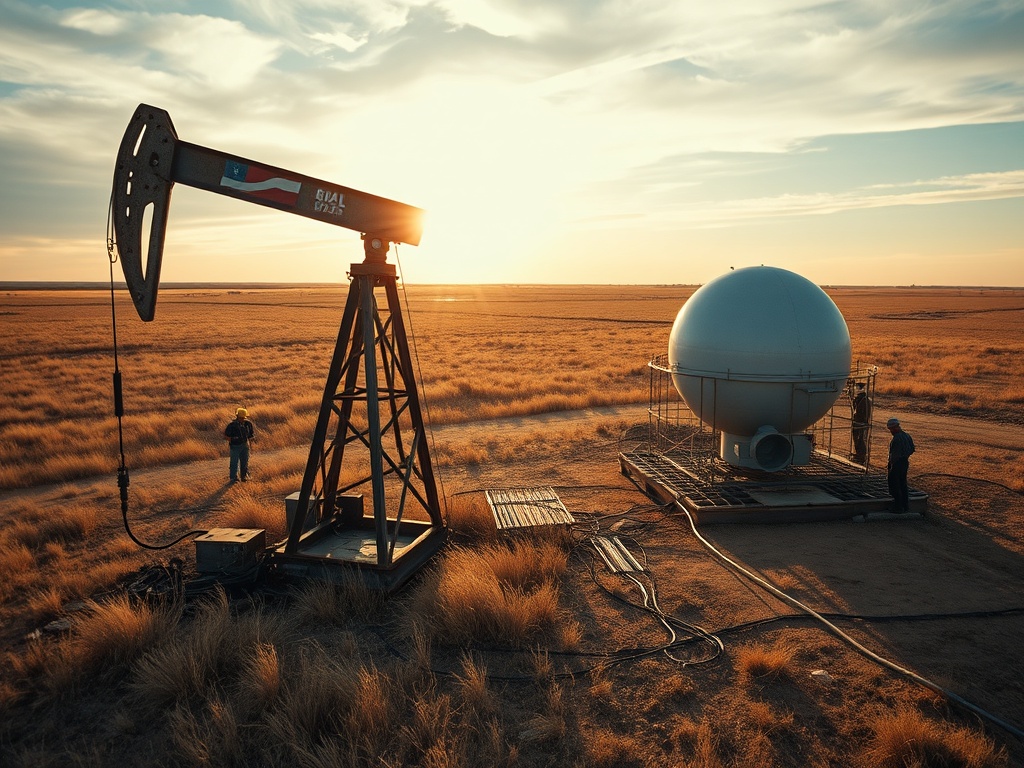
For decades, the oil industry drilled through the American subsurface with a simple logic: extract, sell, abandon. What was left behind was a legacy difficult to quantify and nearly impossible to manage: millions of inactive wells scattered across the entire territory, many without an official owner, leaking methane into the atmosphere and contaminants into groundwater. Oklahoma, to use the most illustrative case, has more than 20,000 of these wells identified. State authorities estimate that sealing them all would take 235 years and hundreds of millions of dollars. Plugging a single well can cost between $75,000 and $150,000, depending on the depth, the condition of the casing, and local geological complications.
For a long time, the only institutional response to that inventory was plugging: a cleanup obligation with no return whatsoever. But something is changing in the structure of that logic. States such as Oklahoma, New Mexico, Alabama, North Dakota, and Colorado are exploring whether those wells — already drilled, with subsurface data already collected — could become infrastructure for geothermal production or energy storage. The question is not merely technical. It is about what kind of asset the system has before it when conditions change.
The Liability That May Cease to Be One
What is happening across several states in the country is a reframing of the problem. The Well Reuse Act, which already passed the Oklahoma House in March 2026 and which the state Senate is currently evaluating, proposes allowing private companies to acquire abandoned wells and convert them for geothermal generation or underground energy storage. The model drew on a similar law that New Mexico had adopted the previous year for its more than 2,000 orphaned wells.
Dave Tragethon, director of communications at the nonprofit Well Done Foundation, which works on identifying and sealing abandoned wells across the country, captured the mechanics most precisely: if there is value, there is greater willingness to deal with the problem and greater capacity to attract financing. That sentence condenses something structural. For years, abandoned wells were treated as debts without a counterpart. What is happening now is that a combination of conditions — greater energy demand, advances in horizontal drilling, bipartisan subsidies for geothermal energy, and a storage market growing due to the intermittency of solar and wind — is changing the denominator of that calculation.
Alabama approved legislation last month enabling the state to regulate and authorize the conversion of oil and gas wells into alternative energy sources, including geothermal. Colorado has just launched a technical study to evaluate the potential of converting wells for geothermal development and carbon capture and storage. North Dakota adopted a law last year ordering the Legislative Council to study the viability of using nonproductive wells to generate geothermal energy. None of these states is yet betting on mass commercialization; all of them are building the legal and informational framework that would make such a bet possible later on.
The most important signal is not in any specific project, but in the legislative pattern: states with both Republican and Democratic governments are making similar decisions about the same type of infrastructure. That suggests that the pressure to resolve the problem of abandoned wells — a combination of environmental liability, methane leakage, uncertain fiscal responsibility, and federal regulatory pressure — is becoming heavy enough that energy conversion appears more attractive than straightforward plugging.
What Makes Geothermal Conversion Difficult
The image of an already-drilled well that only needs to be reconnected to a heat-capture system is technically seductive but not entirely honest. Oil and gas wells typically reach relatively low or moderate temperatures in the subsurface. For geothermal systems that generate electricity, the temperature of the resource is determinative: the hotter it is, the more energy can be extracted. Most abandoned wells on the great central plains are not natural candidates for large-scale electricity generation.
There are also volume problems. Fossil fuel wells generally produce smaller quantities of fluid than a geothermal system needs to drive turbines or to transfer heat efficiently to buildings. And there is a chemical problem: the fluids present in subsurface reservoirs can contain elements that contaminate the working fluids of the geothermal system, which requires additional engineering steps and specialized materials.
Emily Pope, a geologist and researcher at the Center for Climate and Energy Solutions and the author of a recent study on next-generation geothermal energy, was direct on the matter: the conversion of oil and gas wells represents an enormous opportunity, but it is still quite far technologically from being a widely applicable reality. The obstacles are still considerable, although it is worth investing in research and development to move forward.
This places the current state of affairs in a precise position: it is not a technology ready for mass deployment, but neither is it a speculative idea without a foundation. It is a field in which several necessary conditions are already being met — existing infrastructure, available subsurface data, legal frameworks in formation — and in which the sufficient conditions are still being constructed.
The University of Oklahoma, with funding from the Department of Energy through the Wells of Opportunity program, evaluated how to convert four old wells into sources of geothermal heat for schools and homes in the town of Tuttle. The project was paused during last year's freeze on federal funds and is still waiting to begin its next phase. In Pennsylvania, researchers at Penn State are studying how to use abandoned wells — the state has more than 200,000 of them — to heat agricultural greenhouses and house compressed-air storage systems that function as low-cost grid batteries.
Saeed Salehi, who was the project director in Oklahoma before joining Southern Methodist University as an engineering professor, pointed out that well reuse for geothermal energy has concrete structural advantages: geothermal companies avoid significant drilling costs if the wells already have sufficient depth and temperature; oil companies can give a second life to assets that currently cost them millions in plugging fees; and communities near that infrastructure can gain access to clean heat and lower winter energy bills. What is lacking, in his analysis, is a sufficient critical mass of successful projects to scale up. The permitting process for the Tuttle project took nearly nine months, although it is improving.
Geothermal Energy as a Reorganization of Incentives, Not a Patch Solution
What is emerging is not an environmental cleanup policy with a technological twist. It is something more interesting from a structural standpoint: a shift in the incentives surrounding an entire category of abandoned assets.
Historically, ownerless wells were a problem of externalities: the costs fell on the state or on no one, while the profits from extraction had already been captured by operators who in many cases no longer exist. That decoupling between who generated the liability and who bears it is one of the central problems of the political economy of industrial abandonment. The laws that Oklahoma, New Mexico, and Alabama are constructing attack that decoupling from a different angle: instead of pursuing historical parties responsible, they create a mechanism for new actors to take on the wells in exchange for the right to exploit them for different purposes.
That reorganizes incentives without depending on the retrospective pursuit of culpable parties, which is expensive, slow, and politically complicated. If it works, the result is not merely fewer abandoned wells leaking methane: it is a way of privatizing remediation through the enabling of new markets. The Well Done Foundation has already identified the central mechanic: where there is value, there is capital willing to move.
The limit of that logic is also visible. If only wells with sufficiently high temperatures or sufficiently close proximity to the electrical grid are viable for conversion, the majority of the inventory will continue to be a liability without a market-based solution. The technical studies being conducted in Colorado and the Penn State research on compressed-air storage are attempts to expand that viable set, but they have not yet demonstrated commercial scale.
What is changing, regardless of how many wells ultimately end up being converted, is the grammar with which the political system and the energy sector speak about that infrastructure. A drilled well has ceased to be merely a hole with a closure obligation. It is beginning to be treated as a potential asset with embedded subsurface information, physical structure already amortized, and a geographic location within existing distribution networks. That reclassification — from liability to potential asset — has consequences for how responsibility is assigned, how financing is structured, and what types of companies have incentives to enter the market.
The transition that this set of state laws is describing is not one from oil to geothermal as the dominant energy source. It is more bounded and more interesting than that: it is the transition from industrial abandonment as a pure externality to industrial abandonment as a potential input for a new market. How much of that inventory ultimately proves viable will depend on subsurface temperature, conversion costs, energy prices, and the pace at which regulatory frameworks mature. But the direction of movement already has sufficient institutional and technical coherence that it will not easily be reversed.