
Why SpaceX Can No Longer Survive on Storytelling Alone
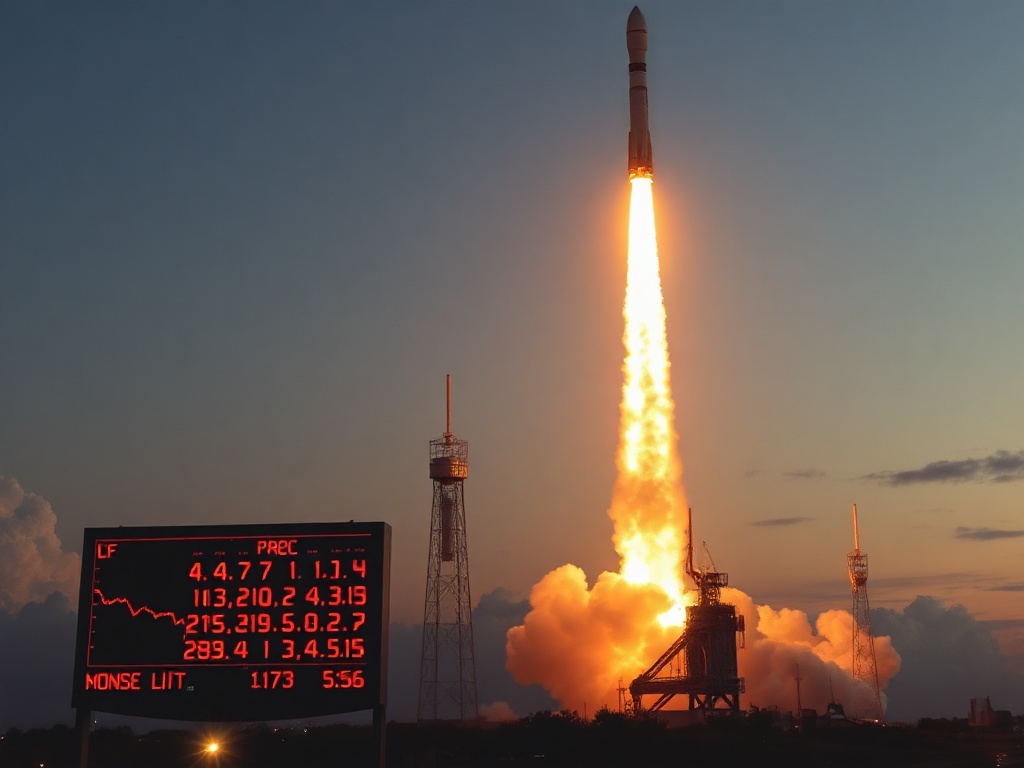
The largest stock market debut in history lasted less than a week before the market began asking questions that the narrative could not answer. SpaceX listed at $135 per share, raised approximately $75 billion through the sale of 555 million shares, and within a few days the initial enthusiasm pushed the valuation toward $3 trillion. Then came three consecutive sessions of declines, with more than $400 billion in market capitalization erased from the map. The correction does not invalidate the business. But it does reveal something far more interesting: the precise moment at which a company stops being funded as a promise and begins to be analyzed as a structure.
That threshold is the one SpaceX has just crossed, and what lies on the other side is not hostility. It is scrutiny.
Debt as Signal, Not as Tool
The first trigger for the selloff was a decision that, read in isolation, seems innocuous: SpaceX announced the issuance of investment-grade corporate bonds despite reporting a cash position of approximately $100 billion. The company explained that the objective was to refinance bridge loans, preserve financial flexibility, and fund future expansion without diluting existing shareholders. Technically, none of those arguments is incorrect.
The problem lies in the signal the structure emits, not the mechanics of the transaction.
When a company with abundant cash decides to take on debt immediately after the largest capital raise in history, the market does not read fiscal efficiency. It reads an appetite for spending that vastly exceeds what the company's own executives were willing to reveal in the prospectus. The debt issuance functioned as an accelerant for concerns that already existed: if $75 billion raised plus $100 billion in cash are not sufficient to fund the coming years without incurring debt, then the scale of planned expenditure is considerably larger than what the market had already priced in.
This matters because the financial architecture of SpaceX operates according to a peculiar logic. Starlink, the satellite connectivity unit, has for years been the company's cash engine: in 2025 it accounted for approximately 61% of gross connectivity revenues and produced positive margins that subsidized the rest of the operations. But now the company is building artificial intelligence data centers — the Colossus project — integrating xAI technologies, and continuing the development of Starship. Each of those lines has profitability horizons measured in years, not quarters. Financing them with debt while the market still has no clarity on when expenditure will convert into free cash flow is, at best, a wager on investor patience. At worst, it is a sign that the company knows it needs more capital than it publicly acknowledges.
The Reflection AI Agreement and the Cost of Becoming Artificial Intelligence Infrastructure
The second axis of the selloff lies in the artificial intelligence strategy and, more specifically, in the multi-billion-dollar computing agreement signed with Reflection AI. The details of the deal are not fully public, but its logic is readable: SpaceX is positioning its data infrastructure and processing capacity as an asset for third parties. It is a bet on converting part of its expenditure into a source of recurring revenue.
The tension is that this bet requires building first. And building first in artificial intelligence is among the most capital-intensive commitments that exist today. High-performance data centers are neither cheap nor fast to build, and the demand that justifies them can shift before the supply is ready. The history of other platforms that attempted to monetize processing infrastructure before having sufficient contracts to underwrite it is instructive: expenditure comes first, revenues come later, and the window between the two is where the market penalizes the valuation.
The agreement with Reflection AI signals that there is at least one large client willing to commit. But one client is not a business model. And in the context of a company that has made its cost structure public for the first time, investors are pricing uncertainty with a discount that they previously could not apply simply because there was no market price.
Here a distributive tension emerges that is worth naming with precision. SpaceX is simultaneously investing in three distinct layers: orbital launch with Falcon 9 and Starship, global connectivity with Starlink, and artificial intelligence infrastructure. Each layer has its own economics, its own timelines, and its own risks. But the market is valuing them as a single block, and when one generates doubt, all three bear the discount. This lack of accounting separation and segment-level visibility is one of the factors that amplifies volatility: without clarity on which unit earns how much and when, any negative signal is applied across the total.
The Mechanics of Volatility and What They Reveal About the Design of the Debut
There is a third element that explains the magnitude of the correction beyond the fundamentals: the structure of the debut itself. SpaceX did not follow the traditional price-setting process involving a valuation range negotiated with institutional investors during the roadshow period leading up to the listing. It opted for a fixed price of $135, with approximately 30% of the shares allocated to retail investors, which implied a distribution of roughly $22.5 billion in the hands of buyers who tend to operate with shorter time horizons and greater sensitivity to sentiment.
That decision accelerated the initial rise. Retail enthusiasm, combined with a limited public float and intense participation in options, drove the stock well above the offering price within days. But the same mechanics that amplify the upswing also amplify the fall: when sentiment turned, there was none of the typical institutional base available to absorb selling pressure without aggressively moving the price. The correction of more than $400 billion in market capitalization was not merely a fundamental adjustment; it was also the result of a placement design that prioritized democratized access over post-listing stability.
This is not a criticism of the model: there are clear strategic and narrative reasons for having chosen that path. But it is a consequence that the system produced in a predictable manner. Retail investors did not absorb volatility the way an institutional fund with a three-to-five-year horizon would. They sold, and the price reflected that aggregate decision immediately.
Governance also plays a role worth naming explicitly. Elon Musk retains the majority of voting power in SpaceX. This means that the public market buys economic exposure without any real influence over capital decisions. Under normal circumstances, that is a concession that investors make in exchange for access to companies with long-term vision and clear leadership. But when spending decisions generate doubt, the power asymmetry becomes an additional discount factor: management cannot be pressured, segment separation cannot be demanded, dividends cannot be required. The only options are to buy or to sell.
What the Market Is Now Demanding Is Not Faith, But Mechanics
The correction does not eliminate SpaceX's potential. Falcon 9 completed more than 620 orbital launches with a success rate above 99% as of March 31, 2026. Starlink continues to expand. The business model has layers that generate recurring revenue. None of that changed across three trading sessions.
What did change is the standard by which the market evaluates the company. Before listing, SpaceX was valued in private transactions by players who could afford to wait and who had access to information that the general public did not. The market price was an opaque reference, negotiated between parties with long time horizons and high tolerance for ambiguity. Since the debut, the price is set by a market that demands accountability quarter by quarter, that reads every debt announcement as a signal, and that discounts uncertainty in real time.
This is not a market dysfunction. It is precisely the function that a public listing is supposed to serve: subjecting the value structure to continuous, decentralized scrutiny. SpaceX chose that scrutiny in exchange for $75 billion. The correction is the first invoice of that choice.
Investors who remain in the role of long-term observers will be watching concrete variables: the quarterly evolution of Starlink margins, the pace of monetization of artificial intelligence infrastructure agreements, the speed of Starship's growth as a commercial platform, and the discipline of capital allocation in a context where simultaneous debt issuance and spending across multiple fronts can erode the narrative of financial strength that the company has built over years.
The system now has a visible price. And a visible price is a responsibility that narrative alone cannot sustain.