
UEM Sunrise converts premium land into capital without bearing the risk of construction
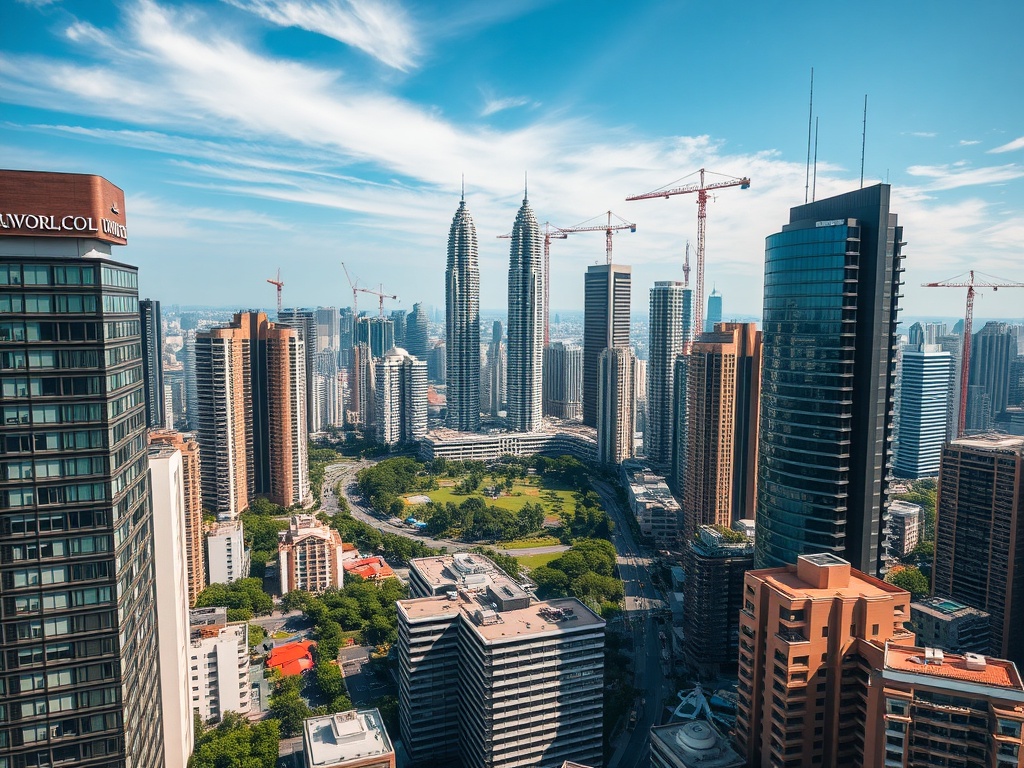
At the corner where Jalan Ampang meets Jalan P. Ramlee, metres from the perimeter of KLCC, there is a 1.6-acre plot that has remained on UEM Sunrise's balance sheet for years without generating any direct operational return. On 3 July 2026, that land ceased to be a dormant asset: the group signed a Development Rights Agreement with EXSIM KLCC Sdn Bhd that guarantees UEM Sunrise a consideration of RM415 million, plus participation in the future profits of the project. The mechanism chosen is not a sale, nor is it self-development. It is something more sophisticated, and it deserves to be read with precision before the corporate narrative simplifies it.
The structure rests on a legal instrument known as a Development Rights Agreement: UEM Sunrise transfers the development rights over Lot 149 to EXSIM KLCC, which assumes full responsibility for executing the project. In return, UEM Sunrise receives a guaranteed sum of RM415,016,784, payable in tranches documented in the Bursa Malaysia filing: 10% was already collected on 26 June 2026, a further 15% on 3 July, and the remaining 75% must be settled within three months, with the possibility of a two-month extension at 8% per annum. The development period is ten years from the receipt of full payment, with a target completion date of 31 December 2036.
What the corporate announcement presents as an act of "portfolio optimisation" is, in financial terms, a value extraction operation on a strategically located asset whose opportunity cost had continued to accumulate every quarter without activation.
The logic behind choosing not to build
Developing land in the KLCC corridor is not an exercise in ordinary skill. The regulatory complexity, capital intensity, product competition, and buyer demands in that segment mean that a mistake in concept or execution is extremely costly. UEM Sunrise, a group with a geographically dispersed portfolio and active projects across multiple growth corridors, would have faced a difficult question: allocate resources to develop a prime plot in an ultra-specialised market where it is not the operator with the greatest density of recent experience, or find a structure that captures the value of the asset without absorbing the burden of the risk of building it.
The choice reveals something about the group's self-assessment: UEM Sunrise knows that Lot 149 is worth a great deal. It also knows that building on that lot — and building it well — requires a type of execution capability in the premium KLCC segment that EXSIM possesses, and that UEM Sunrise does not need to develop if it can monetise the asset in another way. That distinction — between owning a valuable asset and being the best operator of that asset — is precisely where many property groups with large historical landbanks have historically destroyed value.
The Development Rights Agreement resolves that tension with structural elegance: the landowner captures value without assuming execution risk, and the developer with execution capability gains access to a plot that would otherwise never be available in that corridor. The profit-sharing mechanism adds an additional layer of relevance for UEM Sunrise: if the project exceeds valuation expectations, the group participates in the surplus. If the project deteriorates, the loss falls on EXSIM.
That asymmetry is precisely what distinguishes this structure from a straightforward sale. In a sale, UEM Sunrise would have collected a price and exited the game entirely. Here it collects a guaranteed floor and retains upside exposure. From a risk allocation perspective, it is a position that is not easily constructed in a standard negotiation, and it suggests that UEM Sunrise held sufficient market power over the asset to demand conditions that an ordinary seller would not obtain.
What RM415 million reveals about the financial architecture
The size of the guaranteed consideration matters beyond the absolute number. It must be read in light of what is absent from the agreement: UEM Sunrise commits no additional capital, assumes no construction debt, incurs no guarantee obligations to end buyers, and bears none of the construction cost risk that, in an inflationary materials environment, can consume between 15% and 25% of projected margin.
By transferring execution, UEM Sunrise converts an asset that was consuming implicit capital in the form of opportunity cost into a structured cash flow with defined dates. The 25% of the total, equivalent to more than RM103 million, should be in the company's accounts before the end of 2026. That is not a diffuse long-term commitment; it is liquidity with a timetable.
For a group that has been under pressure to demonstrate discipline in capital allocation, this type of structure carries an additional virtue: the money arrives before a single brick is laid. There is no pre-launch phase, no uncertainty about the pace of sales, no liquidity risk during construction. The certainty of income is almost total, at least for the guaranteed tranche.
The profit-sharing mechanism is less transparent in the available data. The exact formula has not been disclosed, nor has the profitability threshold that triggers UEM Sunrise's participation, nor the percentage it would receive. That opacity is not necessarily negative, but it does mean that the total value of the agreement — beyond RM415 million — is currently unquantifiable. For an investor evaluating UEM Sunrise, the floor is clear; the ceiling is not.
What can be inferred is that Lot 149 has a development value that comfortably exceeds RM415 million. Otherwise, the profit-sharing arrangement would lack economic rationale within the structure: EXSIM would not have agreed to pay that guarantee unless there was a reasonable expectation that the project generates sufficient returns to cover that outlay and produce a surplus. The implied valuation of the land and its development potential is therefore above the headline figure of the agreement.
The fragility that the agreement does not eliminate
A well-designed structure is not equivalent to zero risk. There are variables that remain outside UEM Sunrise's control and that deserve analysis.
The first is counterparty risk with respect to EXSIM KLCC. The 75% tranche, approximately RM311 million, falls due within three months. If EXSIM requires the two-month extension, it pays a financial cost of 8% per annum on that balance. That is manageable for EXSIM if the project has secured financing, but if the corporate credit environment in Malaysia contracts during that period, the delay in the final payment could generate cash flow pressure for UEM Sunrise at precisely the moment the group may be counting on that capital for other operational priorities.
The second risk is one of indirect execution: although UEM Sunrise is not building the project, its name appears linked to Lot 149 and to KLCC in the market's imagination. If EXSIM faces execution difficulties over the next ten years — significant delays or changes in concept that affect the perception of the project — UEM Sunrise's reputation in the premium segment becomes exposed by association. The Development Rights Agreement protects the balance sheet, but it does not fully protect the brand.
The third is duration. A development horizon extending to December 2036 is a long one, and UEM Sunrise's profit participation is tied to market conditions that no one can predict ten years in advance. If the premium KLCC segment experiences a sustained correction, projected surpluses are compressed and the variable portion of the agreement may turn out to be marginal or nil. In that scenario, the total value captured would be the guaranteed amount — which remains substantial — but the narrative of "participating in the upside" would be left without substance.
What the Malaysian property market learns from this transaction
Beyond the specific case, this agreement informs a dynamic that is repeating itself with greater frequency in markets where central land is scarce and development costs are absorbing margins that were once generous.
Groups with historical landbanks in premium locations are discovering that owning the land and being the best builder on that land are two distinct competencies, and that combining them is not always profitable. The separation between the asset owner and the execution operator allows each party to contribute what it genuinely controls: the former, the location and legal legitimacy; the latter, production capacity, contractor relationships, knowledge of the end buyer, and the management of construction risk.
This separation of functions, when structured with rigour, can generate better outcomes for both parties than vertically integrated development models in which a single company attempts to control the entire chain. The condition is that the Development Rights Agreement be designed with sufficient safeguards for the party ceding the right: defined payment timelines, penalties for non-compliance, minimum performance clauses, and clear criteria for the calculation of profit participation.
What UEM Sunrise has demonstrated through this transaction is that it understands the difference between owning a valuable asset and being the optimal vehicle for developing it. That distinction, when acted upon with sufficient foresight, converts land into capital without having to navigate ten years of first-person execution risk.
The structural quality of this agreement rests on three verifiable elements: the nominal guarantee is substantial, the payment schedule is specific, and the transfer of construction risk is complete. The elements that remain open — the profit-sharing formula and EXSIM's solidity in meeting the outstanding tranches — will determine whether this transaction moves from being a well-constructed decision to a well-executed one. For now, the architecture of the agreement withstands technical scrutiny without requiring any additional narrative.