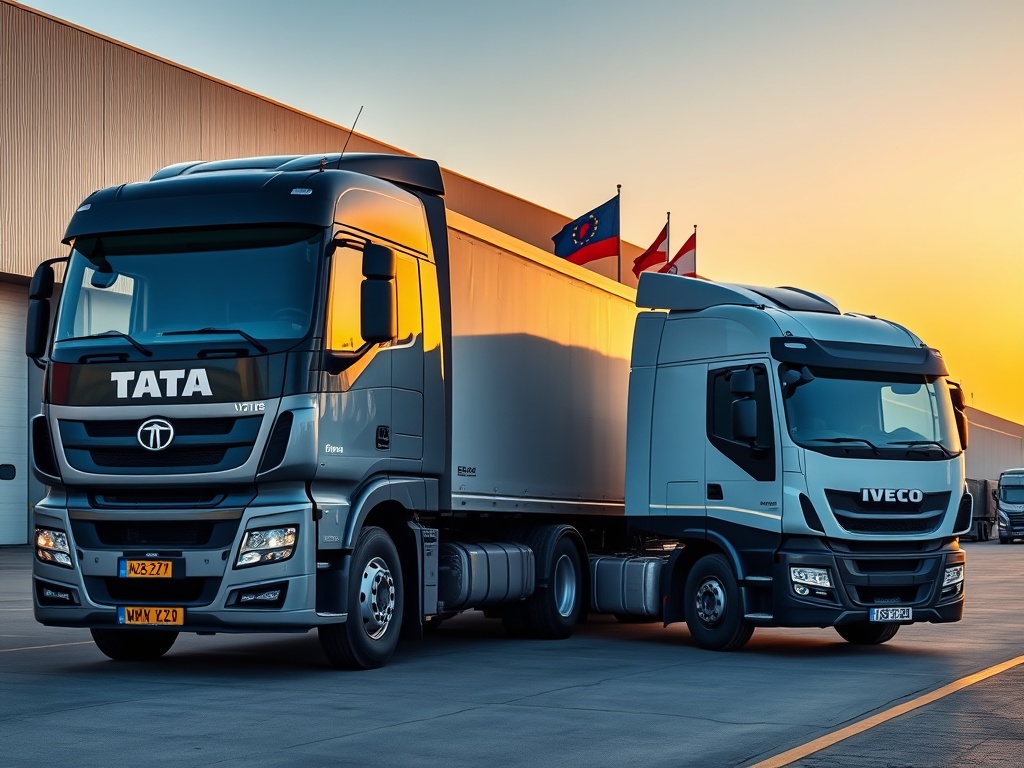

Tata Motors Bets $4.5 Billion to Stop Being a Regional Player
When Tata Motors announced in July 2025 the acquisition of Iveco Group's commercial vehicle business for approximately $4.5 billion in cash, the market reacted as it typically does in the face of moves of this scale: shares of the buyer fell nearly 4% on the BSE while those of the seller rose 7.4%. The short-term reading was predictable. The medium-term one, far more interesting.
This transaction is not a defensive bet or a reflection of domestic saturation. It is an explicit acknowledgment that the commercial vehicle category is in the midst of a sweeping global reconfiguration, and that staying out of Europe and Latin America — the two markets where Iveco has consolidated presence — would mean remaining trapped in the role of low-cost manufacturer for emerging markets at precisely the moment when the industry's technological barriers are rising sharply.
Girish Wagh, executive director of Tata Motors' commercial vehicle division, described it with precision to the press in Mumbai: the combination is "highly complementary." That word — complementary — carries far more strategic weight than it appears to. There is no significant overlap in geographies or portfolios. Where Tata dominates, Iveco barely exists. Where Iveco operates, Tata Motors has no network. That turns this acquisition into something rarer than the headlines suggest: a combination that does not need to destroy in order to generate value.
Geography as a Differential Advantage
The commercial vehicle business has a characteristic that distinguishes it from passenger cars: the service network and regulatory trust in each market are entry barriers that money alone cannot buy. Iveco has built those barriers in Europe and Latin America over decades. Tata Motors has built them in India, parts of Africa, the Middle East, and Southeast Asia. The intersection between both geographic footprints is practically zero.
That has a direct consequence: there is no need to choose between brands, platforms, or distribution channels. The combined portfolio can be deployed without the internal negotiations that typically paralyze industrial mergers during the first two years. There are no two teams fighting over the same customer. There are two distinct networks that can begin referring customers to each other from day one of integration.
Iveco's smallest product is the Daily, a commercial van. Below that segment, Tata Motors has a complete portfolio. Above it, Iveco has premium heavy trucks, buses, and mining dump trucks that currently do not reach the Indian market under competitive conditions. Wagh was direct on this point: those products "could be relevant for India." This is not a statement of aspirations. It is a product map that already exists and that today is being distributed in the wrong markets from the perspective of future demand.
This matters because India in 2026 is not the India of 2015. The government's infrastructure push — roads, ports, logistics corridors — is generating demand for technically more sophisticated heavy vehicles. The Indian customer operating truck fleets along long-distance corridors is today demanding safety standards, fuel efficiency, and connectivity that ten years ago were not purchasing conditions. Iveco brings that technology ready-made. Tata brings the market.
The Risk That Markets Are Mispricing
The 4% drop in Tata Motors' share price at the time of the announcement reflects a reasonable but incomplete reading. The market saw the size of the check — $4.5 billion financed with a one-year bridge loan backed by Morgan Stanley and MUFG — and applied the standard discount for leveraged acquisitions of this scale. That reading captures the refinancing risk but ignores the geometry of the transaction.
The most frequently cited precedent is the acquisition of Jaguar Land Rover for $2.3 billion in 2008. That purchase was also met with skepticism and was also financed under strained market conditions. The structural difference is that JLR was a loss-making business when Tata acquired it, with deteriorating brands and an organizational culture that took years to align. Iveco is an operating manufacturer with competitive technology platforms, a functioning distribution network, and an engine business — FPT Industrial — that gives it technical depth in emissions and electrification.
The real risk is not in the purchase price. It lies in two execution variables that the market can hardly price from the outside: the speed of the carve-out of Iveco's defense business and the integration architecture that Tata decides to implement once the transaction closes. The separation of the defense business is a condition precedent to closing; until that occurs, the transaction cannot be formalized. Regulatory delays in that carve-out — which involves sensitive assets in European jurisdictions — represent the most immediate risk vector.
On integration, Wagh was deliberately careful: Tata does not plan to move manufacturing from Europe to India. The logic is different. It is about redesigning supply chains, increasing the participation of suppliers in lower-cost locations — including Eastern Europe — and sharing investments in electrification, connected vehicles, and software platforms. That is a slower and more complex integration agenda than the simple consolidation of plants, but also more politically sustainable in a European context where trade unions hold real power over industrial change processes.
What This Move Reveals About the Industry
The acquisition of Iveco by Tata Motors carries a significance that goes beyond both companies. It is the clearest signal yet that the global commercial vehicle industry is entering a phase of accelerated consolidation driven by three simultaneous pressures.
The first is technological. Emissions regulations in Europe — Euro VII — and the push toward electric or hydrogen fleets require investments in platforms that no mid-sized manufacturer can individually amortize with its current volume. FPT Industrial, Iveco's engine arm, is precisely the type of asset that a mid-scale manufacturer needs to avoid becoming trapped into buying expensive technology from its own competitors.
The second is geopolitical. Global supply chains are being redesigned with resilience criteria that did not exist five years ago. A manufacturer with presence in India, Europe, and Latin America has a diversification of origin and destination that protects it from regional disruptions in a way that a manufacturer concentrated in a single bloc simply cannot replicate.
The third is structural demand. Emerging markets — India, parts of Africa, Southeast Asia — are in an infrastructure growth phase that will generate demand for heavy trucks for at least another decade. Developed markets are in a fleet replacement phase driven by environmental regulation. These are two distinct cycles, and having presence in both converts the combined company's sectoral exposure into something significantly less volatile than that of either party separately.
Tata Motors is targeting a 40% share of the domestic commercial vehicle market by fiscal year 2028. It has already recaptured ground in the heavy truck segment, where it reached its highest market share in a decade. Margins in the commercial vehicle division are at double-digit levels, both at the operating and EBITDA level. That is the financial standing from which a transformative acquisition is executed: with one's own muscle, not as a desperate exit.
A Bet That Changes the Playing Field
The global commercial vehicle industry has spent years looking at the same board: Daimler Truck, Volvo Group, Traton, Paccar. Manufacturers with scale, technology, and global presence built over decades. For an Indian manufacturer — even the domestic leader — that board had an implicit ceiling. The scale required to compete in emissions technology, long-range platforms, and global service networks was beyond organic reach.
The acquisition of Iveco does not eliminate that gap overnight. But it changes the playing field in an irreversible way. Tata Motors ceases to be a large manufacturer in emerging markets with global ambitions and becomes a manufacturer with real presence in three geographic blocs, with European-class technology, and with a distribution network in markets where it previously could not compete.
What precedes this move — and which very few analyses are taking into account — is the quiet work of the last five years within Tata's commercial vehicle division: margin recovery, launch of next-generation platforms, compliance with BS-VI emissions standards, and reconstruction of market share in the most profitable segment. Without that foundation, the acquisition of Iveco would be a capital bet built on fragile fundamentals. With it, it is the decision of a company that has already resolved its domestic challenge and now has the financial and operational capacity to execute at an entirely different order of magnitude.
The closing of the transaction is expected in the third quarter of 2026, subject to the separation of the defense business and pending regulatory approvals. What comes after will not be straightforward, but the structural logic of the combination is considerably more solid than what the market reflected on the day of the announcement. Companies that change categories rarely do so to immediate applause.