
Lavazza bets €1 billion in the U.S. with a capsule-free coffee tablet
The Keurig coffee maker has been installed in American kitchens for more than a decade as though it were part of the furniture. The K-Cup is convenient, compatible with dozens of brands, and available at Target, Walmart, and in practically every corporate break room in the country. Keurig Dr Pepper generated $3.99 billion in net coffee sales in its U.S. segment alone during 2025, with around 50% of the ground coffee capsule market. That is not a position; it is an infrastructure.
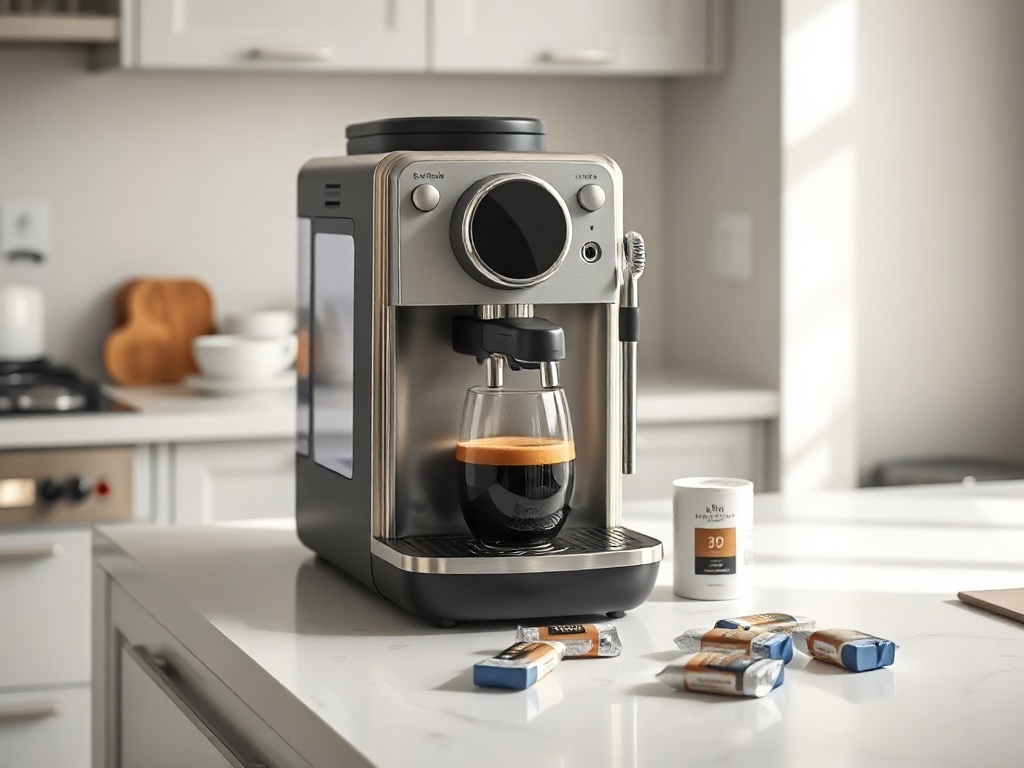
Against that backdrop, Lavazza has just announced that it will launch its own single-serve system in the United States in August 2026. Not an aluminum capsule like Nespresso. Not a plastic pod like K-Cups. A compressed tablet of pure coffee, with no coating, no binder, and no outer wrapping. The system is called Tablì, requires an exclusive Lavazza machine, and arrives backed by more than 15 patents, five years of industrial development, and a production facility specifically constructed for the format in Gattinara, Italy.
The group's chief executive officer, Antonio Baravalle, was explicit with CNBC: the company wants to build a €1 billion business in the U.S., and Tablì is the tip of the spear. To put that figure in perspective, Lavazza reported global net revenues of €3.9 billion and a net profit of €92 million in 2025. If that figure materializes in the North American market, the country would represent approximately one quarter of the group's current revenues, up from a much more modest position today: more than $100 million in annual sales through large-format retail distribution. The ambition is not incremental; it is structural.
The bet behind the format
Before analyzing whether Lavazza can win market share, it is worth understanding what the company decided to build and why that specific design matters.
The Tablì system was born from the acquisition of Caffemotive, an Italian startup purchased in 2020 that had developed the original concept of the coffee tablet. Lavazza spent five years turning that idea into a viable industrial process. The technical problem was not trivial: producing a pure coffee tablet dense enough to survive transport and handling, without protective capsules, without chemical binders, and that still functions consistently inside a pressure machine, required redesigning the logic of production from the ground up. Baravalle described it as "a very complicated industrial process." That kind of language from a CEO tends to be an understatement; in this case, the more than 15 patent registrations suggest the description is entirely literal.
What Lavazza obtained at the end of that process is not just a product that differs in shape. It is a bet on how the perception of value in the single-serve market will evolve. The tablet eliminates the element that has most eroded Keurig's reputation over the years: plastic waste. Keurig itself was the subject of an SEC sanction in 2024 over misleading statements regarding the recyclability of its capsules, which resulted in the payment of $1.5 million in penalties. The company's website today warns that its pods "are not recycled in many communities." Nespresso resolved part of the problem with an aluminum capsule return program, but neither system reaches the point that Tablì is aiming for: that the only waste material is used coffee grounds.
The sustainability thesis is not a layer of marketing added after the fact. It is the reason the format makes economic sense for Lavazza. An incumbent like Keurig has too much capital invested in its K-Cup infrastructure to abandon it, and any move toward cleaner formats would cannibalize its installed base of machines and its capsule supply chain. Lavazza does not carry that weight. It can arrive with a different architecture without destroying anything of significant value it already owns — at least in the U.S. market, where it does not yet control any relevant hardware infrastructure.
What the $100 million figure does not say about the system's economics
The figure of $100 million in annual U.S. retail sales that Lavazza currently handles appears solid in absolute terms, but it reveals a weak position in terms of business model. Today, those revenues come in part from coffee pods sold under the Keurig system — meaning Lavazza is competing on someone else's turf, under rules set by someone else, and with margins constrained by a contract that Baravalle himself described as "important" and one with which they are "very happy." That comfort comes at a structural cost: Lavazza does not capture the value generated by consumer loyalty toward a proprietary platform.
The Tablì model changes that equation if it works. The logic is the same one Nespresso has been executing for decades: the machine is the entry point, and the tablets are the recurring revenue stream. Once the consumer acquires the device, coffee spending migrates to a closed lane where Lavazza controls pricing, distribution, and experience. The captive consumable economics are structurally superior to competing on a supermarket shelf alongside dozens of interchangeable pod brands. The risk lies in the numerator: the installed machine base.
This is where reading the case demands more careful analysis than optimism. Keurig spent more than a decade building the density of installed machines that allows it to generate nearly $4 billion annually. Nespresso, with a much more focused premium proposition, holds around 7% of the pod market in the U.S. Lavazza is starting practically from zero in terms of domestic U.S. hardware, in a market where consumers already have machines at home and where switching systems involves an additional outlay for a new coffee maker. The Tablì introductory kit is priced at $99.99 and includes the machine, a milk frother, and 60 tablets. It is a reasonably well-designed entry point to reduce friction, but it does not guarantee sustained penetration.
What can be analyzed is the pace of financial effort that Lavazza is prepared to sustain. The 26.9% growth in North American billings during 2025 gives the group an internal argument to justify heavy investment, and Baravalle confirmed that the company has directed significant resources toward the U.S. market over the past two years, with plans to maintain that intensity for at least five more. With €92 million in net profit on €3.9 billion in revenues, Lavazza operates on tight margins for a company that wants to simultaneously finance expansion in its home market, a new production plant in Italy, and a long-term penetration campaign in the world's most competitive market. The margin for error on adoption assumptions is narrow.
The fragility the narrative does not mention
The most evident risk facing Tablì in the U.S. is not sustainability or the entry price. It is platform incompatibility in a market with a high installed base of rival machines. A consumer who already has a Keurig or a Nespresso at home has no immediate reason to replace it, unless Tablì's value proposition surpasses a perception threshold that justifies the cost and effort of switching. That threshold is higher than product launches typically acknowledge in their press releases.
The second vector of fragility is the dependence on a distribution channel that has not yet been confirmed at scale. The official launch in August 2026 begins with a presence on Lavazza's website and an arrival on Amazon later in the year. The company mentioned its presence in Target and Walmart, but there is no public confirmation that Tablì will have distribution in those chains in the short term. Building recognition for a new format, with a machine the consumer has never seen, through digital channels in a market dominated by the inertia of the K-Cup, requires a level of customer acquisition investment that the group's current numbers can barely support comfortably.
The third angle is the competitive response. Keurig has already announced its K-Rounds, a pod free of plastic and aluminum that uses a plant-based coating and was developed in partnership with Delica Switzerland. It is not a system identical to Lavazza's, but it directly attacks the same sustainability argument that Tablì wields as its differential advantage. If Keurig manages to reframe the sustainability narrative around its own pods before Tablì installs a critical mass of machines, part of Lavazza's differential argument evaporates without the quality of the product changing in the slightest.
None of this invalidates the bet. What it does is define the condition under which it works: Tablì needs American consumers to adopt the tablet not merely out of curiosity, but with enough conviction to invest in the hardware and maintain their purchasing habit. That conversion — not the launch — is the data point that will determine whether Lavazza is building an asset or financing an expensive narrative.
Lavazza is playing the long game, but time has a price
There is something structurally coherent in the way Lavazza arrived at this point. The acquisition of Caffemotive in 2020 was not a marketing move; it was the incorporation of a technical capability that subsequently required five years of real industrial development before seeing the light of day. That is not startup speed, but it is a sequence in which each step had to be resolved before the next one could begin. The investment in patents and in a dedicated plant indicates that the company is not betting on a product that can be imitated in 18 months with basic engineering. There is intellectual property, and there are physical assets that create friction for competitors.
The question the market will resolve over the next 24 months is whether the combination of sustainability proposition, espresso quality, and entry price is sufficient for Tablì to acquire critical mass before Keurig responds with its own plastic-free solution. The single-serve coffee business is, in essence, an installed-base business: whoever controls the machine in the home controls consumption for the years that follow. Lavazza knows this, and that is precisely why Tablì is not a line extension — it is an attempt to create a proprietary platform in adversarial territory.
The group's net profit margin, at around 2.4% on revenues in 2025, leaves little room to absorb prolonged years of losses in the U.S. without the rest of the business compensating. The €1 billion bet is real in terms of strategic intent, but the financial architecture sustaining it is tight. Lavazza is wagering that the pace of adoption in the U.S. will be sufficient to generate a return before the investment effort exhausts the balance sheet's capacity. It is a bet with clear logic, genuine proprietary assets, and a real competitive window — financed by a margin that does not forgive prolonged execution errors.