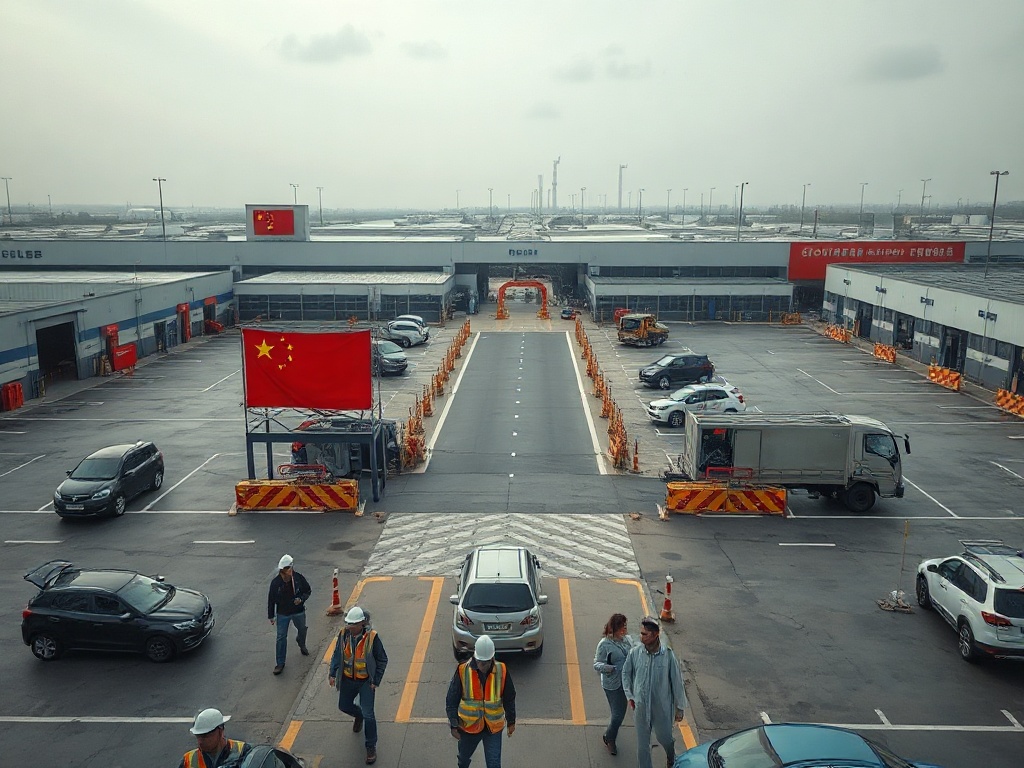

When European Factories Become China's Cheapest Asset
There is a pattern that repeats itself whenever an industry enters a forced transition: the assets that once defined the strength of a sector end up being acquired by those who arrived later, with less history and with structurally different costs. The European automotive industry is living through that sequence right now — not as a metaphor, but as a concrete movement of capital and productive capacity.
What the headline in The Telegraph captures — China taking control of Europe's decaying factories — does not describe merely a one-off transaction. It describes a mechanism that has quietly taken hold while the European public debate was revolving around tariffs, subsidies and the ban date for combustion engines. The plants that Nissan, Volkswagen and Ford cannot afford to keep running are being evaluated, acquired or absorbed by Chinese manufacturers who do not share that cost problem. And they are doing so, in many cases, with the implicit endorsement of the very European governments that need to justify those jobs to their electorates.
This is not a story about Chinese strategic malice or European incompetence. It is a story about incentives that all point in the same direction, and about what happens when the fixed assets of one technological era become stranded on the balance sheets of companies that can no longer make them profitable.
The Stranded Asset as an Entry Window
Chery Automobile took control of the plant that Nissan left behind in Barcelona. Volkswagen negotiated with trade unions over the closure of Dresden and Osnabrück — two plants that until recently manufactured the ID.3 and the T-Roc Cabriolet respectively — and openly signalled its willingness to sell Osnabrück to a Chinese buyer. Banking sources cited in Reuters reports estimate that these assets could sell for between 100 and 200 million euros per plant, figures that for a Chinese manufacturer with sufficient financial backing represent a fraction of the cost of building from scratch, complete with all the permits already in place, logistics infrastructure already installed, and above all, a skilled workforce immediately available.
The Chinese Chamber of Commerce in Berlin has already confirmed active interest in assets within the German automotive sector, describing the situation as a "long-term strategic investment opportunity." That description is not merely corporate optimism: it is an acknowledgement that the entry price into a Western-scale market is unlikely to be this low again.
To understand why this moment is specific, one must look at the structure of Europe's problem. Combustion engine plants cannot easily be converted to electric vehicle production without massive investment in tooling, assembly lines and supply chains. Volkswagen, which operates with average labour costs more than three times higher than those of its Chinese competitors, cannot absorb that reconversion across all its plants simultaneously while maintaining operating margins already under pressure. The result is predictable: the plants that are not part of the strategic core become available.
Chinese manufacturers, by contrast, are not arriving at those plants to produce the same things with different hands. They arrive with already mature electric vehicle platforms, battery supply chains that are either proprietary or contractually secured, and business models that do not depend on the margins that European manufacturers have historically sustained in the premium segment. They arrive, in many cases, prepared to produce at prices that no European manufacturer can match in mid-volume segments.
The Political Calculation That Makes It Possible
What makes this movement especially complex is not the industrial logic, but the political structure that sustains it. When a plant faces closure and a Chinese investor appears promising to maintain jobs, the decision-making framework of a regional or national government changes radically. The calculation shifts from "industrial sovereignty versus openness" to "closure and unemployment versus employment under a foreign flag." In that scenario, the second option wins almost every time.
The former chief executive of Stellantis described this mechanism with a clarity that is rarely heard in ordinary corporate language: the day a Western manufacturer finds itself in severe difficulty, with plants on the verge of closing and protests in the streets, a Chinese manufacturer will arrive offering to preserve the jobs and will be welcomed as a saviour. This is not a future hypothesis. It is a description of what is already happening in Barcelona and of what is being negotiated silently in Germany.
This pattern has a direct consequence on the structure of European negotiation. Every plant that is sold or leased to a Chinese manufacturer reduces the capacity of the European Union to apply restrictive trade policies without triggering domestic consequences. A tariff on electric vehicles manufactured in China has one effect; a measure that affects plants operating in Hungary, Spain or Germany with local employees carries an entirely different political cost. The industrial presence of Chinese companies on European territory is not merely a commercial strategy: it is a position on the regulatory negotiating board.
Chinese manufacturers know this. The decision to produce locally rather than export from China is not driven solely by the logic of avoiding tariffs, although that rationality does exist. It also responds to the understanding that a physical presence on European soil generates local political interlocutors, labour relationships that would complicate any restriction, and an institutional legitimacy that purely exporting manufacturers cannot build from the outside.
What the Incentives Reveal When They All Align in the Same Direction
The movement of Chinese capital into European factories does not occur in a vacuum. There are three forces converging simultaneously that together create a window unlikely to open again under the same conditions.
The first is the surplus of installed capacity in Europe for technology that no longer has a clear commercial future. Combustion engine lines, transmission systems and a large part of the manufacturing infrastructure of traditional manufacturers are either suboptimised or simply underutilised. Those assets retain value as physical infrastructure — buildings, logistics, electricity supply, rail access — even if they no longer have value as production lines for the products they used to manufacture.
The second is the structural cost advantage of Chinese manufacturers, which is not limited to lower wages at origin. Manufacturers such as BYD or Chery arrive with battery costs per unit of energy that are significantly lower than those of their European competitors, partly due to scale and partly due to vertical integration in the critical materials supply chain. That advantage does not disappear when they produce in Europe; it is partly transferred through the supply of components from China.
The third is the temporal asymmetry between European political cycles and Chinese investment horizons. A regional government facing elections in two years needs to justify employment today. A Chinese manufacturer with state backing can afford to hold a position that generates no return for a decade if the acquired asset has long-term strategic value. That difference in time horizon is not merely a financial advantage; it is a structural negotiating advantage.
When these three forces act simultaneously, the result does not require any malicious coordination or any explicit geopolitical strategy to produce the pattern that The Telegraph names in its headline. The incentives are already aligned. Rational actors do what those incentives tell them to do.
What becomes visible at the end of this analysis is a redistribution of value that is not being managed as such. Europe is ceding productive capacity, knowledge embedded in its workforce and positioning in the electric vehicle manufacturing chain in exchange for short-term employment stability and the avoidance of the political cost of closure. That exchange may be rational at the margin for each individual decision-maker. But its accumulation represents a transfer of strategic capacity whose total cost no one is measuring in consolidated form, and whose reversibility diminishes with every plant that changes hands.