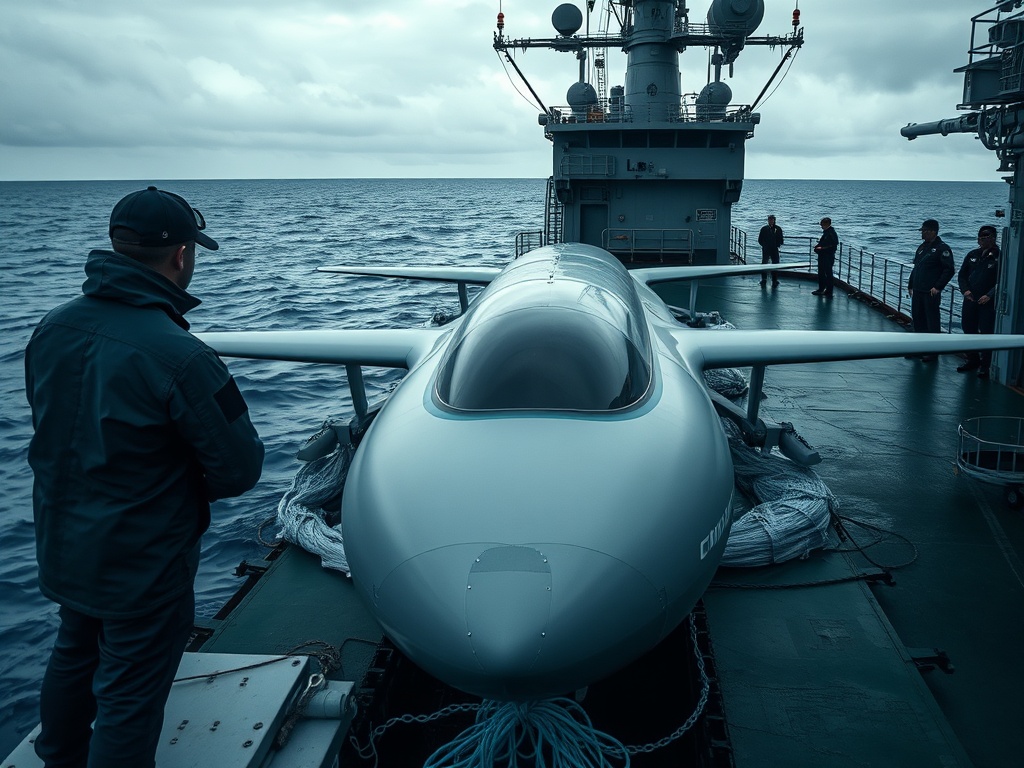

Unmanned Underwater Vehicles and the Adoption Problem AUKUS Didn't Name
On May 30, 2026, on the sidelines of the Shangri-La Dialogue in Singapore, the defense secretaries of the United States and the United Kingdom shared an unusual moment of institutional self-criticism. John Healey, the British Defense Secretary, said it without embellishment: "For too long in AUKUS, we talked too much and delivered too little." The phrase summarizes five years of a trilateral pact that promised to reconfigure the balance of power in the Indo-Pacific and that, up to that point, had produced more statements than operational hardware.
What follows that sentence is what deserves analysis. The three countries — the United States, the United Kingdom, and Australia — announced the first "flagship project" of AUKUS Pillar Two: a family of unmanned underwater vehicles with planned deliveries by 2027. The program encompasses multi-mission payloads designed for reconnaissance, strike, anti-submarine warfare, mine countermeasures, electronic warfare, and maneuvering in disputed littoral zones. Pete Hegseth, the U.S. Secretary of Defense, described it as a "highly adaptable" system that will maintain the "collective advantage in the maritime domain."
There is a technical and geopolitical story here that defense-specialized media will cover with precision. But there is another story, less often told, that lives in the gap between what this class of programs announces and what it actually produces in terms of operational adoption. That is the story that matters for understanding whether 2027 will be a milestone or a new iteration of the same pattern that Healey publicly acknowledged.
When Institutional Credibility Erodes Before the Product Arrives
AUKUS was born in September 2021 with two pillars. The first: nuclear-powered submarines for Australia. The second: shared advanced technologies — submarine systems, hypersonics, artificial intelligence, quantum computing, cyber capabilities. Pillar One generated an immediate diplomatic crisis with France, whose conventional submarine contract with Australia was cancelled, and has advanced within the expected margins for programs of this complexity. Pillar Two, by contrast, accumulated meetings, communiqués, and working groups without any system ever reaching the hands of any soldier.
This is not a minor detail. In the psychology of institutional adoption, the credibility of a program does not depend solely on its technical promise. It depends on whether the people who must adopt it — in this case, the naval forces of three countries with distinct operational cultures, separate chains of command, and budgets subject to different political cycles — have reasons to believe that this time will be different. Five years without tangible deliverables under Pillar Two do not generate abstract skepticism. They generate a learned pattern: the organization that repeats the announcement-without-delivery cycle trains its own operators not to reorganize their routines in anticipation of a capability that might never arrive.
Healey saw it clearly enough to name it. That is unusual for a sitting defense minister. And it is precisely the kind of diagnosis that needs to be accompanied by something more than a new delivery date if it is to change internal behavior. The question that official communiqués do not answer is whether the acknowledgment of past failure translated into a change in how this program was designed, or whether honest rhetoric was simply added to the same process that produced the previous results.
The Friction That Weapons Systems Share With Any Complex Product
Unmanned underwater vehicles are not conceptually new. Military navies have been operating autonomous systems in low-risk roles for decades: mine detection, seabed mapping, submarine infrastructure inspection. What has changed over the last ten years is the combination of autonomy, range, payload capacity, and tolerance to signal interference that makes these systems relevant for high-intensity combat missions. The leap from a support function to a reconnaissance and strike capability integrated into real naval operations is, in adoption terms, a categorical leap, not an incremental improvement.
That leap implies frictions that do not appear in press releases. The first is the friction of operational trust. A veteran submariner who has built their professional identity around the direct control of a platform — with all the sensory information that entails — does not adopt an autonomous system by decree. They need to understand its failure limits, its behaviors under ambiguous conditions, and how it interacts with their own tactical procedures. That understanding is not transmitted through a manual. It is built through real operating time, through errors that do not cost lives, and through the kind of accumulated trust that only repeated experience generates.
The second friction is systems integration. The announcement emphasizes the "adaptability" of the payloads, suggesting that the design prioritizes modularity over optimization for a specific mission. That makes sense from an acquisition perspective — a flexible system more easily justifies its cost before budget audits — but it introduces complexity in the field. An operator who needs to configure a system for a mine countermeasures mission one day and for littoral reconnaissance the next is not using two simple tools. They are using a platform that requires technical judgment for each configuration, raising the competence threshold necessary to extract value from the system.
The third friction, and perhaps the most underestimated, is geographic and institutional. Australia will operate these systems in the Indo-Pacific. The United Kingdom has interests in the North Atlantic and the South China Sea. The United States has simultaneous presence across multiple theaters. Tactical interoperability between three forces with distinct doctrines, communications systems, and classification hierarchies is not a technical problem solved by the fact that the three countries signed an agreement. It is a problem of operational standardization that requires joint exercises, shared data protocols, and agreements on who holds decision authority in mixed-crisis scenarios. None of those elements appear in the May 30 communiqué.
2027 as a Credibility Threshold, Not as a Destination
The 2027 date serves a function that goes beyond the acquisition calendar. It is a credibility management device. After five years in which Pillar Two delivered no tangible capabilities, setting a specific and near-term date has the effect of turning the program into a verifiable claim. In 18 months, either there is operational hardware in the hands of the three navies, or the pattern that Healey acknowledged repeats itself with an additional delivery of words.
From the perspective of behavioral economics applied to institutions, this is a high-visibility public commitment. Theory predicts that public commitments are more effective at generating compliance than private ones, because the cost of failing is twofold: the operational cost of not having the capability and the reputational cost of confirming that Healey's diagnosis was correct but the solution was insufficient. That double cost should, in theory, align the incentives of all parties toward effective delivery.
But there is a condition that the theory of public commitments does not automatically resolve: the commitment must be specific enough to be verifiable. "Deliveries from 2027 onwards" is a threshold that can expand in practice. An initial delivery of prototypes for evaluation in 2027 technically fulfills the promise. A full operational capability integrated into all three naval forces is something different. The gap between both interpretations is exactly the space where defense programs have historically lived, fulfilling the letter of their commitments while postponing the substance.
What would distinguish this program from that pattern is not the date itself, but whether behind it lies a delivery architecture that resolves the frictions named above. The communiqués describe the desired outcome with precision. What they do not describe — and this is structural, not a criticism of transparency — is the adoption process that converts delivered hardware into integrated operational capability. Those two moments are not the same moment.
The Seabed as Infrastructure and What That Changes in the Analysis
Healey added an element that tends to get lost in defense coverage oriented toward combat capabilities: the unmanned underwater vehicles will improve the ability of the three countries to respond to threats against submarine cables and pipelines. This paragraph deserves more attention than it receives.
Global submarine infrastructure — data cables, gas pipelines, energy cables — is one of the most critical and least protected assets in the world economy. A significant fraction of global internet traffic and international financial transactions depends on cables lying on the seabed, at depths that make continuous monitoring difficult and whose repair requires weeks even under ideal conditions. Incidents in recent years in the Baltic Sea and other regions have elevated the perception of vulnerability among governments and corporations that depend on that infrastructure.
This materially broadens the use case for underwater vehicles beyond high-intensity warfare. A system capable of patrolling cable corridors in the Indo-Pacific, detecting anomalous activity near critical infrastructure, and transmitting data in near-real time to analysis centers has value both in peacetime and in sub-threshold tension scenarios. That dual use — defense in wartime contexts, infrastructure protection in everyday contexts — is precisely the kind of value proposition that facilitates adoption because it solves problems that already exist today, not only those that might exist in a future conflict.
For governments that must justify spending before their legislatures, the ability to point to concrete and present use cases reduces the political friction that accompanies speculative defense programs. For telecommunications, energy, and finance companies that operate submarine infrastructure, it opens a conversation about what level of cooperation with government submarine surveillance programs makes commercial sense and under what conditions.
That demand vector — not war, but the protection of concrete economic assets — is what determines whether the underwater vehicle market grows within projected ranges or exceeds them. And it is the vector that industrial actors within AUKUS, from the major contractors to the providers of sensors and autonomy, should be articulating in their conversations with non-governmental customers.
What the Acknowledgment of Failure Reveals About the Underlying Problem
Healey's remark was not merely honest. It was an involuntary diagnosis of something deeper than delivery delays. Five years of talking more than delivering under Pillar Two are not explained by a lack of intention or resources. They are explained by the nature of the problem that pillar attempts to solve: coordinating advanced technological development between three countries with separate defense industries, distinct export controls, incompatible information classifications, and institutional cultures that have historically operated in parallel, not in an integrated fashion.
That structural friction does not disappear with a flagship project. What changes is the visible surface of friction. By designating a specific program with a concrete date, the three governments create a reference point that compels resolution of the problems of technology transfer, data sharing, and operational standards that could previously be deferred because there was no imminent delivery to make them urgent. The 2027 date does not eliminate the friction. It compresses it.
The pattern that multinational defense programs have historically followed suggests that this compression produces two possible outcomes. The first: the integration problems are resolved at the speed the date demands, which requires executive decisions that sacrifice technical perfection in favor of operational delivery. The second: the integration problems fragment the program into national components that each country delivers separately under the same label, losing the interoperability that gave the joint effort its value.
The difference between both outcomes is not decided in press releases. It is decided in the conversations that take place between acquisition officials and intellectual property lawyers in the weeks and months following the announcement. Those conversations are not public. But their results will be visible when 2027 arrives, and what they reveal will say more about AUKUS's capacity to function as an operative technological alliance than any ministerial statement.
The adoption of complex systems does not fail because the product is bad. It fails because organizations underestimate the work that occurs between the delivery of the hardware and the moment when that hardware changes what someone does on a Tuesday morning at sea. That work — of trust, of integration, of reconfigured operational habit — is what no communiqué can accelerate, and it is precisely what will determine whether the first flagship project of Pillar Two marks a before and after or simply adds one more chapter to a pattern that Healey already had to acknowledge out loud.