
The Drone Warfare is Won with Resilience and Mobility
Hoverfly and Overland AI are not merely merging two platforms; they are packaging a capability: aerial persistence supported by autonomous ground mobility. This combination fundamentally alters the operational economics of the battlefield and public procurement.
The unmanned systems industry has been competing for years in a showcase of specifications: greater range, more sensors, diverse modes, and lofty promises. In this arena, nearly all systems end up looking similar. The recent collaboration between Hoverfly Technologies and Overland AI, announced on March 11, 2026, is noteworthy for a different reason: it is reshaping the value curve with a new logic. This isn’t just about a new drone or a new vehicle; it’s about an integrated air-ground capability designed to endure, maneuver, and sustain operations in environments where GPS fails and human risk is high.
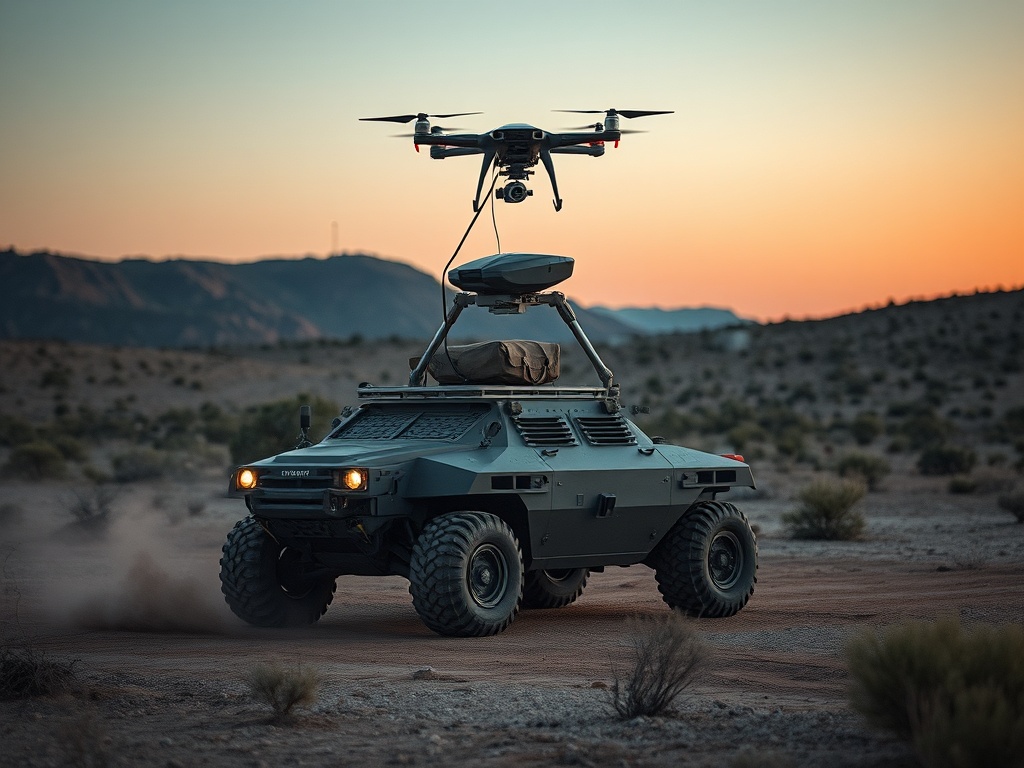
According to a press release from PRNewswire, the core of this integration combines Hoverfly's Spectre TeUAS (a tethered unmanned aerial system cleared by Blue UAS) with Overland AI's ULTRA UGV (an autonomous ground vehicle equipped with a power stack for navigation in unstructured, GPS-denied environments). The declared outcome is a mobile observation and communications node, offering aerial persistence and ground autonomy, designed for defense, national security, and government missions. The operational promise relies on two cost game-changers: the tether eliminates the typical airborne battery limitation, and the autonomy reduces the reliance on operators and "clean" routes on the ground.
This move is also backed by financial fuel. Overland AI recently closed a $100 million funding round, exceeding $140 million since its spin-off from the University of Washington in 2022 and reports over 100 employees along with a $2 million contract with the U.S. Army. Additionally, they have conducted demonstrations with units such as the 82nd Airborne Division and the Defense Innovation Unit, and also with CAL FIRE for fire mitigation. These are not lab tests; they are real-world scenarios where logistical friction, terrain, and timing immediately expose any over-engineered system.
The Value Proposition: Not Just a Drone or Vehicle, but Useful Time
Most executive teams in military and public robotics remain caught in the fetish of maximizing performance for each platform. This approach produces shiny catalogs and delicate operations. Here, the unit of value is different: sustained useful time with mobility. A tethered TeUAS like Hoverfly's aims to operate for “hours or days” with continuous power — something a battery-powered drone cannot achieve without rotation, recharge logistics, and windows of vulnerability. When that persistence is mounted on an autonomous UGV, the system transforms from a “fixed point” to an asset that advances with the operation, reinforces perimeters, extends communications, and maintains aerial and radio frequency surveillance above the terrain.
From a mission logic standpoint, this curves a cost that rarely appears in comparisons: the cost of interruption. Each battery drain, each platform handover, and each manual repositioning creates gaps in situational awareness and compels the exposure of personnel or manned vehicles. In the release, Steve Walters (CEO of Hoverfly) frames it as the need for autonomous systems “that work together, not in silos,” while Stephanie Bonk (co-founder and president of Overland AI) describes it as a “mobile overwatch and communications node” aimed at reducing risk and sustaining maneuvers. This choice of language is not aesthetic; it defines the product as a command, control, and protection function, not merely a reconnaissance toy.
The integration also introduces a tactical advantage highlighted in the communication: the ability to operate in a “RF-quiet” manner with continuous power through tethering. Without extrapolating beyond what has been published, the strategic point is clear: in contested environments, duration and operational discretion are more valuable than peak performance. Many organizations buy for the peak but deploy for the median. This package is designed for the tough median.
Eliminate and Reduce to Gain on the Ground
When I hear “air-ground integration,” many executives envision more complexity, more interfaces, and more training. The potential merit of this approach is quite the opposite: if executed correctly, it allows for eliminating friction and reducing operational burden.
Elimination begins with cutting the fantasy of drones as battery-consuming, short-flight consumables. A tethered system transfers part of the energy problem from “battery management” to “management of a cable and a support platform.” That is not free, but it is more manageable engineering when the objective is persistence.
Reduction means lowering the number of micro-tactical decisions that currently burden operators and commands: when to take off, when to land, when to rotate, where to recharge, who escorts, and who secures the launch point. On the ground, Overland AI’s autonomy is designed to navigate in unstructured, GPS-denied environments at “tactically relevant” speeds, according to their information. This theoretically reduces the need for perfect routes and constant teleoperation.
The classic risk is that integration turns into a fair of subsystems and permissions: connectors, compatibilities, updates, and certifications. Here comes an important data point for adoption: Hoverfly underscores its Blue UAS Cleared status, a filter that in the DoD world can be the difference between an “interesting demo” and a “repeatable purchase.” This is not about glamour; it’s about supply chain governance.
Simultaneously, Overland AI has recently completed the DARPA RACER program in November 2025, asserting that demand has shifted “decisively from experimentation to operational integration,” according to statements attributed to their executives in financing-related notes. This phase transition is what kills most startups: transitioning from tests to deployments with maintenance, field support, and training.
Capturing Margin is in the Deployment Architecture
If this collaboration remains a prototype, it is just another note. If it evolves into a standard deployment architecture, it changes how capacity is bought and sold.
In defense and security, margin is not captured solely in hardware; it’s captured in repeatability: manufacturing, support, training, integration with command and control, and a maintenance model that does not collapse under mud, vibration, and connectivity failures. In the available material, Overland AI indicates that it will use the $100 million to scale ULTRA production, research, manufacturing, field support, and operational integration. This breakdown reveals mature decision-making: the bottleneck is not the demo; it’s the deployment chain.
Hoverfly, for its part, does not publish financial figures in the cited sources, but its position as a U.S. manufacturer of TeUAS for persistent ISR, communications, and force protection suggests that it understands the pain of the government customer: continuity, certification, and operational availability.
The interesting aspect is how this combination could reorder budgets. Instead of purchasing “a UGV” and “a UAS” as separate lines, the buyer could start buying a function: enhanced perception and mobile communications link. This shifts the conversation from specifications toward mission outcomes. And that’s where many incumbents fail: they are optimized to sell components, not to own operational results.
In the public sector, this can also shift the debate toward contracts that reward availability time and performance in the field, not just equipment delivery. I do not assert this as a fact from the announcement; I note it as the natural direction when the product is formulated as a persistent capability. The organization that dares to package “hours of overwatch with mobility” as a commercial unit creates a fresh comparison and leaves competitors fighting in an outdated catalog.
Non-Clients Are Outside the Front
The news is communicated from defense, national security, and government perspectives. But demonstrations with CAL FIRE open up a demand map that the industry tends to treat as “secondary”: civil emergencies where aerial persistence and ground mobility are valuable for coordination, safety, and continuity.
A TeUAS mounted on an autonomous UGV can function as a communications and observation point in fires, natural disasters, critical infrastructure surveillance, or high-risk events where human exposure must be minimized. There’s no need to embellish it: when there’s smoke, power outages, incomplete roads, and a need to maintain perimeters, the “short battery-powered drone flight” turns into an interruption routine. Persistence changes that pattern.
The strategic twist here is recognizing that many “non-clients” reject unmanned systems not out of lack of interest but due to hidden costs: training, battery logistics, coordination of multiple teams, flight permissions, and the burden of maintaining stable operation for hours. If integration can reduce those frictions, the market expands to actors who currently cannot afford a dedicated drone unit.
Now, there’s also the opposite risk: over-service. If the package becomes so militarized, heavy, or expensive that it only serves a minority, it locks itself into a niche of large budgets. The winning design is one that maintains focus on the function: persistence and mobility with minimal complexity. There’s no glory in selling a spacecraft when the customer needed continuity.
Executive Boldness is About Removing Pieces, Not Adding Catalogs
This announcement points in the right direction: integrating air and ground to enhance reach, sustain communications, and reduce human exposure. But success is not decided by the press release; it’s determined by the mud. The operational metric will be sustained availability in scenarios where GPS, connectivity, and time work against you.
For C-Level executives, the lesson is uncomfortable and pragmatic. In saturated platform markets, differentiation appears when standard variables that inflate costs and training are eliminated, and value units that the buyer can contract, measure, and repeat are created. The innovation that defends itself is not the one that accumulates functions but the one that makes previous comparisons obsolete.
Executive leadership is measured in field validation and repeatable adoption, not in burning capital to fight for crumbs in a catalog full of options.