
Robot Legs for $2,500 and What That Tells the Humanoid Market
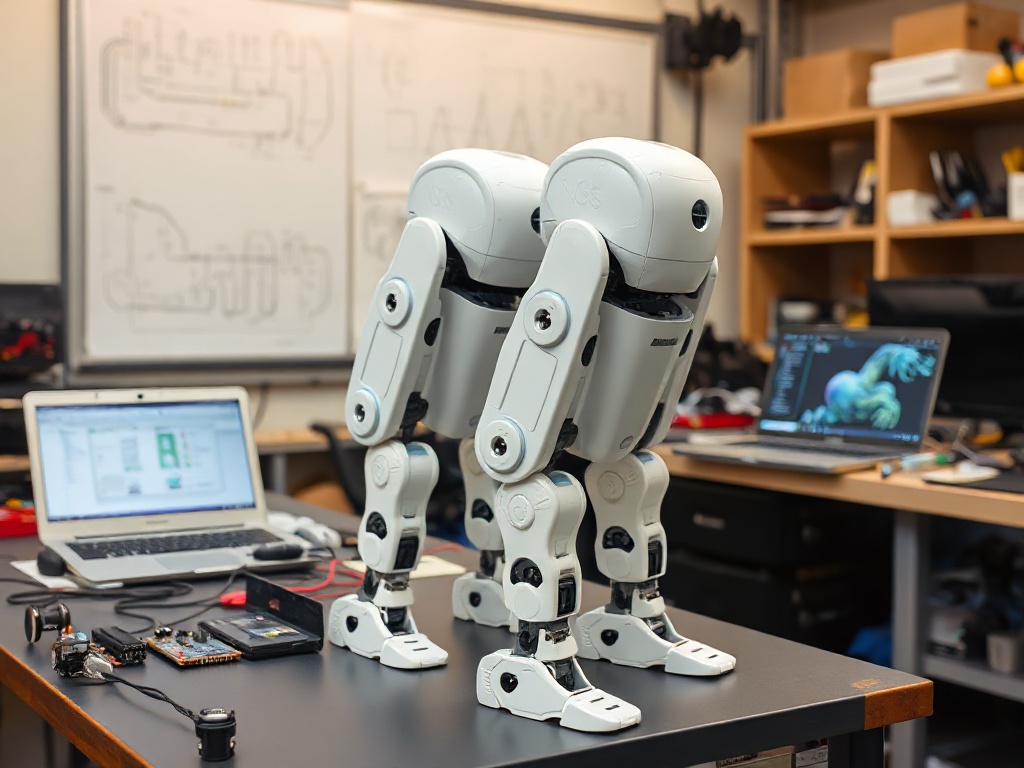
Hugging Face has just published the blueprints, wiring diagrams, and software to build a pair of humanoid legs for approximately $2,500 in parts. There is no arm, no torso, no head. Just 3D-printed bipedal legs assembled from off-the-shelf components. The project is called LeRobot Humanoid, and its primary value lies not in what walks, but in what it unlocks for any laboratory that today cannot afford to pay six figures for a proprietary platform.
The question this opens is not a technical one. It is structural: when an artificial intelligence platform decides to lower the hardware entry cost for robotics to a price equivalent to that of a mid-range laptop, it is moving a piece on the board that does not move by generosity alone. There is mechanics behind it.
The Open Model as a Data Flow Capture Strategy
Virgile Batto, the Hugging Face engineer leading the project, was explicit in the launch blog post: "If you're looking for the most advanced humanoid robot, this is not it. If you're looking for one you can build, understand, repair, instrument, simulate, and use for learning experiments, this is the robot we are trying to make." That sentence is not corporate humility. It is market positioning with surgical precision.
The design encompasses 3D printing files, a bill of materials, wiring diagrams, assembly instructions, and above all, software tools to calibrate and control the robot both in the physical body and in simulation. That last element is where the real strategic value is concentrated. Hugging Face is not selling hardware: it is building the convergence point between simulation and physical experimentation, and it is doing so in a way that whoever adopts the platform ends up inside the Hugging Face ecosystem of tools for training, documenting, and sharing robotic control policies.
The flow of value here does not circulate through the sale of parts. It circulates through the models, the datasets, and the experimental results that thousands of researchers and laboratories are going to generate on this platform, and which will very likely end up hosted, published, or refined within the Hugging Face infrastructure. It is the same pattern that worked with language models: offer the open platform, concentrate community activity at a single point of knowledge accumulation, and scale from there toward higher-margin services.
What Hugging Face is building with LeRobot Humanoid is not a robot. It is a mechanism for aggregating training data in the physical world, financed in large part by the R&D budgets of those who build and experiment with the device.
Where Value Is Distributed and Who Absorbs the Invisible Cost
The price of $2,500 is the materials cost for whoever assembles it. Hugging Face does not charge for the blueprints or the software. That is deliberate. The real cost of the project is distributed among those who adopt it: laboratories and startups pay in engineering time, in components, in electricity, in hours of experimentation. In return, they generate data, develop control algorithms, and in many cases publish those results openly on the Hugging Face infrastructure.
This distribution has an asymmetry worth naming. Smaller adopters — university groups, laboratories with limited budgets — capture the value of accessing a platform that would otherwise be out of their reach. The access is genuine and the benefit is real. But the accumulation of knowledge derived from that access tends to concentrate in whoever designed and maintains the central infrastructure. There is no extraction in the classical sense, because no one is being stripped of something they already had. But there is a structure of incentives in which the principal long-term beneficiary of the distributed work is the platform that aggregates it.
This does not invalidate the model. It defines it. And it is important to follow it before judging it.
Hugging Face is also building a tiered price portfolio that reveals the logic more clearly. Reachy Mini sells for $299 and targets expressive interaction with people. HopeJR, developed with the French company The Robot Studio, targets a humanoid robot with 66 degrees of freedom at a target price of $3,000. LeRobot Humanoid fills the space of affordable bipedal locomotion. Three platforms, three entry points, three vectors of data accumulation and community activity built on the same central infrastructure.
CEO Clement Delangue has said publicly that the goal of open robotics is to counteract the concentration of capabilities in large proprietary companies. That narrative is consistent with the facts of the launch. But it also describes the mechanism by which Hugging Face positions itself as the central alternative to those companies, which has its own consolidation logic.
The Market This Bet Targets from the Base
The market context makes the move more legible. According to a McKinsey report from April 2026, a commercial humanoid robot costs between $30,000 and $150,000 per unit while companies are still building their supply chains. Venture capital funding in robotics exceeded $40 billion in 2025, more than triple that of 2023. Unitree Robotics, one of the most aggressively priced Chinese companies, sells models for under $20,000 but reported a 53% decline in first-quarter 2026 profits, despite 68% revenue growth. The price war in the humanoid segment is already underway and is compressing margins before the market has even matured.
In that context, Hyundai Motor Group is reportedly advancing plans to produce Boston Dynamics' Atlas robot at its electric vehicle plant in Georgia, with plans for a facility capable of producing 350,000 robotic actuators annually. The manufacturing infrastructure for humanoids is being built at industrial scale.
What Hugging Face understands is that this race toward mass manufacturing is going to require robust control algorithms, tested under varied conditions, trained on millions of hours of real physical interaction. Whoever controls the infrastructure where those algorithms are developed and shared holds a strategic position that does not depend on winning the hardware price war. It is an upper-layer move: you do not compete at the chip level, you compete at the model level that runs on top of the chip.
The risk of the model does not lie in direct competition with Boston Dynamics or Unitree. It lies in whether the community that adopts LeRobot Humanoid produces results good enough for larger commercial players to want to incorporate them, and whether Hugging Face can capture part of that value when that happens. Open blueprints guarantee adoption, but they do not guarantee that the value generated returns to the platform in a sustained way.
The Tension the Launch Has Not Yet Resolved
The model has a structural fragility that the enthusiasm of the launch has not yet made visible. Hugging Face is betting that opening up the hardware generates enough community activity to consolidate its position as the reference point for open learning robotics. That bet makes sense in the academic segment and among early-stage startups. But as the humanoid market matures and actors with greater manufacturing capacity drive down costs, the relevant question will be whether the companies that scale up will continue to build on the Hugging Face infrastructure or will migrate toward proprietary stacks with greater vertical integration.
The track record of open platforms in other sectors suggests that retaining medium and large actors requires something more than free access. It requires the central platform to offer capabilities that those actors cannot replicate internally at a lower cost. For now, Hugging Face holds an advantage in the critical mass of AI models and tools. If that advantage is maintained when physical robotics enters its industrial maturation phase, the model is solid. If the major players in the sector decide to build their own training and data infrastructures, Hugging Face will have accelerated the market's learning curve without retaining a corresponding share of the value generated.
The launch of LeRobot Humanoid is, for now, a well-designed bet for the early phase of the market. The low entry cost attracts the actors who are going to generate the most data over the next two to three years. The integration between simulation and physical hardware gives Hugging Face a differentiated position relative to platforms that only operate in one domain. And the narrative of openness against corporate concentration is credible enough to sustain adoption without sounding like empty marketing.
What the launch does not yet answer is what that model looks like when humanoids stop being research and become productive infrastructure. That is the moment when the distribution of value between the central platform and the actors who built on top of it will be renegotiated, and by then Hugging Face will need something more than open blueprints to remain at the center of the system.