
The Robot That Beat Kiplimo Reveals Honor's Most Expensive Bet
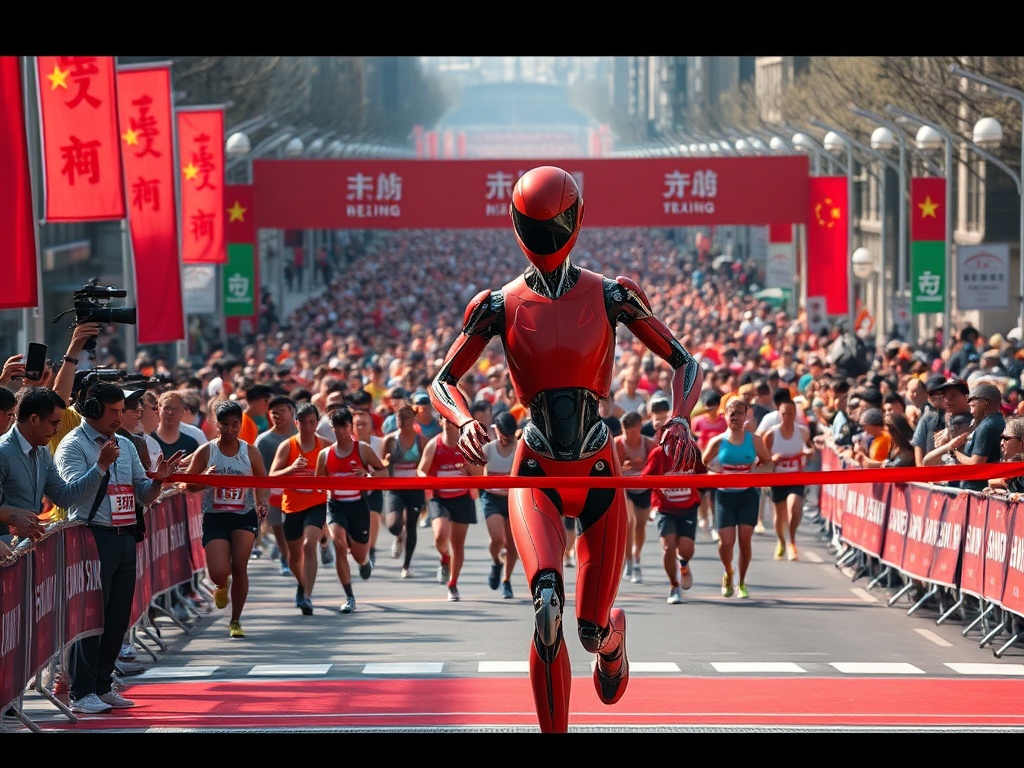
On April 19, 2026, in the corridor of the Beijing Economic-Technological Development Area, a deep red robot called Lightning crossed the finish line of a half marathon in 50 minutes and 26 seconds. It surpassed the human record of 57 minutes and 20 seconds set weeks earlier by Ugandan athlete Jacob Kiplimo in Lisbon. The 12,000 human runners sharing the event needed more than an hour. CCTV cameras broadcast it live. Coverage was enthusiastic and global.
What did not appear in that coverage was the financial mechanics behind the achievement: Honor, a smartphone brand, had just executed a demonstration of robotic capability in front of Chinese state media, investors, and potential industrial clients. That spectacle comes at a cost. And understanding who finances it — and with what logic — is precisely the exercise that any business leader should undertake before applauding.
From Selling Screens to Building Legs
Honor built its reputation on mass-market consumer hardware: smartphones, tablets, accessories. Its engineering has solid roots in thermal management and miniaturization, which explains a technical detail that went almost unnoticed in the reports: Lightning's joints incorporate a liquid cooling system adapted directly from smartphone technology. This is not a metaphor for technology transfer; it is literally the same heat dissipation principle that prevents a mobile processor from melting under sustained load, now applied to motors that must maintain cadence for 50 continuous minutes.
That reuse of existing engineering is not a minor detail from a financial standpoint. It means that Honor did not start from zero in R&D for robotics. Part of its investment in robotics amortizes intellectual and physical infrastructure that was already depreciated or in active use. That compresses the marginal cost of entering the segment, although it does not eliminate it.
The strategic move has a clear logic: Honor is diversifying its revenue base in a smartphone market that, in China, faces saturation and severe competitive pressure. Beijing E-Town, the technology park where the race took place, is not a neutral backdrop: it is a hub with government incentives, access to public financing, and political visibility. The simultaneous coverage by China Daily, Global Times, and CCTV is not a coincidence; it is the architecture of a launch backed by state narrative.
What Those 50 Minutes Do Not Measure
Lightning won with autonomous navigation. But there is a data point in the report that deserves sustained attention: a second Honor robot, controlled remotely, completed the course in 48 minutes and 19 seconds — two minutes faster. However, the event rules prioritized autonomy in the scoring system, and Lightning took the recognition.
That distinction is not merely procedural. It is the difference between a robot that requires a human operator in real time — with all the communication infrastructure costs, latency, and personnel that entails — and one that makes its own decisions on uneven terrain. For any industrial client evaluating these systems, autonomy is not a marketing feature; it is the variable that determines whether the operational cost per unit makes sense at scale.
That said, Lightning also fell near the finish line after colliding with a barrier and required human assistance to recover and continue. That incident, recorded and reported, is the most honest metric of the current state of development: autonomy functions under controlled conditions, but resilience in the face of unanticipated events remains the bottleneck. For a company seeking contracts in logistics, manufacturing, or public spaces, that gap between demo and mass deployment carries a price that has yet to be quantified in any official communication.
The year-over-year performance leap is, however, real and impressive. The winner of the inaugural edition of this same race finished in 2 hours, 40 minutes, and 42 seconds. A year later, Lightning cut that time by more than two hours. That improvement curve cannot be explained by engineering alone; it also reflects accelerated iteration financed with capital whose source matters more than its volume.
The Moment When the Spectacle Must Become an Invoice
This is where the sports story becomes a business diagnosis. Honor has not announced any commercial contracts derived from Lightning. There are no robotics sales figures, no confirmed industrial clients, no projected revenue from the segment. What exists is state coverage, a finish-line video, and the echo of a well-executed public relations feat.
That is not inherently criticizable. Capability demonstrations are a legitimate market development mechanism, especially in categories where the client needs to see before committing budget. But there is a time window between the demo and the contract, and that window carries a daily cost. Every month that Lightning runs without any client paying for its capabilities is a month in which spending on R&D, manufacturing, testing, and events like this one generates no return.
The signal that business leaders should read here is not technological. It is financial: Honor is in the phase where expenditure precedes revenue by a margin that has not yet been publicly disclosed. State coverage suggests that part of that margin may be subsidized by Chinese industrial policy, which completely changes the sustainability analysis of the model. A company that advances because its clients pay has a very different architecture from one that advances because the State propels it. Both can win races. Only one of the two survives when the political or budgetary winds change.
Lightning beat Kiplimo on the clock. The next record that Honor needs to break is harder to photograph: the time it takes for an autonomous robot to pay for its own development through revenue from real clients. Until that number appears in a financial report, the most important race is still running.