
Motorola in India went from 2.5% to 8.5% market share in three years. This is what is moving that number
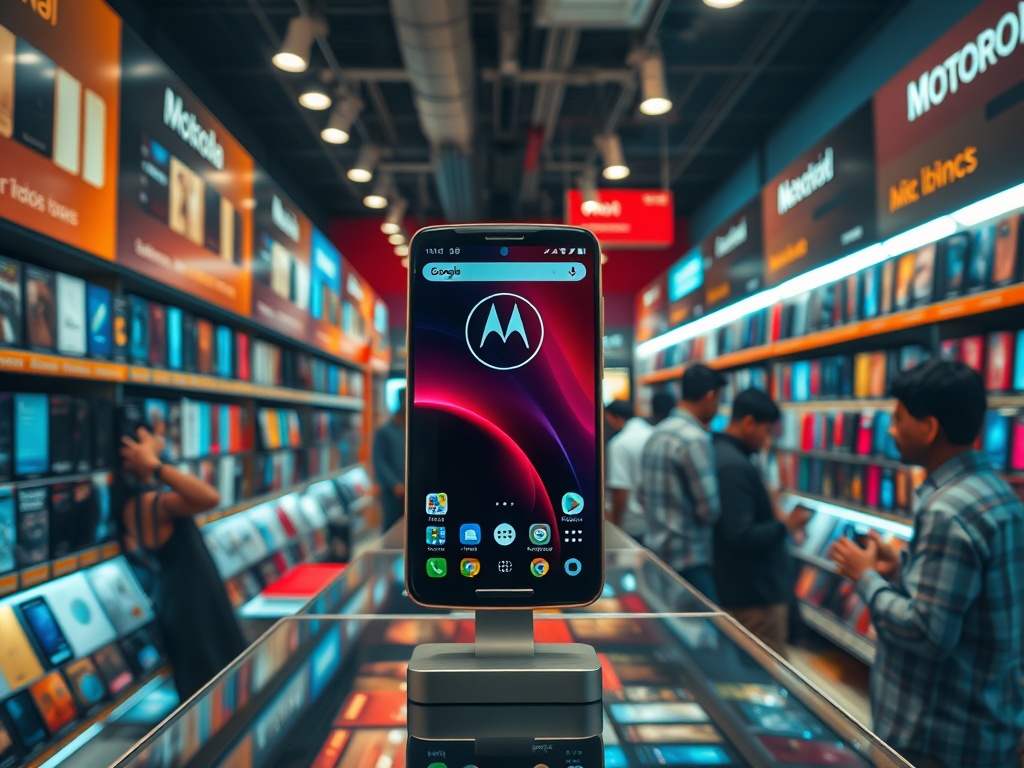
There is a difference between growing in a market and changing position within it. Motorola has just demonstrated that both things can happen at the same time. According to statements by T.M. Narasimhan, Managing Director of Motorola India, the company went from controlling 2.5% of the smartphone market in India three years ago to the current 8.5%, with expectations of continuing to advance. The figure is not just a commercial achievement: it is the symptom of a deeper reconfiguration in how value is distributed within one of the most competitive consumer markets on the planet.
India is, by volume metrics, a battlefield where margins are compressed by design. The market is today worth approximately 44 billion dollars and is projected to reach nearly 89 billion by 2032, with annual growth of 8.1%. That expansion does not occur on open ground: it occurs on a board where Vivo controls 17% of the market, Xiaomi 15.5%, Realme 11.8%, and Samsung 11.7%. Moving three percentage points in that environment requires something more than advertising. It requires that the value distribution model works in a way that competitors have not yet replicated, or have not wanted to replicate.
The geometry of growth that Motorola does not explicitly name
The most revealing piece of data from Narasimhan's statements is not the market share percentage. It is the composition of revenues. Three years ago, the Edge and Razr series represented a single-digit percentage of Motorola India's total billing. Today they represent between 55% and 60%. That shift toward the premium segment is not a portfolio accident: it is the decision of where value is captured.
In high-volume markets like India, the usual logic for recovering ground is to lower prices and defend participation in the low-end segment. Motorola did the opposite, or more precisely, did both things at the same time without sacrificing either one. It maintained a presence in the G series, which gives it volume and presence in offline channels, and simultaneously pushed upward with Edge and Razr. The result is an average selling price that rises without total volume falling, which explains the business growth that Narasimhan describes as 3 times in two years and 10 times in five years.
This structure has a specific mechanics that is worth decomposing. When a brand manages to take its premium segment from single digits to representing more than half of revenues, it fundamentally changes the internal distribution of value. Distributors have more margin per unit in the high end. Offline points of sale have an incentive to actively recommend the product. The consumer who buys an Edge or a Razr builds a relationship with the brand that someone who buys an entry-level G does not build. The entire system begins to function with a different gravity, because the incentives to remain within it become stronger for every actor.
The 53% year-on-year growth in shipments that Counterpoint Research recorded for Motorola in the third quarter of 2025 coincides exactly with the period of greatest expansion of the offline channel in India, which went from representing 48.3% to 56.4% of the market. It is not a coincidence of timing: it is the evidence that Motorola's strategy bet on the channel that was gaining weight while its Chinese-origin competitors continued optimizing their models for the online channel.
What the Razr Fold reveals about the long-term bet
The launch of the Motorola Razr Fold in India is not just the company's entry into the foldable phone segment. It is a signal about how Motorola understands the distribution of value between form, function, and brand perception. Narasimhan acknowledged that the device is being imported for now, and that local production will depend on demand and market acceptance. That caution is, in itself, a strategic posture: not committing fixed capital before validating demand.
The foldable phone segment in India is marginal in volume but not in signal. Samsung and Huawei have fought that space for years with mixed results in terms of mass adoption. Motorola enters with the Razr, which has a historical advantage of brand recognition in that specific format, and does so at a moment when the Indian premium market is growing structurally. The average selling price of smartphones in India has risen steadily, and Narasimhan himself acknowledged that Motorola has already increased prices by between 30% and 45% across various models due to rising memory and component costs.
That price increase, far from being an isolated risk, is part of an industry context that affects all competitors equally. Memory shortages and rising costs do not discriminate between brands. What does differentiate companies is whether they have sufficient brand positioning to pass those costs on to the consumer without losing volume. Motorola, with its repositioning toward the mid-to-high and premium range, is in a better position to absorb that pass-through than a brand that competes primarily on price in the low end. A brand that lives in the 8,000 to 12,000 rupee segment cannot raise prices by 30% without destroying its value proposition. A brand with an established presence in the 25,000 to 50,000 rupee segment has more room to maneuver.
The model that can still break
Describing Motorola's growth without pointing to the tensions that accompany it would be an incomplete analysis. The current structure has at least two fragility points that deserve attention.
The first is the dependence on a favorable macroeconomic context. The smartphone market in India grew exceptionally in the third quarter of 2025, driven by the festive season that historically concentrates demand. Counterpoint described that period as the highest in five years. Motorola captured part of that tailwind. The problem is that the 53% year-on-year growth built on an exceptional festive quarter carries no guarantee of repeating itself in ordinary quarters. If aggregate demand normalizes or falls — which is plausible given the generalized price increases that Narasimhan anticipates for the sector — Motorola's growth will have to be sustained by its own fundamentals and not by the tide effect.
The second fragility point is structural and has to do with the offline channel. Motorola benefited from the shift toward that channel, but that channel has its own profitability requirements. Offline distributors in India operate with considerable fixed-cost structures and require margins that the online-first models of Xiaomi or Realme were not obliged to sustain. If Motorola wants to maintain its position in that channel as it scales, it will have to guarantee sufficient margins per unit or sufficient inventory turnover. Both things depend on the product mix continuing to tilt toward the high end. If the mix retreats toward the low end due to competitive price pressure, the offline channel will lose the incentive to prioritize the brand.
The alliances with Swarovski, Bose, Pantone, and Corning that Narasimhan mentioned are signals that Motorola is investing in brand perception to sustain that mix. Those associations are not decorative: they are attempts to anchor the brand's identity in attributes that justify higher prices to a consumer who has abundant options in every segment. The risk is that those alliances function as marketing narrative without translating into real preference at the point of sale. The proof of their effectiveness lies not in the press release but in whether the 30,000-rupee consumer chooses an Edge over a Samsung or a Vivo when the salesperson is not actively pushing any particular brand.
The distribution of value that decides whether the model holds
Motorola's growth from 2.5% to 8.5% in three years is a result, not a guarantee. The relevant question for evaluating its sustainability is not whether the brand grew, but whether the system of actors that made that growth possible has the incentives to remain cohesive.
What the case shows, when examined carefully, is that Motorola built a model where value is distributed in a reasonably functional way among the principal actors. Offline distributors earn more margin per unit in the high end than in the low end. Consumers in the mid-to-high segment receive a differentiated proposition that does not compete on price alone. The brand recovers positioning in a segment that allows it to pass on costs without destroying volume. Lenovo, as the owner, sees the Indian business grow in a market that represents one of the greatest expansion opportunities in the region.
That alignment is not permanent by nature. It depends on Motorola continuing to be capable of launching products that justify mid-to-high price points, on the offline channel maintaining its relevance in the face of e-commerce platforms that may regain ground, and on competitors with considerably greater resources — Vivo and Samsung in particular — not deciding to defend their position with a price aggressiveness that Motorola cannot sustain.
The model is working. It is not yet bulletproof. And the difference between those two conditions is what the next four quarters are going to reveal with far greater precision than any executive statement.