
Apple Took Seven Years to Fold the iPhone — and That's Why It's Going to Win
In 2019, Samsung launched the Galaxy Fold on the market and the screens were breaking within two days. Huawei responded with the Mate X, an aggressive bet from a geopolitically complicated flank. Google entered in 2023 with the Pixel Fold, decent but unconvincing. Throughout all that time, Apple launched nothing. No leaked prototype that survived testing, no rushed release to avoid missing a news cycle. Seven years of operational silence that, from the outside, looked like inaction and, from the inside, were anything but.
What Bloomberg today describes as "the most significant redesign in the history of the iPhone" was not born in a creative lab with colorful walls and whiteboards covered in post-its. It was born from a portfolio decision: Apple chose not to scale this bet until it had resolved the engineering that makes scaling it worthwhile.
The Problem Nobody Wanted to Solve Before
The foldable phone market has a structural flaw that everyone knows about and few have tackled head-on: the visible crease in the screen. It is not a minor aesthetic problem. It is the most physical signal that the product is not ready yet, the wrinkle that reminds the user every time they open the device that they are paying more than a thousand dollars for something that is still a promise.
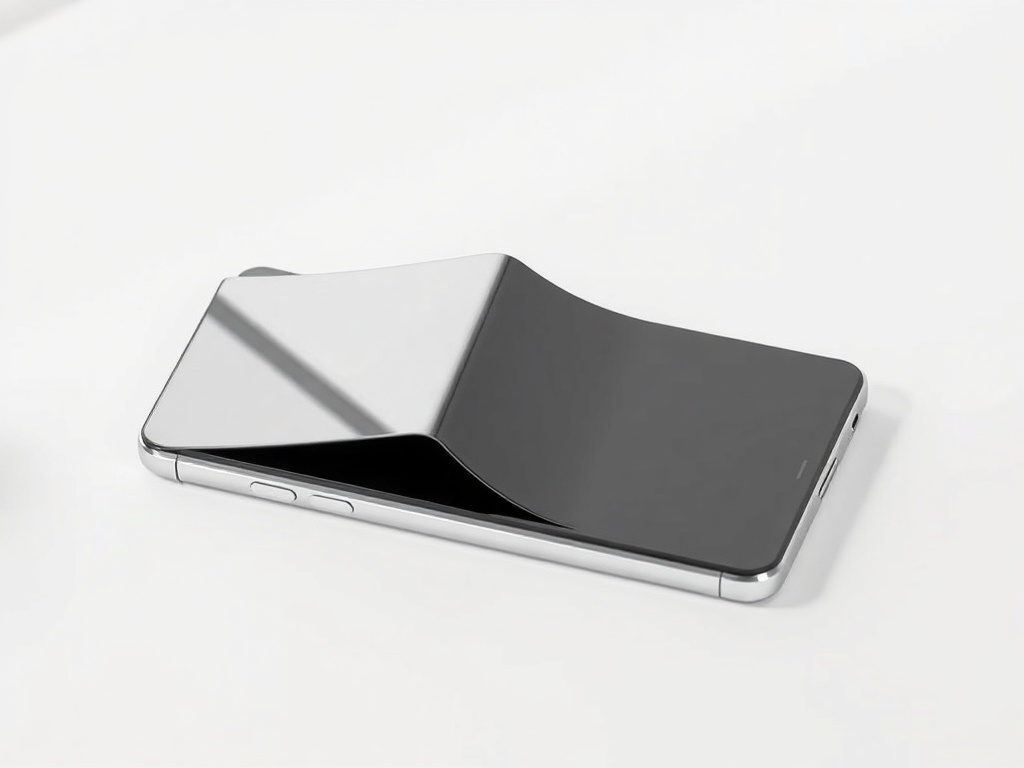
Apple rejected multiple display samples from Samsung Display before validating its 7.8-inch panel. It combined ultra-thin glass with a high-precision adhesive and a hinge zone with variable thickness — thinner at the center to facilitate the fold, more resistant at the edges — to achieve a practically invisible crease. The result is a device that measures 4.5 mm thick when open, making it the thinnest iPhone ever manufactured, including flat models.
That is not just materials engineering. It is a positioning statement: Apple did not enter the foldable market, it entered the solved foldable market. The difference between those two phrases is worth, according to TrendForce, 20% of market share captured from day one of sales. For a segment where Samsung and Huawei have spent years fighting over every percentage point, that number represents a competitive fracture, not a marginal adjustment.
The consequences are already being felt before the launch. Chinese manufacturers are repositioning their product lines in anticipation of the naming Apple might use — iPhone Ultra — because they know that Apple has the capacity to redefine what the word "premium" means in any category it decides to occupy. That is not generated by the product. It is generated by the architecture of how the product was developed.
The $2,000 Bet and Its Real Trade-offs
There is a simplistic reading of this launch: Apple is going to charge more than $2,000 for a phone with only two rear cameras, no telephoto lens, no Face ID, and no TrueDepth system. From the logic of the current iPhone Pro, that looks like a regression. From the logic of Apple's portfolio, it is a calculated decision.
The iPhone Fold does not compete with the iPhone 18 Pro. It competes with the iPad mini plus the iPhone Pro together, collapsed into a single device that fits in your pocket. The internal screen in 4:3 format — the same aspect ratio as the iPad — is not a design accident, it is the value proposition: visual multitasking in a form factor that previously required two devices. Touch ID in the power button is not a security downgrade; it is the only biometric authentication solution that works within the available space at that level of thinness.
What does represent a concrete operational risk is the supply chain. Foxconn is in trial production right now, with the goal of scaling to mass production in July 2026. Analyst Ming-Chi Kuo warns that manufacturing difficulties could generate unit shortages through 2027. That is not a demand problem — it is an installed capacity problem for producing something that nobody had manufactured before at this scale and with these tolerances. For Apple, whose financial model depends on high ASPs and sustained volumes, a supply constraint on the highest-priced product in its history is not a public relations obstacle: it is a direct risk to revenues that cannot be recovered retrospectively.
The decision to use Lens Technology glass with Corning base materials, rather than relying exclusively on Samsung Display, speaks to a deliberate management of that risk. Apple diversified the supply chain before it needed to, not after suffering the first break. That is portfolio management applied to logistics.
Seven Years of Observation Is Not a First-Mover Advantage
Apple was not first in foldables, and that matters less than it seems. It was the first to solve the problem that foldables had. The distinction between those two positions determines whether a company is exploring to learn or exploring to scale.
Samsung explored to learn. Each generation of the Galaxy Fold improved upon the previous one, absorbed the cost of public mistakes, and gradually built a critical mass of users willing to tolerate imperfections in exchange for being at the frontier of the form factor. That is a valid strategy with its own advantages: Samsung today has a base of foldable users, real usage data, and a mature supply chain. What it does not have is the ability to relaunch the category with a product that renders the visible crease argument obsolete — because that argument was born with them.
Apple structured its exploration differently. It kept the project in incubation for as long as it took to resolve the three technical problems that made the product unviable at its standard: the crease, the thickness, and the durability. Only when all three had answers validated by real suppliers — not in a laboratory, but in trial production at Foxconn — did it move the project into the scaling phase.
That describes an innovation management approach with clear exit criteria, not with arbitrary launch deadlines dictated by the conference calendar. The operational difference is significant: projects that scale before the core problem is resolved generate technical and reputational debt that gets paid for years. Apple chose to pay the cost in time. Its competitors chose to pay it in public iterations.
The iPhone Fold arrives on the market — with a probable presentation date in September 2026 — not as a late follower, but as the company that let others educate the category while it resolved the product standard that matters. In portfolio innovation, arriving first rarely defines the winner. What defines it is who converts an expensive novelty into the version of the product that makes everything that came before feel provisional.