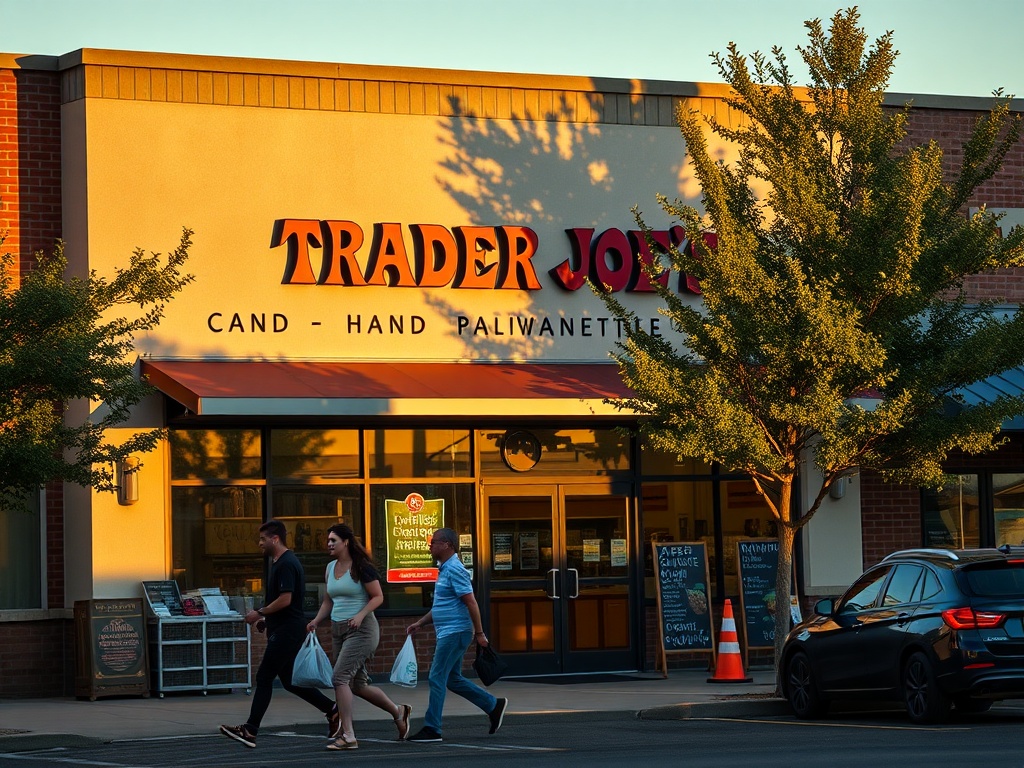

Trader Joe's Opens 30 Stores at Its Own Pace: The Geometry of a Model That Doesn’t Need to Rush
By late October 2025, Trader Joe's quietly updated the opening page on its website. No press releases, no CEO on camera, and no promises of dates. The result was a list of 30 new locations spread across 18 states, including diverse markets such as Mid-City New Orleans, Broken Arrow in Oklahoma, and Bee Cave in Texas. Sixteen of those locations were added in a single recent update. The company simply added them and continued operating.
This discretion is not accidental. It is the hallmark of a company that has built such a robust competitive position that it does not need the noise to drive demand. While Dollar General led the sector with 55 openings in a month, Aldi added 22, and Trader Joe's reported 13, the sector data revealed something more telling than a simple count: 125 supermarket openings versus 58 closures in the same period. The market is moving, and Trader Joe's is doing so at its own pace, not that of its competitors.
The important question is not how many stores are opening. It's about understanding why that number, in those markets, with that institutional silence, has a very specific distribution logic.
The Model that Creates Demand Before Opening the Door
Trader Joe's operates stores ranging from 10,000 to 15,000 square feet, a fraction of the space of a conventional supermarket. However, the industry attributes sales figures per square foot that exceed $2,000 annually, a level few supermarket formats achieve. That metric is not superficial: it defines the complete logic of why this model can sustain margins without needing to scale at the speed of a discount operator.
The mechanism is precise. By concentrating its offerings on private-label products—which eliminate the negotiation costs associated with large brands and the shelf space those brands demand—the chain controls two variables simultaneously: sourcing costs and customer perceived value. A consumer entering Trader Joe's is not comparing unit prices against Walmart across the street because the products are not comparable. This market disconnection is, strategically, the most profitable decision the company makes every day.
The current expansion reinforces that logic. Markets like Holladay in Utah, Peachtree City in Georgia, or Glenmont in New York are not high-profile capitals. They are communities with middle to upper-middle incomes, a history of spending in premium categories, and, in many cases, a consumer base that has been requesting a store for years. Trader Joe's does not come to create demand: it goes where demand already exists and has nowhere to go. This structurally reduces opening risk and shortens the maturation period for each location.
What Opening Two Stores at the Same Time in New Orleans Reveals
One of the most revealing moves from the current list is the simultaneous opening of two locations in New Orleans: one in Mid-City on Tulane Avenue and another in Uptown on Napoleon Avenue. This follows a recent precedent in Sherman Oaks, California, where the chain opened a store directly across from an existing one.
From the perspective of a discount operator, opening two stores in the same city—or across from one’s own—sounds like a planning error. From Trader Joe's perspective, it indicates that the unmet demand is concentrated enough to support both locations without cannibalization. The small format acts as a natural regulator: if the Mid-City store can’t accommodate more people at peak times, the Uptown store does not compete with it but rather complements it.
This pattern also has implications for local suppliers and real estate developers negotiating with the chain. Trader Joe's does not require large-format anchors or 500-space parking lots. It enters second-generation shopping centers, established urban corridors, and spaces that larger operators reject. This gives it negotiating power in leasing without needing to state it publicly. The locations at 550 Lancaster Ave in Berwyn, Pennsylvania, or at 2083 NE Burnside Rd in Gresham, Oregon, are examples of stores that likely have more favorable leasing conditions than a chain needing 40,000 square feet to operate.
What is happening in the real estate value chain is as important as what is happening in the supply chain. And on both fronts, Trader Joe's position is stronger than corporate silence suggests.
Scaling without Losing the Friction that Creates Value
The real risk of this expansion does not lie in logistics or capital. It’s in something harder to measure: the possibility of diluting the experience that justifies the price.
Trader Joe's does not sell groceries. It sells a discovery experience within a small, deliberately limited physical format. The absence of online sales is not nostalgia: it’s a decision that preserves physical traffic and customer interaction with the product. When someone enters looking for Mandarin Orange Chicken and finds three new seasonal items that weren’t there the previous week, that productive friction is what generates unplanned purchases and customer loyalty. No recommendation algorithm replicates that at the same operational cost.
The issue with 30 simultaneous openings—even if distributed across 18 states—demand a volume of staff training and operational culture that cannot be scaled by decree. Trader Joe's has built its service reputation on store teams with high autonomy and relatively low turnover for the sector. If expansion pressures that variable, the first symptom won’t be financial: it will be operational, manifesting as degraded customer experiences that the company won’t report because it is private and has no obligation to do so.
That opacity is an advantage in capital markets but is also why the market cannot monitor whether the expansion is compromising the value proposition that sustains it.
Geographic Expansion as a Sign of Maturity, Not Urgency
Trader Joe's is not rushing. It is choosing. The difference between Dollar General's 55 stores monthly and Trader Joe's 13 does not reflect lesser ambition: it reflects that both models optimize different variables. Dollar General maximizes geographic coverage in markets with high price sensitivity and limited retail access. Trader Joe's maximizes profitability per square foot in markets with unmet demand for differentiated products.
These two models do not compete with each other in any relevant sense. They compete with their own internal constraints. For Dollar General, the risk is saturation and margin erosion when two of its stores overlap. For Trader Joe's, the risk is replicating a cultural model that has so far worked precisely because it has been challenging to scale quickly.
The 30 locations on the opening list, along with the additional 12 that some specialized media reported as imminent following the last round in December, shape an expansion cadence that the company clearly considers sustainable without compromising its cost structure or customer proposition. That confidence, in a company with no public debt and no obligation to report quarterly results, carries specific weight that competitors with shareholders should study carefully.
The stakeholder that gains value in this expansion is the consumer in secondary markets who finally gains access to a format that previously required a trip. The one who loses relative position is the regional medium-format supermarket that operated without differentiated competition in those same corridors: its advantage was not quality, but the absence of alternatives, and that advantage just had its shelf life shortened by 30 more markets.