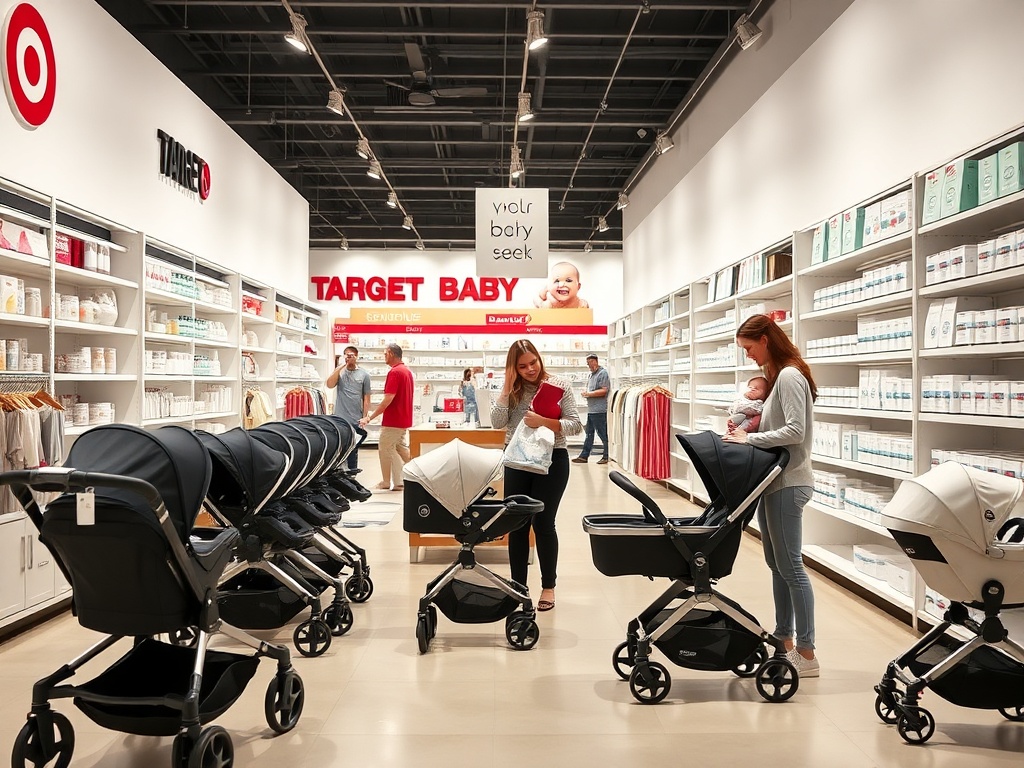

Target bets on babies to stop three years of decline
There is a moment in the life of many first-time parents when the baby section of a large store generates more anxiety than relief. Dozens of strollers stacked in boxes, with no way to fold or push them, unknown brands with similar prices, an aisle that mixes diapers with baby monitors and crib sheets without any editorial logic. That experience, repeated across thousands of Target visits in recent years, cost the company nearly a full point of market share. And in a category where the customer who comes in for a stroller tends to stay for a decade, that point has consequences measured in revenues far beyond the baby aisle.
Starting in March 2026, Target began converting baby sections in approximately 200 stores — roughly 10% of its network — into what the company internally calls "baby boutiques": spaces where strollers are out of the box, where they can be folded, pushed, and compared on the store floor, and where brands such as UPPAbaby, Stokke, Bugaboo, and Doona coexist with its own Cloud Island line. The chain added around 2,000 new product references available across all its stores and online, and is piloting a free advisory service through Tot Squad to help parents build baby registries or compare products.
It is the largest investment Target has made in the baby category in more than ten years. And it arrives at a moment when the company needs to show something concrete: Michael Fiddelke, who took the helm as CEO in February 2026 after replacing Brian Cornell, faces three consecutive years of sales decline and four straight quarters of falling traffic, both in physical stores and on the website. On May 20, the company reports first-quarter results under his leadership.
Why the baby category carries such a large strategic bet
The strategic logic of Cara Sylvester, Target's Chief Merchandising Officer, is direct: families with children under five years old spend twice as much as the average Target shopper, and families with children of any age visit stores twice as frequently. But there is another less obvious angle. Sylvester explained in an interview with CNBC that when people become parents, they tend to reduce the number of stores where they shop because they have less time available. Whoever manages to capture that loyalty during the stroller phase is not selling a stroller: they are buying years of spending on children's clothing, household goods, groceries, and everything a family needs in its first decade.
That is the mechanism that Simeon Gutman, retail analyst at Morgan Stanley, described as an "on-ramp" to higher sales and a wallet share that sustains itself over several years. This is not a vague metaphor. In terms of unit economics, the cost of acquiring a first-time parent who chooses Target as their primary store is distributed across years of purchases in high-margin categories. The baby boutique is not the product; it is the point of contact that justifies the spending on conversion.
The problem is that Target arrived late to reinforce it. Numerator data for the twelve months through February 2026 shows that Walmart holds 27% of the baby products market in the United States — including strollers, diapers, formula, and food, but excluding children's clothing — and that figure grew from 25.4% recorded two years earlier. Amazon holds steady at 24.4%. Target fell from 18.6% to 17.6% over the same period. In absolute terms, that one-percentage-point drop in a category that moves billions of dollars annually is not a trivial figure.
The irony of the moment is that the birth rate in the United States is also in decline: births fell from 4.32 million in 2007 to 3.61 million in 2025, according to preliminary data from the Centers for Disease Control and Prevention. A reduction of 16% over 18 years. That Target is making its biggest bet on babies precisely now, when there are fewer babies than at any recent point in time, might seem counterintuitive. Sylvester acknowledges it plainly: what she is seeking is not volume but retention. The father or mother who chooses Target for their first $1,000 stroller is a customer with a much higher lifetime value than the one who walks in once for a discounted pack of diapers.
The gap left by Babies R Us and Buybuy Baby
There is an industry context that makes this move easier to read, and that is often overlooked in broader retail analysis. The two major specialized chains for baby products in the United States — Babies R Us and Buybuy Baby — closed their doors after filing for bankruptcy. Babies R Us reopened in a pop-up store format within some Kohl's locations, but the physical space of the specialized category was left structurally vacant.
Before those bankruptcies, first-time parents had a clear destination where they could see, touch, and compare products from different brands with a level of expert guidance that large-format stores simply did not offer. That void was not satisfactorily filled by e-commerce, precisely because the purchase decision for a stroller or a car seat is among the most emotional and tactile decisions that exist. Nate Gunn, co-founder and CEO of WildBird, a baby carrier brand that debuted in Target stores in March 2026, described it with precision: parents are buying hundreds of products within the span of a few months, social media multiplied the available options, and the feeling of confusion intensified — it was not resolved by presenting even more choices on a screen.
What Target is building is a response to that void. The boutique format allows a first-time parent to walk into a store they already know and leave with a decision made about a $1,000 stroller, with the free guidance of Tot Squad and without having had to visit four different stores. That has real value. The physical experience in the baby category is not decoration; it is part of the purchase argument.
What remains unclear is whether the improved shopping experience will translate into measurable changes in traffic and conversion before the chain's financial fatigue becomes harder to manage. Target has approved a capital budget of $5 billion for this fiscal year — more than one billion additional dollars compared to the prior year — earmarked for new store openings and remodels. It did not disclose how much of that is specifically allocated to the baby boutique project, but the scale of the commitment speaks to a bet that cannot be quickly reversed if first-quarter results disappoint.
What the market sees and what remains unresolved
There are positive signals in traffic data estimated by Placer.ai, an analytics firm that tracks physical visits to establishments using anonymous mobile device data. After four consecutive quarters of decline, the platform detects a stabilization or slight recovery in visits to Target stores. But a stabilization of traffic is not the same as a recovery of market share, and even less so in a category where Walmart has been growing consistently.
The macroeconomic context does not help unconditionally either. Rising fuel prices tend to amplify what is known as the "K-shaped economy": higher-income households sustain their spending while lower-income households cut back. Gutman, the Morgan Stanley analyst, was direct in noting that Walmart is better positioned than Target to navigate that scenario, because it has gained share among higher-income households that offsets adjustments among more financially constrained customers. Target, historically positioned between Walmart's price point and the experience of a department store, operates in that middle band where pressure is most intense.
Adding to that is a risk that Target cannot control through aisle redesign: the boycott called by the American Federation of Teachers just ahead of the back-to-school season, one of the highest-spending periods of the year in categories where Target holds significant strength. The impact of that boycott on the flow of families — precisely the segment the chain is trying to win back — is a variable that analysts are monitoring closely.
The bet on babies, viewed from the outside, appears to be a reasonable and well-grounded move. The behavioral data on customers with children justifies it, the void left by the defunct specialists facilitates it, and the coherence with what Target has always been — a store for families who want something better than the lowest price, but without paying boutique-level prices — gives it direction. What remains to be demonstrated, and what the May 20 results will begin to answer, is whether a single category can function as an anchor when the rest of the store has not yet finished finding its way back to itself.
Target lost share because at some point it stopped being the place where families wanted to be. Recovering it does not depend on adding a $1,000 stroller to the aisle: it depends on whether the parent who walks in for that stroller decides they also want to buy their groceries there, the child's clothing, and the living room décor. The baby boutique only has value if it is the first room in a longer relationship. And that longer relationship is still waiting to be built.