
Tata Sons bets 29 billion rupees without having proven that the market wants them
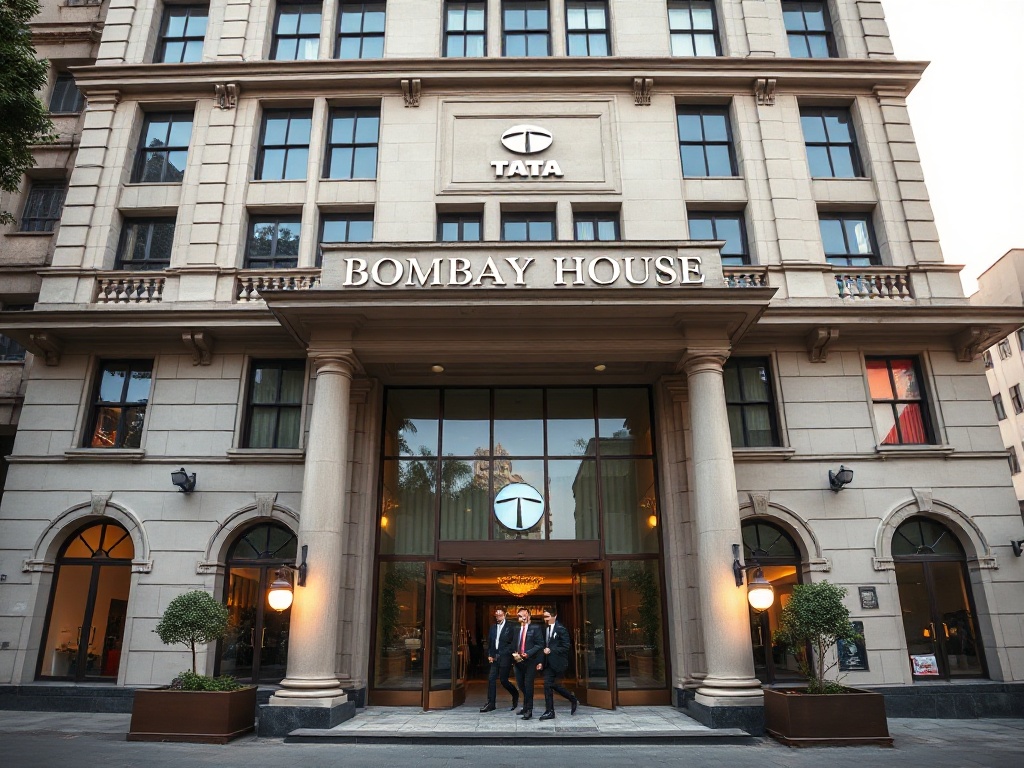
On May 26, 2026, at Bombay House, the neoclassical building in Mumbai where the Tata Group has made its most important decisions for more than a century, the six members of the Tata Sons board of directors met for approximately six hours. There were no public statements upon leaving. Natarajan Chandrasekaran, executive chairman of the $180 billion conglomerate, did not speak to the press.
What is documented is this: the unlisted companies of the Tata Group accumulated losses of 10.905 billion rupees in fiscal year 2025, and internal estimates suggest that figure could scale to 29 billion rupees as investment in aviation, digital, and electronics accelerates. Chandrasekaran presented to the board a revised strategic roadmap for those businesses. The question that roadmap cannot answer on its own is whether the markets it targets are willing to validate it.
That is the real tension beneath all the restructuring narrative.
The problem is not the loss, it is when it was decided it was worth it
Tata Sons has three businesses under the microscope that share a structural characteristic: they are capital-intensive, have return cycles measured in years, and operate in markets where a leader already exists and holds a scale advantage.
Air India competes against IndiGo, which carries more than 60% of India's domestic passengers. Tata Digital, with its super-application Tata Neu, faces Amazon, Walmart-backed Flipkart, and JioMart with Reliance's physical distribution network behind it. Tata Electronics wants to be a global player in semiconductors and device manufacturing in a sector where Taiwan, South Korea, and China have decades of advantage in learning curves and massive government subsidies. Tejas Networks, in telecommunications equipment, pushes against Nokia and Ericsson.
None of these bets is unreasonable by definition. Air India has brand history and an international route network. Electronic manufacturing in India has geopolitical tailwinds. The validation problem is not whether the bets are bad, but when the group decided they were good and with what market evidence it made that decision.
Here appears the pattern worth auditing: conglomerates with closed ownership structures — and Tata Trusts controls around 66% of Tata Sons — tend to confuse strategic conviction with market validation. Conviction says "India will need a competitive private flag carrier" or "there will be demand for domestic electronic manufacturing." Both statements may be correct as macroeconomic analysis and completely insufficient as an investment thesis for a specific company at a specific moment.
Market validation asks something different: given that market exists, can Tata win in it with a cost structure that justifies the capital invested and within a timeframe that the holding company can absorb without compromising other priorities?
That second question is the one Noel Tata, vice chairman of the board, raised with sufficient force on February 24, 2026, as to defer the renewal of Chandrasekaran's mandate. And it is the one the May 26 meeting attempted to answer.
A governance designed for consensus faces a strategy that requires speed
The February episode revealed something more than a dispute over losses. It revealed a structural friction between the decision-making model the group inherited from Ratan Tata — based on consensus among the owning parties — and the pace required by the markets where Tata is deploying capital today.
Chandrasekaran proposed postponing the vote on his third mandate because he wanted consensus, not a four-to-one majority. That gesture respects the corporate culture of the group. It also signals that an organization where the majority shareholder's approval is not automatic for the chief executive is an organization where every major strategic decision carries the additional weight of internal legitimization.
This is not a problem of individuals. It is a problem of governance architecture facing a business portfolio that no longer resembles the one that justified that architecture. When the Tata Group was primarily steel, cars, hotels, and services technology, the consensus model between Tata Sons and Tata Trusts worked because the decision horizons were compatible. A hotel or a steel plant does not require the same kind of rapid pivot as a super-application competing against Amazon or an airline that needs to redesign routes within weeks.
The intersection of capital intensity, established competition, and slow governance is not an impossible formula to manage, but it requires that the rules be explicitly designed for that context. The available evidence suggests that Tata Sons is still in the process of establishing those rules.
The May 26 meeting was, in that sense, more an exercise in internal alignment than a classic strategic review. Chandrasekaran needed the board to understand not only what each business does, but why capital will continue to flow toward them even while they generate losses. That demands something more than a results presentation: it demands a shared framework about when a loss is an investment and when it is evidence that the model does not work.
The discussion about listing on the stock exchange is not philosophical, it is about who can challenge the strategy
The position of Venu Srinivasan, independent director nominated by Tata Trusts, in favor of listing Tata Sons on the stock exchange is generating enough tension for the Tata Trusts board — scheduled to meet on June 8 — to review his future as a nominated director. In terms of institutional signal, that is significant.
The official narrative against listing Tata Sons is that the stock market generates short-term pressures incompatible with the group's long-term strategy. There is substance in that argument. Public capital markets penalize bad quarters in businesses that require years to mature.
But the counterargument — the one Srinivasan has publicly defended — has a technical dimension that goes beyond philosophical preferences: Tata Sons is registered as an upper-layer non-banking financial company (upper-layer NBFC) under the Reserve Bank of India's regulation. This classification, mentioned in specialized sector analyses, implies that the regulator has the capacity to require certain transparency and capital adequacy standards that bring Tata Sons' reporting obligations closer to those of a public entity, regardless of whether it lists or not.
If the regulator decides to apply stricter standards, the distinction between listing and not listing is partially reduced to semantics: the external pressure of scrutiny exists regardless. The difference is that with a listing, the market also provides a capital financing mechanism that can precisely relieve the pressure on the holding company's balance sheet generated by financing losses in businesses such as Air India or Tata Digital.
What makes this debate interesting is that it cannot be separated from the question of who has the authority to challenge the investment strategy. A listed Tata Sons has institutional investors, sell-side analysts, and specialized financial press questioning the rationality of its capital allocations every quarter. A private Tata Sons only has Tata Trusts. And if within Tata Trusts the dominant position is "let us keep investing," then the external correction mechanism is practically nonexistent.
This does not mean that listing is the correct decision. It means that the resistance to listing carries an implicit cost that is rarely calculated with the same rigor as the costs of listing: the cost of not having an external validation process that forces justification of capital allocation in terms of risk-adjusted returns.
The revised roadmap is only as valuable as what happens over the next eighteen months
Chandrasekaran is 63 years old. A third five-year mandate requires an exception to the internal policy that sets the retirement of executive directors at 65. The mandate, if approved, projects him through to 2031. That horizon covers the period in which Air India should complete its integration with Vistara and begin generating positive cash flows, in which Tata Digital should have demonstrated whether Tata Neu has sufficient user retention to justify the accumulated investment, and in which Tata Electronics should have visibility on its first sustainable contracts in device manufacturing or semiconductors.
The problem with tying leadership renewal to the performance of those businesses is that it creates a perverse incentive if not accompanied by explicit and reviewable metrics: the chief executive may find himself pressured to show positive signals in the short term, even if that implies sacrificing the long-term discipline that those same businesses require. That is the logic that destroys long-term investments when they are tied to internal political cycles.
The operational question after May 26 is not whether the board supported Chandrasekaran's plan — information that Tata Sons did not publish. The question is whether that support came accompanied by concrete milestones, deadlines, and exit metrics for the loss-making businesses, or whether it was simply a narrative endorsement of the general strategic direction.
Conglomerates do not fail because their chief executives have bad ideas. They fail when those ideas, good or bad, can no longer be challenged internally with the same rigor with which the market would challenge them from the outside. The May 26 meeting at Bombay House was, above all, an attempt to rebuild the internal space for that kind of challenge. Whether it produced measurable commitments or simply reaffirmed the existing strategic conviction is what will determine whether the revised roadmap has operational value or is simply a well-presented photograph of where the group had already decided it was going.