
The robot that wants to be your companion, not your employee
There is a specific moment in the history of domestic robotics where the industry decided that value lay in solving tasks. Vacuuming. Mopping. Monitoring. The logic was impeccable: if the robot does something useful, the consumer pays. Colin Angle demonstrated this better than anyone when he launched the Roomba in 2002 and turned a wheeled disc into the first domestically adopted mass-market robot. For two decades, that bet paid off. Then came Chinese competition, Amazon walked away from the acquisition, and Angle left iRobot in 2024.
What followed was not retirement. It was a different bet — and a structurally riskier one.
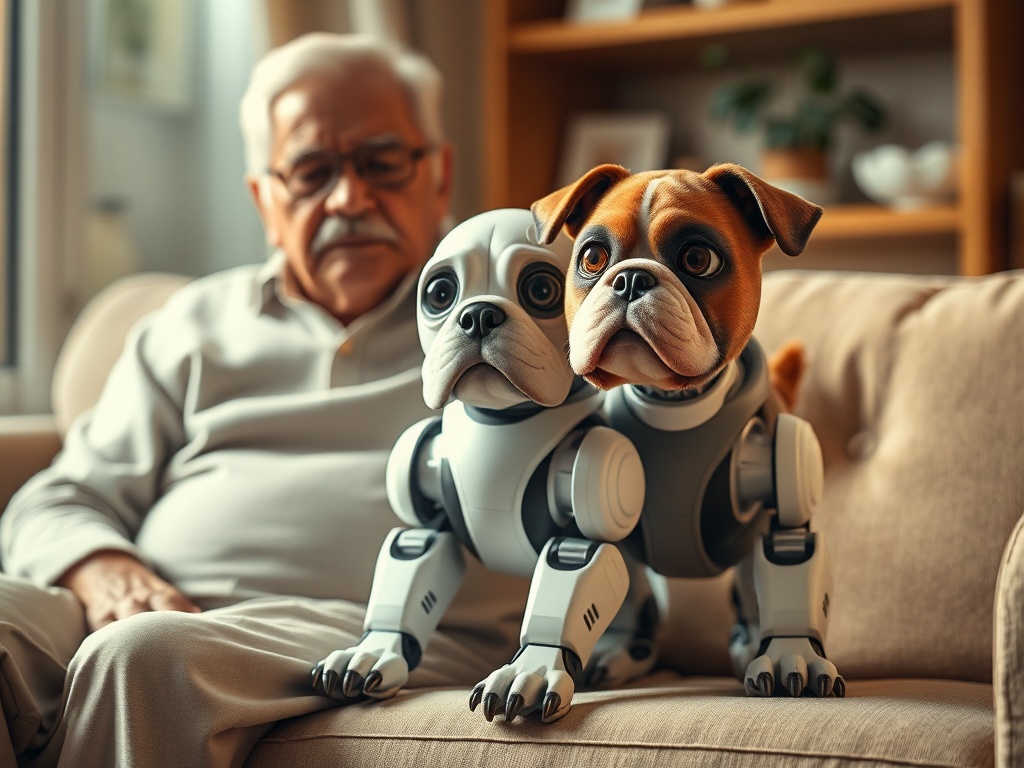
In May 2026, on the stage of the Wall Street Journal's Future of Everything conference in New York, Angle unveiled the Familiar: a four-legged robot, the size of a bulldog, with expressive eyes, tactile synthetic skin, and ears that evoke a bear cub. It does not speak. It does not vacuum. It does not execute smart home commands. It learns to recognize your routines, makes animal-like sounds, approaches when you arrive home, and can follow you to the kitchen. The value model is no longer efficiency. It is the bond.
That shift is not a product design detail. It is a complete restructuring of the value capture logic that Angle built over 25 years, and it deserves to be read at that scale.
From the robot-as-tool to the robot-as-relationship: what changes in the mechanics of value
The Roomba sold measurable utility. The consumer could quantify what they were getting: less time vacuuming, a clean floor, convenience. The price was justified by a direct equation between function and expenditure. That model has clear limits, but also clear advantages: the customer knows why they are buying, and the company knows what it must optimize.
The Familiar operates under a different logic. What it sells is not a verifiable function but a relational experience, and that radically changes how value is built and sustained over time. Emotional value does not depreciate the way functional value does, but neither can it be demonstrated in a 30-second advertisement or a technical specification sheet. It requires the consumer to experience it in order to believe in it, and that carries a much higher acquisition and conversion cost than any home appliance.
The natural comparison is Sony Aibo, launched in the nineties and relaunched in 2018. Aibo was an honest experiment in whether the market would pay for robotic companionship. The verdict was ambiguous: there is a loyal and emotionally committed user base, but it never reached mass scale. The price was high, the functionality was limited in its first version, and the affective bond, though real for those who developed it, was not sufficient to generate market volume.
Angle knows that precedent. His differentiation argument is not design or form, but intelligence. The Familiar uses generative language models to listen to and learn from what you say, adapt its behavior to your patterns, and build a relationship that evolves. "Before generative AI, robots couldn't easily understand what people were saying," noted Maja Matarić, professor at the University of Southern California and one of the project's advisors, who has spent 25 years working in social assistance robotics. That sentence is the technical hinge of the argument. The Familiar is not Aibo with better marketing. It is Aibo with a layer of adaptive personalization that was not possible to build until less than a year ago.
The problem is that this technical differentiation still has no public price or detailed specifications. There are no investment figures, no launch window, no visible cost structure. What exists is a well-received prototype and a strategic argument without market validation.
The target segment reveals the risk architecture of the model
Angle identified a specific segment for the Familiar: older adults who have passed the peak age for pet ownership. The logic he laid out is precise: they do not stop wanting companion animals, but rather the burden of care, veterinary costs, feeding, and the possibility of outliving their pet dissuades them from acquiring a new one. A robot that offers the bond without the operational burden resolves a genuine tension.
That segment has interesting strategic attributes. Older adults have spending power in many developed markets, are sensitive to loneliness — a public health problem documented across multiple countries — and have the time to develop the kind of bond that the product requires in order to generate value. Matarić explicitly mentioned senior living facilities and emotional support in mental health as viable applications.
But that same segment generates frictions that are not yet resolved in what is publicly known about the project. Technology adoption among older adults requires minimal configuration interfaces and robust post-sale support, two areas where hardware startups routinely underestimate costs. A robot that learns from your habits needs an adaptation period during which the value is not yet apparent. If the target consumer has a low tolerance for technological frustration or depends on third parties to configure devices, the onboarding period becomes the product's greatest risk of abandonment.
There is also a structural tension in the revenue model that the project has not yet publicly resolved. Robots with adaptive AI companionship generate their differential value over time, not at the moment of purchase. That suggests the model should include some form of recurring revenue, whether through subscriptions to model update services, software maintenance, or access to new capabilities. Without that layer, the company sells hardware once and then funds the differential value that justified that initial sale without return. That is a fragile financial architecture for a product whose primary appeal is precisely that it improves over time.
Angle's advisory team offers signals about the intentions of the project. Marc Raibert, founder of Boston Dynamics and a pioneer in robotic locomotion, provides technical credibility in four-legged mobility. Cynthia Breazeal, inventor of the social robot Kismet and of Jibo, has direct experience with the limits and possibilities of expressive robotics. Matarić has spent decades studying how humans build bonds with machines and under what conditions those bonds are sustained. This is not a team assembled for the press photo. It is a network with a shared history at MIT and an explicit skepticism toward the humanoid robots that dominate the news cycle but have yet to demonstrate everyday utility.
That shared skepticism is also a market position. The Familiar is deliberately positioned outside the race for the humanoid — a space where investments are enormous and practical results are still scarce. Angle is betting that the market for emotional companionship is more viable in the short and medium term than the market for automated domestic labor. He may well be right. But "he may be right" and "he has a sustainable business model" are two distinct claims.
What Angle knows that the industry has not yet learned to value
There is a pattern in the way Angle builds products that deserves attention regardless of what happens with the Familiar. With the Roomba, he did not invent the robotic vacuum cleaner; rather, he was the first to make it sufficiently reliable, accessible, and autonomous for the mass market to adopt it. The leap was not technological in origin. It was product engineering applied to consumer behavior.
The Familiar repeats that logic. Sony Aibo exists. Four-legged robots with AI exist. What Angle claims to have solved is the specific combination of form, behavior, and adaptability that causes the bond to form. "When it feels happy, that makes you happy," he said during the presentation. That sentence, spoken by any other founder, would sound like marketing. Spoken by someone who spent 25 years observing how real consumers interact with robots in their homes, it carries considerably more weight.
Matarić's reaction upon seeing the prototype for the first time is an operational data point, not merely an anecdote. A researcher with decades of work in human-robot interaction who "immediately got on the floor to pet it and played with it to see what it would do" is describing something that her own theoretical frameworks tell her is difficult to achieve. Research in social robotics consistently shows that robots frequently fall into the uncanny valley: too humanoid to seem like tools, too mechanical to generate empathy. The Familiar appears to have found a design space that avoids that valley without copying any existing form.
That has technical value. It also has market value, if it can be scaled. And that is where the unresolved problem lies.
Consumer robotics hardware is one of the most capital-intensive businesses that exists. Margins are low, development cycles are long, manufacturing costs are high, and consumers have expectations shaped by decades of electronic devices that become cheaper over time. iRobot, with all its scale and brand recognition, could not withstand the pressure from Chinese manufacturers producing functional robotic vacuums at a fraction of the price. The Familiar, if it manages to reach the market, needs a value proposition sufficiently differentiated so that price is not the axis of the purchasing decision.
Angle's bet is that the emotional bond generates that differentiation. That no one replaces their companion just because there is a cheaper one available. That adaptive personalization creates a unique relationship between the robot and its owner that is neither transferable nor comparable. If that bet is validated with real users, the model has a retention logic that very few hardware products can claim. If it is not validated, the company has an elegant prototype and an exceptional advisory team, but without the engine that converts all of that into a business.
The value distribution is still incomplete and that is the tension that defines the project
Angle has a solid market argument, an extraordinary talent network, and a reading of the limitations of generative AI that seems more honest than most of the sector's prevailing discourse. What he does not have — or at least what he has not shown publicly — is a revenue architecture that closes the equation between the cost of producing sustained emotional value and the willingness to pay among the segments that need it most.
Older adults in care facilities, patients with emotional support needs, people living alone: all of these represent segments with genuine needs verified by decades of research. But many of those segments depend on healthcare systems, insurers, or municipalities to access support technology, and those channels have slow adoption cycles, complex regulatory approval processes, and payment models that do not easily adapt to products that still have no official price.
If Familiar Machines targets the direct consumer with high purchasing power, the market is smaller but the sales cycle is shorter. If it targets health or care institutions, the market is broader but the commercial complexity is of an entirely different order. Those two strategies require distinct organizational structures, and the decision about which to pursue first determines what kind of company is being built.
The Familiar, in its current state, is a prototype that demonstrated one important thing: that the bond between humans and robots does not need to imitate human or canine form in order to be activated. That is a finding with implications that go far beyond this specific product. But a finding is not a business model, and the distance between the two is precisely where it will be decided whether this bet becomes Angle's second major contribution to domestic robotics or a well-documented experiment that others will leverage later on. That tension is not resolved by the prototype. It is resolved by the first year of sales — and that data does not yet exist.