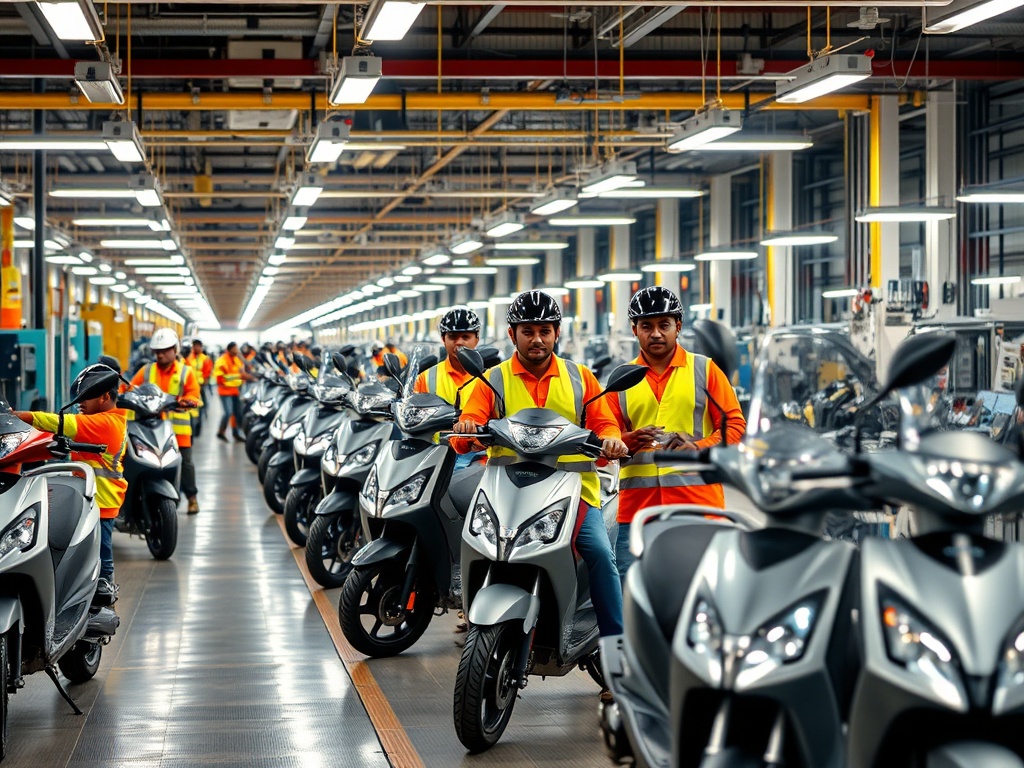

Ola Electric rises 93% from lows, but the question is not how much it gained — it's what is sustaining the recovery
The stock market forgave Ola Electric in a matter of weeks. From its all-time low of 22.25 rupees per share, recorded in March 2026, the Indian electric scooter manufacturer accumulated a recovery of 93% in just two months, reaching 42.88 rupees on the National Stock Exchange of India at the end of May. In a single session, the stock climbed close to 9%. Market capitalisation returned to the spotlight. The headlines turned favourable once again.
But there is an inconvenient gap that no stock market rebound can conceal: Ola Electric's all-time high, recorded just days after its debut in August 2024, was 157.40 rupees per share. From there, the trajectory was long and sustained downward. The current rebound, however dramatic it may appear in percentage terms, returns the stock to levels that represent less than one-third of that peak. The market is not celebrating a triumph; it is calibrating whether the recent signals are sufficient to revise upward an investment thesis that, barely two months ago, many had practically abandoned.
That calibration deserves analytical attention. Because what happened with Ola Electric over these two months is not simply a story of price recovery. It is a case that illuminates how operational confidence is built — or destroyed — in a sector where the technological promise arrived before the discipline of manufacturing.
The quarterly result that changed the tone without changing the structure
The immediate catalyst of the rally was the publication of fourth-quarter results for fiscal year 2026. Ola Electric reported a consolidated net loss of 500 crore rupees for the January–March period, representing a contraction of 42.5% compared to the 870 crore recorded in the same quarter of the previous year. For a market that had been punishing the stock for growing losses and declining market share, that compression of losses was enough to reignite interest.
The logic of the rebound is not irrational. In electric mobility companies that have not yet achieved profitability, the market tends to discount the future based on the direction of the vector, not the absolute value of the metrics. When losses are reduced sequentially and volumes show signs of recovery, investors begin to recalculate the operational breakeven point going forward. That is exactly what happened here.
The volume figures also supported the narrative: retail sales in March and April 2026 stood between 10,000 and 12,000 units per month, compared to an average of around 8,000 per month between November 2025 and January 2026. Market share in the electric two-wheeler segment recovered to 8–9% in April and May, after having fallen to just 5% in the fourth fiscal quarter. These are real improvements, not cosmetic ones.
The problem is that the report from Emkay Global itself — one of the leading analysis firms that followed the case closely — attributed part of that upturn not to renewed strength on Ola's part, but to a combination of factors that the company cannot control: greater available installed capacity at its facilities, greater penetration into more price-sensitive markets in northern India, and the fact that established competitors such as Ather were operating at full plant utilisation amid broadly strong demand. In other words, Ola recovered ground partly because the market grew and its rivals had no room to absorb additional orders. That recovery has a natural limit.
Gigafactory, batteries, and the temptation of two models at the same time
There is one element in Ola Electric's recent trajectory that deserves to be examined more carefully, because it could be the factor that determines whether the company manages to stabilise or whether it deepens its strategic dilemma.
According to Business Today reports cited in the contextual analysis, Ola Electric was maintaining conversations with automobile manufacturers — both global and domestic — to supply lithium-ion cells and battery packs from its gigafactory in Krishnagiri. If those negotiations succeed, the company would be making a weighty decision: to become an industry supplier as well, not merely a vehicle manufacturer selling to the end consumer.
That move has a clear financial logic. A gigafactory requires sustained volume to justify its fixed costs. If the demand generated by its own vehicle business is not sufficient to keep plant utilisation high, selling cells to third parties is a way to improve cost absorption and generate an additional revenue stream. Vertical integration, which was presented from the outset as a competitive advantage, becomes a profitable asset only if installed capacity is used consistently.
The price cut that Ola applied in April to the Roadster X+ model points in the same direction. The company reduced the price of that variant by 60,000 rupees, lowering it from 1,89,999 to 1,29,999 rupees — a drop of more than 30% — and justified that move by invoking precisely the economies of scale at the gigafactory and the integration of internally developed battery technology. The argument is that production costs fell sufficiently to pass that benefit on through pricing without dramatically sacrificing gross margin.
But here a strategic tension emerges that no investor should ignore. Ola Electric is attempting to operate simultaneously as a consumer-oriented vehicle manufacturer, as a battery technology company, and as a potential industrial supplier of cells. Each of those roles has a different operational logic, requires distinct capabilities, and competes for the same executive attention. Vertical integration, well executed, can be a source of strength. Vertical integration poorly sequenced can become a complexity trap that drains resources without consolidating any market position in a solid way.
The question that Emkay does not answer, but which analysis of the situation demands be raised, is whether the organisation has the management depth to execute those three bets simultaneously, to the standard that each one demands. There is no definitive answer in the current data. But the history of companies that build complex manufacturing capacity before having consolidated their customer base is long enough to demand caution.
What the share price cannot read on its own
The stock market is good at capturing changes in short-term expectations. It is less reliable at reading the quality of operational execution when that execution is in the middle of a transition.
Ola Electric has spent several quarters operating in territory where results are better than expected compared to the prior period, but remain fundamentally deficit-generating. The reduction in losses is a signal of direction, not a signal of arrival. The 93% jump in price reflects the fact that the market has updated its worst-case scenarios toward something less catastrophic. That makes sense. But it should not be confused with evidence that the model has found its equilibrium point.
The indicators that truly matter for assessing whether the recovery is sustainable are three in number, and none of them is fully resolved yet.
The first is market share under genuine competitive pressure. Emkay explicitly warned that Ola's volume recovery will take place in an environment where established competitors are adding capacity in the second half of the fiscal year, which will reintroduce structural pressure across the industry. Gaining market share when a rival has no room to expand is not the same as gaining it when the rival does have that room.
The second is the non-financial cost structure. The after-sales service problems and brand perception damage that Ola accumulated during the months of market share loss do not disappear with a better quarter. Operational reputation is rebuilt more slowly than the share price. And in a market where the electric vehicle still generates mistrust among first-time buyers, the service experience is a conversion factor that is at least as important — if not more so — than the list price.
The third is dependence on favourable market conditions. Growth in the electric two-wheeler segment in India has been strong. Part of Ola's recovery is explained by that sector-level tailwind. If the pace of adoption moderates — for macroeconomic reasons, due to changes in government incentives, or because of saturation among early adopters — the company cannot rely on the market continuing to absorb its production at the current rate.
Emkay decided to raise its volume estimate for fiscal year 2027 by approximately 10%, drawing on the momentum in the electric segment. But it maintained its caution regarding the long-term risk profile. That combination — an upward revision of short-term estimates alongside long-term structural caution — is precisely the kind of mixed signal that makes a 93% stock market rebound comprehensible without it necessarily constituting a validation of the business model.
The threshold that separates the rebound from consolidation
Ola Electric is at a moment where the narrative improved before the structure did. That is not unusual for capital-intensive manufacturing companies going through phases of adjustment. But it does require that observers keep separate two readings that the market tends to merge into one: the reading of the price and the reading of the business.
The price rebounded because expectations were excessively depressed and the results arrived better than what those prices had discounted. That is market mechanics, and it is valid. What remains unresolved is whether the company can sustain consecutive operational improvements in an environment where competition will intensify, where the brand requires repair on the after-sales service front, and where the gigafactory bet only creates value if plant utilisation is maintained at a consistently high level.
The distance between 42 rupees and 157 rupees is not merely arithmetic. It is the space between a company that convinced the market it had an unbeatable scale thesis and a company that now has to demonstrate it can execute that thesis without the benefit of the doubt extended to it in its early years. That demonstration is not made in a single quarter. And it is not measured in the closing price on a Friday.