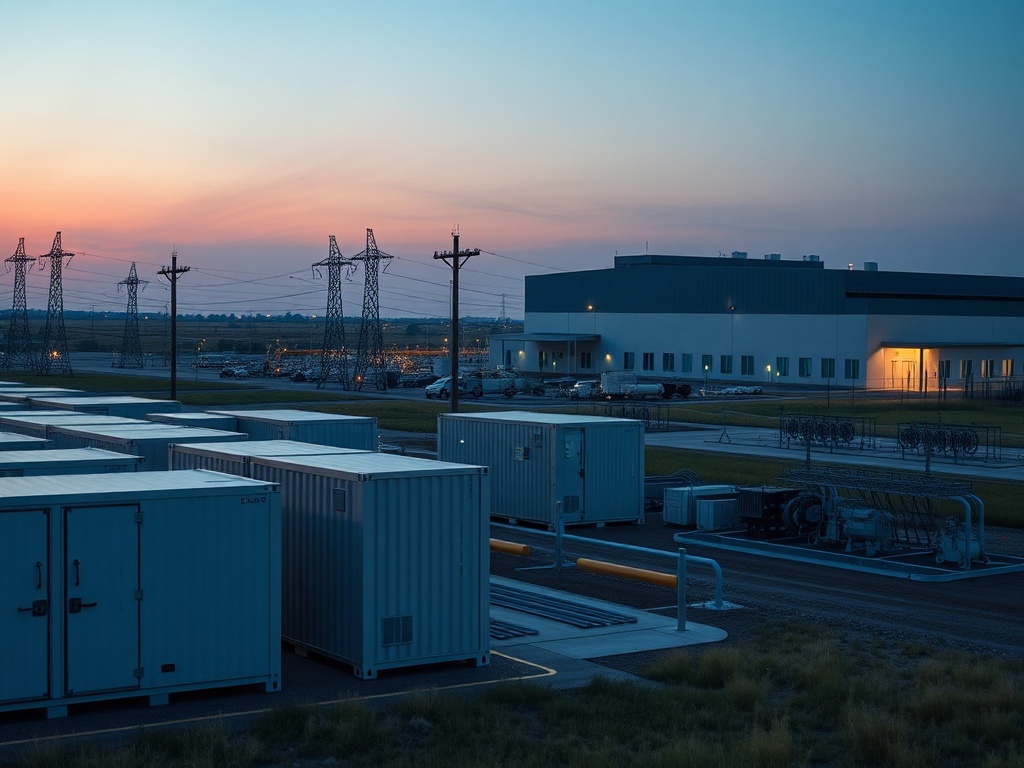

The rise of AI is not primarily hitting algorithmic limits; it is hitting an older, less glamorous limit: electricity availability, on time and with sufficient stability. While corporate rhetoric continues to speak of the "cloud" as if it were an abstract resource, data center developers are making a brutally physical decision: to build their own generation "behind-the-meter" and power GPU clusters with natural gas reciprocating engines and aeroderivative turbines.
According to TechRepublic, this strategy is accelerating due to years-long delays in connecting to the electric grid and a shortage of traditional combined cycle turbines. The result is a wave of projects in the U.S.—with Texas as the epicenter—aiming to deploy gigawatt-scale capacity within timelines that the electrical system cannot promise. Reports mention 58 gigawatts of planned or under-construction gas power in Texas, with a significant proportion exclusively dedicated to data centers. This figure is emblematic of the times: digital infrastructure is no longer "using" energy but rather competing for it.
What fascinates here is not the technology itself but the managerial psychology driving change. When a company decides to produce its own energy to run AI, it is doing more than ensuring operational continuity. It is acknowledging—sometimes without stating it—that the previous plan was a fragile promise.
The Race for Immediate Power is Redefining the AI Landscape
The news can be better understood as a sequence of defensive decisions turned offensive. Data center developers encountered a simple bottleneck: the grid cannot connect them with the speed the AI business demands. In that void, natural gas emerges as the most available shortcut, and modular generation becomes the preferred format.
The examples collected by TechRepublic are eloquent in scale and industrial creativity. Crusoe signed a $1.25 billion agreement with Boom Supersonic to supply 29 gas turbines based on airplane engines for data centers serving OpenAI in the U.S.; Crusoe's Stargate campus in Abilene, Texas, demands 1.2 gigawatts and relies on aeroderivative turbines. Meanwhile, Meta is associated with a site in El Paso, Texas, that would be powered by over 800 mobile mini-turbines, and a development in Ohio—New Albany Business Park—includes the Socrates South generating project of 200 megawatts, approved by the Ohio Power Siting Board.
That Ohio project is a pragmatic inventory: Titan 250 and PGM 130 turbines from Solar Turbines, SGT400 from Siemens Energy, and 15 Caterpillar 3520 reciprocating engines, all powered by pipeline gas. Documents mention construction starting in June 2025, completion by November 2026, and commissioning before the end of 2026.
There is a clear pattern here: when the main asset is computation, energy ceases to be an overhead expense and transforms into productive capacity. The company that once bought megawatts as if buying paper now manufactures them as critical inventory. This shift—however much it may be dressed up in engineering—is a strategic declaration about speed, control, and risk tolerance.
Reciprocating Engines: The Technical Choice That Reveals a Business Obsession
The most revealing detail of the story is not "gas yes or gas no." It is the preference for reciprocating engines over slower traditional plants, alongside the adoption of aeroderivative turbines for their availability. The reason lies in the nature of AI consumption: transient loads, sharp ramps, spikes that don’t ask for permission.
Jeff Ferguson, president of Titus Low Carbon Ventures, states plainly in TechRepublic that reciprocating engines are a better solution for data centers due to their ability to handle transient loads; they can start in one minute compared to an hour for traditional plants. This operational difference is, at its core, a difference in business models. The AI data center is not optimized for “cheap energy generation” but for avoiding minutes of instability that degrade performance, compromise service level agreements, or directly hinder revenue.
The figures presented in the briefing help clarify the market's hunger: American Intelligence and Power Corp. selected Caterpillar for 2 gigawatts of G3516 generator sets in West Virginia, capable of going from zero to full load in seven seconds. INNIO Group announced its largest order, a 2.3 gigawatt project with VoltaGrid, with 92 “power packs” of 25 megawatts each, optimized for environments up to 122°F.
In parallel, Bloom Energy reports that its order book more than doubled last year, and a November 2024 survey cited by TechRepublic indicates that data center leaders expect 30 percent of sites to use on-site energy as primary or supplementary sources by 2030. More than a trend, it is an architectural shift: a new layer of private electricity generation is being created, installed at the pace of digital demand.
My reading is uncomfortable for many executive committees: this technical preference exposes an organization that no longer trusts its dependencies. When a business purchases engines that start in seconds, it admits that its tolerance for uncertainty has become minimal and that its promise to customers is stronger than its patience with the system.
Behind-the-Meter Also Hides Behind the Conversation
The "behind-the-meter" movement has one virtue: speed. It also comes with a temptation: turning a governance decision into a procurement decision. This is the crack through which corporate ego enters.
I see three conversations that many companies are trying to postpone while signing contracts and moving CAPEX.
First: The Economic Truth of Delay. If the data center arrives late, revenues arrive late; and in AI, being late is not just losing sales but losing position. This pressure explains why they pay for aeroderivative turbines and why hundreds of modular units are deployed. The problem arises when the company presents the decision as an “energy optimization” rather than what it is: a time purchase to maintain a commercial schedule.
Second: Reputational and Transition Exposure. Natural gas comes with scrutiny over emissions, fuel costs, and methane. The news highlights the clash between net-zero promises and the reality of electrical continuity. This clash cannot be resolved with a press release or sustainability slogan. It requires transitional architecture, cleaner fuel pathways when applicable, measurement, and discipline not to turn a temporary solution into structural dependency.
Third: The Internal Culture of Responsibility. When a company “bypasses” the grid, it also bypasses a comfortable narrative: blaming the environment for every delay. Building one’s generation is to assume that the bottleneck is not an excuse; it is a design variable. This is the part where leadership becomes exposed: not for buying gas, but for accepting that its strategy requires controlling more links in the system.
TechRepublic also cites data from Global Energy Monitor: over 1,000 gigawatts of new gas capacity developing globally, a 31 percent increase in one year, with the U.S. accounting for 25 percent of the pipeline and over one-third dedicated to data centers. Cleanview identifies 46 data centers that sum up to 56 gigawatts of self-generation, equivalent to 27 Hoover dams. This magnitude no longer allows the issue to be treated as an operational exception. It is an industrial reconfiguration.
The real managerial risk is this: believing that the organization can industrialize AI without industrializing its conversation about energy, emissions, permits, community, and the financial resilience of the model.
The Move that Accelerates Revenue Also Raises the Coherence Cost
If I view profitability without sentimentality, the logic is clear. Data centers have an enormous opportunity cost when they are ready but lack energy. With connection delays, on-site generation becomes a way to protect the expected return on real estate assets, equipment, and computing contracts.
But the real cost is not just CAPEX and gas. The real cost is organizational coherence.
When a company announces climate ambitions while simultaneously raising gas gigawatts behind the meter, it is not necessarily being hypocritical. It may be facing a systemic constraint. Incoherence arises when leadership tries to hold both narratives without integrating them: when it presents gas as a “bridge” but signs agreements and designs sites as if that bridge were a permanent highway.
A power dynamic also plays out here: energy ceases to be a facilities issue and becomes a corporate strategy. This reshuffles priorities among CFOs, COOs, infrastructure leaders, and sustainability advocates. Those who do not manage this tension effectively end up with an organization that executes quickly but discusses late; and late discussion is expensive because it comes when the contract is signed, and regulators, the community, or investors demand explanations.
At this point, Ferguson’s remark about handling transient loads serves as an unintentional metaphor: the AI business is transient and abrupt, and an organization pursuing it without mature conversation also becomes transient and abrupt internally. Teams are racing, responsibilities are vague, decisions are justified by urgency, and a culture rewards putting out fires.
The executive exit is not to slow AI or sanctify the grid. It is to elevate the standard of internal honesty. To state precisely what is being purchased: time, control, speed, and continuity. And also to clarify what is being mortgaged: part of the flexibility of the climate narrative, exposure to fuel, regulatory complexity, and a technical dependency that will later be costly to dismantle.
Serious leadership does not promise purity. It promises mature management of constraints.
Mature Management Turns Kilowatts into Verifiable Promises
This wave of gas for AI is, at its core, an audit of promises. Promises to customers about availability. Promises to investors about growth. Promises to society about impact. And internal promises about what the organization is willing to sustain when the environment does not cooperate.
The temptation for the C-level is to treat this as a technical problem with a contractual solution. To sign with Caterpillar, INNIO, Solar Turbines, Siemens Energy, Bloom, or whoever, and close the subject. That is administrative comfort.
The reality is that energy is already part of the product. If the company sells computation, it is selling electrical stability. If it trains models, it is purchasing thermal continuity, fuel logistics, maintenance, and permits. If it chooses gas for speed, it is also choosing scrutiny and a conversation with the future.
I have seen too many organizations confusing control with maturity. Control is installing engines and generating behind the meter. Maturity is sustaining the complete conversation: how much it costs, what risks are accepted, what will be communicated, what will be measured, what will be reviewed, and what conditions will trigger a change in course.
The culture of any organization is nothing more than the natural result of pursuing an authentic purpose or, alternatively, the inevitable symptom of all the difficult conversations that a leader's ego prevents them from having.