
Lufthansa Fragments Mid-Flight and Its Passengers Pay the Price
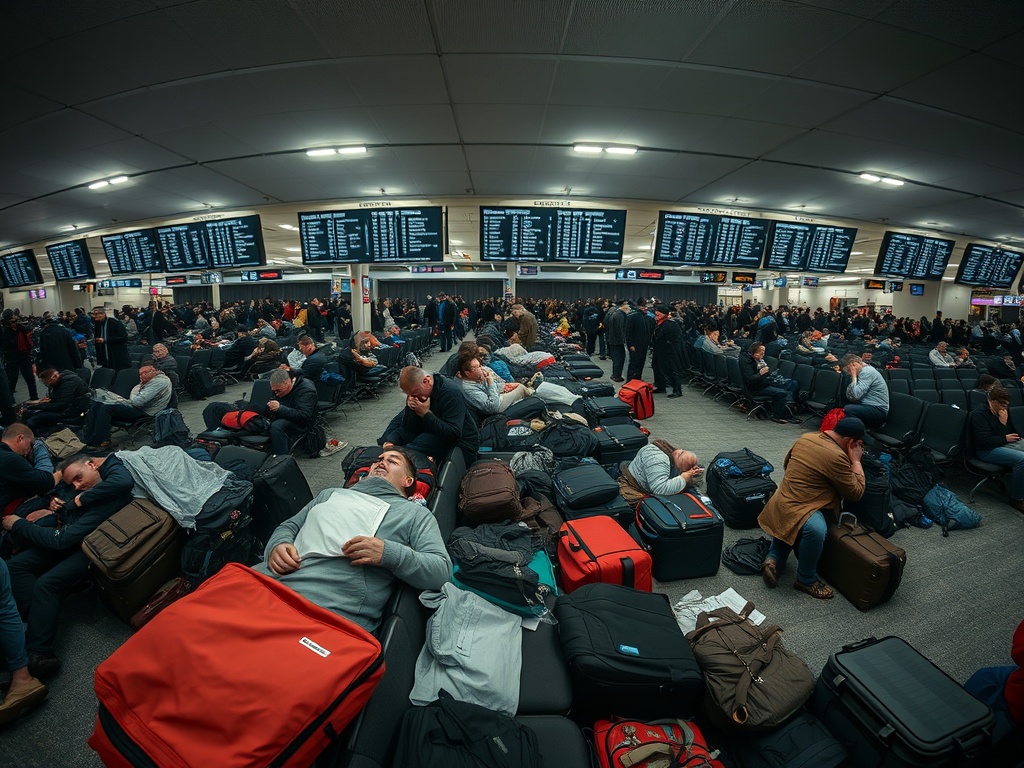
In mid-April 2026, dozens of Nigerians slept on the floor of Frankfurt Airport. Not because of bad weather delays or an isolated technical failure. They were stranded by the fourth strike Lufthansa had faced in two weeks: first the ground staff (Verdi, April 8), then the cabin crew (UFO, April 10, with 580 flights cancelled and 90,000 passengers affected), then the pilots (Vereinigung Cockpit, April 13–14), and then UFO again with a second stoppage on April 15–16 that eliminated between 80% and 90% of all operations. The airline rebooked some of the stranded passengers onto Royal Air Maroc. Those passengers waited from 5:55 pm until the following day due to technical problems with the replacement aircraft — with no transit hotel, no clear communication, and some travellers whose visas had expired preventing them from re-entering German territory.
An anonymous passenger summarised it bluntly: "The experience was horrible. I couldn't make my appointment in Nigeria and it cost me a great deal. It was frustrating because there was very little communication at the start and people had to sort things out on their own." Another added that Air Maroc simply abandoned them at the airport.
This is not an anecdote about customer service. It is the visible symptom of an operational architecture that has been accumulating assumptions without ever validating them.
A Model Built on Certainties That Nobody Tested
What is happening with Lufthansa in April 2026 cannot be explained by bad luck of timing. It is explained by a sequence of decisions made in boardrooms without sufficient friction with the reality of those who actually fly the planes.
The unions UFO and Vereinigung Cockpit have been demanding a 15% pay rise plus €3,000 in inflation compensation for months. Lufthansa has rejected the demands, characterising them as financially unsustainable in the midst of its restructuring process. Both positions can simultaneously be understandable and simultaneously be wrong in the way they are being managed. The problem is not the wage disagreement itself, which is normal in any industry with high labour costs. The problem is that Lufthansa entered the negotiation without a concession model that its own crews considered credible, and the unions escalated to the point where the company could no longer sustain operations. That is not a communications error: it is a design error in the negotiation process, which functioned as a rigid system right up until it collapsed.
On April 18, four days after the pilots' stoppage, Lufthansa announced the permanent retirement of the entire Lufthansa CityLine fleet: 27 aircraft taken out of service, with staff either absorbed or made redundant. It is a decision that, executed at that speed and in that context, signals that the regional fleet was already a liability disguised as an asset. Retiring 27 aircraft all at once is not agility; it is a belated acknowledgment that this capacity should never have been scaled to the level it had reached.
The pattern is consistent: operational capacity was built upon post-pandemic recovery projections, cost structures were locked in without room for manoeuvre in the face of union pressure, and when the first real test of labour conditions arrived, the system had no way of absorbing the impact without cancelling hundreds of flights.
What the Lagos–Frankfurt Route Reveals About Poorly Designed Dependency
The story of the Nigerian passengers stranded in Frankfurt is not a minor piece of collateral damage. It is the exposure of a fragility that affects some of the airline's highest-value routes.
Travellers from the African diaspora heading to Europe represent a segment with relatively inelastic demand: travel dates tied to professional, family, or legal commitments. When that passenger misses a business appointment in Lagos because they spent the night on a chair in a German airport, the loss of trust is not abstract. It translates into an active search for alternatives, and alternatives exist: Emirates, Qatar Airways, and Turkish Airlines all operate competitive connections between Nigeria and the rest of the world, with hubs that have shown greater stability in terms of recent labour disputes.
The Nigerian Civil Aviation Authority confirmed that Lufthansa notified the relevant authorities and that rebooking passengers on other airlines complies with regulation. Michael Achimugu, spokesperson for that body, put it in direct terms: "Either they book passengers onto other airlines or they put them up in hotels. It's that, or the passengers just stay there forever." Minimum regulatory compliance is the floor, not the ceiling. And performing at the minimum when your nearest competitor is operating with greater continuity is precisely how you lose market share on routes that do not recover easily.
The European passenger compensation regulation (EC 261/2004) adds direct financial pressure: cancellations originating from the airline's own strikes can give rise to compensation obligations of up to €600 per passenger depending on the distance involved. With 500 flights cancelled per incident and 90,000 passengers affected per stoppage, the cumulative financial exposure across this cycle of strikes is far from marginal.
Iterating the Labour Model Before the Market Forces It
The lesson Lufthansa is learning at great cost is the same one that applies to any organisation that builds complex structures without mechanisms for continuous adjustment: systems that lack frequent feedback points do not fail gradually. They fail in cascade.
UFO has warned that it is preparing further stoppages before the end of April 2026, with an eye on the Pentecost peak and the start of the European summer — which are precisely the highest-revenue periods for any transatlantic airline. Lufthansa declares itself open to dialogue while pressing ahead with the CityLine cuts. That can be read as a negotiating posture. It can also be read as two parallel processes that are not informing one another.
What no financial restructuring plan can compensate for is the accumulated loss of operational trust. A passenger who reorganised their schedule, paid for a connecting flight, and slept on a chair in a German airport is not going to read the press release about Lufthansa's strategic transformation. They are going to look for a different airline.