
Ion Quantum Computing Enters Industrial Phase as Control Moves Within the Cryostat
For years, the dominant narrative in quantum computing has revolved around qubits, fidelities, and promises of computational advantage. However, the battleground for the next two decades is less glamorous: wiring, electronics, noise, and thermal dissipation. In February 2026, a collaboration between Fermilab and MIT Lincoln Laboratory demonstrated a pragmatic turning point: trapping and manipulating ions using ultra-low-power cryoelectronics mounted inside the cryogenic and vacuum environment of an ion trap system, while also measuring electronic noise and maintaining the position of the ions. The news isn’t simply that “an experiment works.” It is that scaling has ceased to be an aspirational phrase and has transformed into an engineering problem with components that already fit together.
The team itself frames this development in terms of scale: Farah Fahim, leader of Fermilab’s microelectronics division, emphasizes that by showing that low-power cryoelectronics can operate within ion trap systems, they can accelerate the scaling timeline and, crucially, “support systems with tens of thousands of electrodes or more.” Robert McConnell from MIT Lincoln Laboratory specifies the point precisely: challenges remain in controlling ion arrays at practical scale, but this demonstration of compact, low-noise electronics lays the groundwork for hybrid integrated systems in the short term. Travis Humble, director of the Quantum Science Center, frames it as a new direction towards scalability through the integration of cutting-edge capabilities.
This column takes that demonstration as what it is: a regime shift in system design. And I analyze it through a single lens, one that aligns perfectly with this moment: Zero Marginal Cost. Not as a slogan, but as an industrial dynamic: when control electronics are miniaturized, integrated, and their thermal load is reduced, the cost of adding control channels and electrodes begins to decline steeply. In quantum computing, that slope can determine who advances to useful systems before capital loses patience.
The True Adversary of Scaling was the "Outside": Ambient Temperature Control, Cables, and Noise
Trapped ion quantum computers are prized for their long coherence times and high-fidelity operations, but their scaling runs into a known wall: the number of physical connections and control apparatus when much of it exists at ambient temperatures. In practice, moving signals from outside to a cryogenic environment involves interconnection complexity, more failure points, more sources of noise, and an assembly cost that scales poorly.
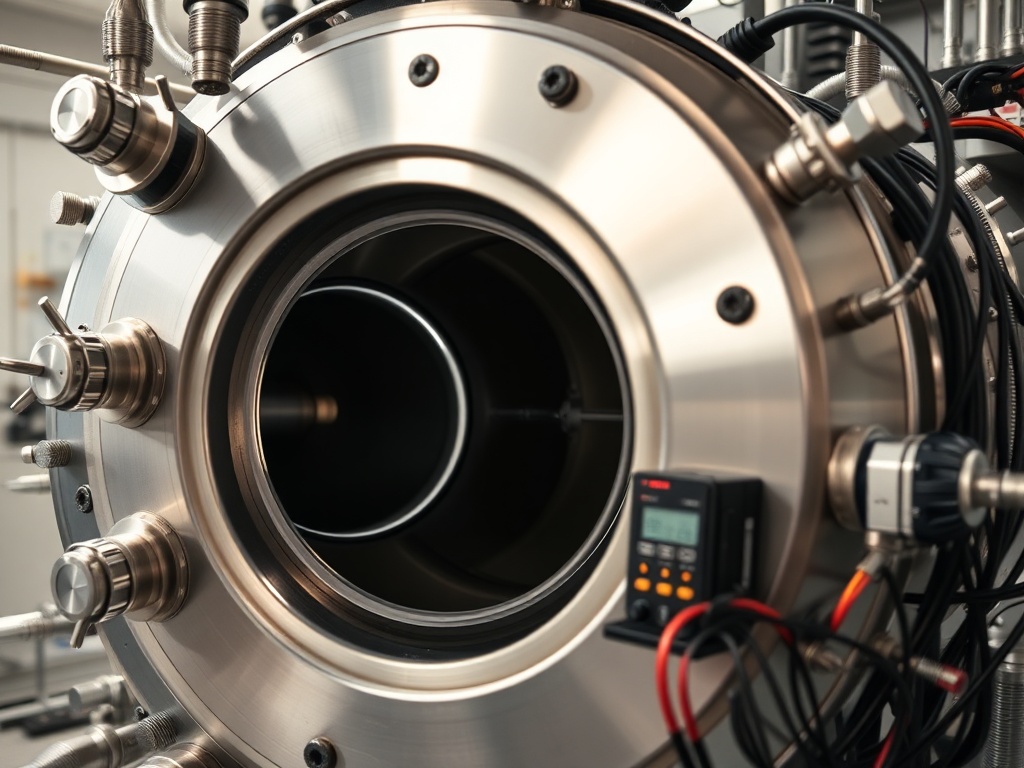
The reported demonstration integrates cryoelectronics developed by Fermilab within the ion trap system of MIT Lincoln Laboratory in an extreme vacuum and cold setting. Operationally, the milestone hinges on three verbs that matter to any system architect: move, hold, and measure. Moving ions and holding their position requires fine control of electric fields through electrodes; measuring electronic noise within the same environment provides direct evidence of one of the sought advantages: less thermal noise and higher sensitivity.
This redefines the bottleneck. Previously, the discussion revolved around whether one platform or another would reach a certain number of qubits “someday.” Now the debate becomes more concrete: how many electrodes can I control reliably, how much power can I dissipate in cold, how many cables can I eliminate, how much latency and noise can I cut. The result is not a marketing promise; it is a signal that the “system”—not just the qubit—is entering an integration logic.
Simultaneously, the industry context is already pushing in that direction. The field is populated with competing modalities—superconductors, photonics, hybrids—and, within ions, there is a growing emphasis on replacing laser dependence with electronic control as a vector for scalability. The announcement cited by Interesting Engineering positions this demonstration as a tangible step within efforts funded by the United States Department of Energy, coordinated through centers like the Quantum Systems Accelerator and Quantum Science Center. This institutional architecture matters because quantum scaling is not an isolated laboratory project: it is coordination of capabilities, suppliers, standards, and, above all, sustained budgets.
Cryogenic Integration Drives Marginal Cost Down, Altering Power Dynamics
When I talk about Zero Marginal Cost in exponential technologies, I am not referring to free resources. I refer to the transition from artisanal systems—where each additional unit costs nearly as much as the first—to industrialized systems, where adding capacity costs progressively less as the design becomes replicable, compact, and standardized.
In an ion trap, “capacity” does not just mean more qubits. It means more electrodes, more control channels, more ion routing paths, more functional areas within the chip. If each additional electrode requires external wiring, ambient temperature instrumentation, and increasing calibrations, the marginal cost of scaling rises. If, however, the control electronics become small, low-noise, and viable within the cryostat, the marginal cost begins to fall because part of the peripheral infrastructure that doesn’t scale is eliminated.
Fahim’s phrase about “tens of thousands of electrodes or more” is the central economic clue. That figure is not cosmetic: it describes a frontier where the system ceases to be a demonstrator and begins to resemble a complex programmable machine. And that complexity is only manageable if control integrates as classical electronics did at the time: closer to the “substrate” where computation occurs.
This change also redistributes power in the value chain. If scalability hinges on cryoelectronics and integration, capabilities historically not at the center of the quantum narrative gain significance: circuit design for extreme cold, packaging, materials, interconnections, and testing. In other words, the competitive advantage shifts from qubit physics to system engineering. And this shift tends to compress costs over time because engineering—when it matures—becomes a repeatable process.
In the same industrial landscape, the note mentioned fidelity milestones in the trapped ion world: IonQ announced 99.99% fidelity in two-qubit gates using its electronic control technology (EQC), surpassing a previous record of 99.97%. Regardless of who leads the ranking, the macroeconomic takeaway is direct: higher fidelity means lower error correction overhead to achieve fault-tolerant computing, reducing the need for additional physical qubits. Control integration and fidelity enhancement is a combination that not only improves performance; it reduces future costs per unit of useful computation.
The Competitive Landscape Reorganizes Around “Integrated Hybrid Systems,” Not Just Slogans
Quantum computing exists in a market where narratives compete with capital patience. What matters in 2026 is not who publishes the most elegant paper, but who reduces the scaling risk with verifiable evidence. Here, MIT Lincoln Laboratory and Fermilab present a concrete piece: low-power cryoelectronics operating in the environment where the trap resides.
Robert McConnell expresses it soberly: significant challenges remain in controlling ion arrays at practical scale, but this compact, low-noise electronics lays the foundation for integrated hybrid systems that are expected to develop soon. That phrase is, in reality, a compressed industrial roadmap: “integrated hybrid” implies that the final product will not be a set of subsystems connected for convenience, but an architecture designed for manufacturing, testing, and maintenance.
Simultaneously, other fronts aim for the same destination: the miniaturization of traps through 3D printing, with demonstrations of entangled gates and metrics on motional heating, seeks to reduce noise and enable applications in sensing, atomic clocks, and mass spectrometry. It is not the same path, but the same economic logic: more functionality in less volume, more repeatability, less sensitivity to external infrastructure.
The consequence for the sector challenges those still thinking “one platform will win and the others will disappear.” What tends to happen in frontier technologies is that modalities converge into integration and manufacturing strategies. The real fight moves to technology packages: cold electronics, integrated photonics where applicable, electronic control to reduce dependence on bulky instruments, and a calibration and operational software that supports large scales.
In this arena, public funding coordinated by DOE research centers functions as a catalyst for shared capabilities and expensive infrastructure. In the short term, that does not guarantee automatic commercial leadership. But it does reduce the technological baseline risk and accelerates transfer towards more plausible architectures.
Mandate for Leaders: The Winner Will Be Who Turns the Lab into Production Line
The demonstration of cryoelectronics within an ion trap system should not be read as an “incremental advance.” It should be interpreted as a signal that quantum computing is entering its industrial phase: the phase where future performance depends less on experimental heroics and more on integration, manufacturing, control, and costs.
The paradigm shift is mathematical. If control integrates and noise decreases, scaling stops being a complexity multiplier and starts resembling a capacity multiplier. That is the point where marginal cost tends to compress, timelines shorten, and the competitive map rewrites.
Global leaders allocating capital, talent, and technology purchases must treat quantum computing as what it is already becoming: a race of complete systems where advantage builds through mastering integration and economies of scale, because that discipline will define who captures the strategic computational infrastructure of the next decade.