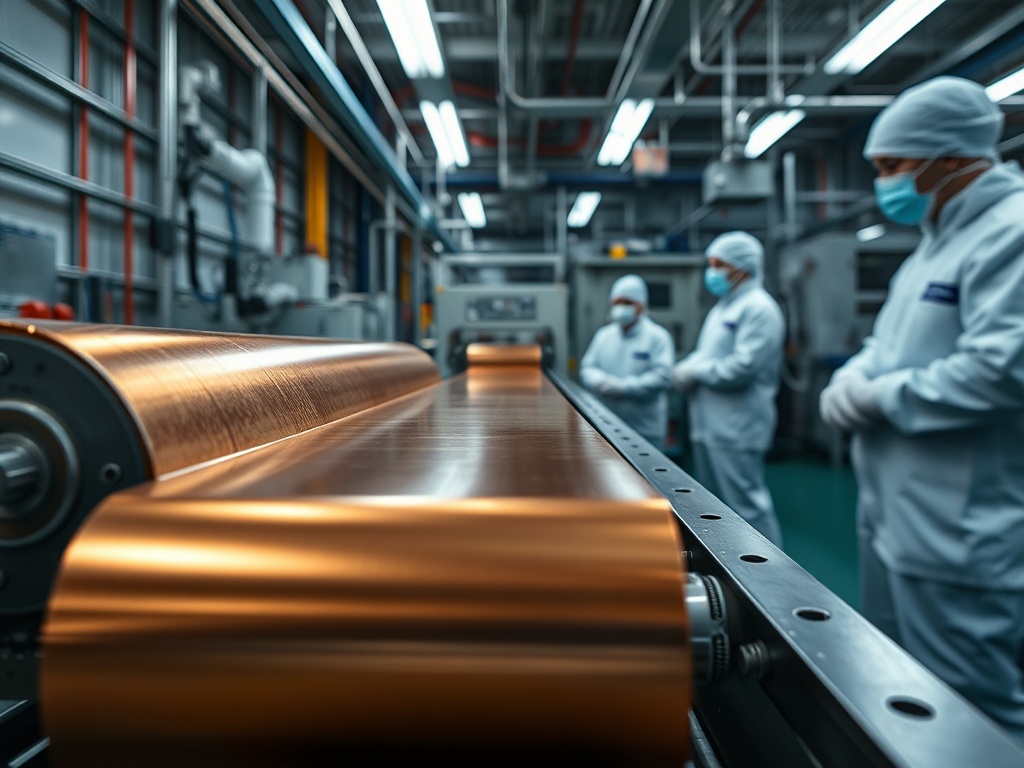

The Lithium Coating that Transforms a Chemical Improvement into a Measurable Industrial Advantage
The race for the "better" battery is often framed as a competition of exotic materials and next-generation promises. Yet, in manufacturing, financial decisions rarely hinge on the most elegant idea. Instead, they are driven by improvements that boost performance and reduce friction in the production line.
At this intersection lies the advancement published on January 21, 2026, in Energy and Environmental Science by a team from UNIST (South Korea): a dry process electrode technology that incorporates a thin film of metallic lithium between the active material of the anode and the copper current collector. According to the report, this 'subfloor' of lithium cuts capacity loss in the first cycle by 75% compared to traditional dry thick electrodes and could increase electric vehicle range by approximately 20%. Additionally, the technique achieves 100% initial coulombic efficiency (ICE) at the anode and raises the ICE in complete cells with NCM811 by 20%, while maintaining compatibility with existing roll-to-roll manufacturing. The operational implications are critical: it replaces adhesion "primer" layers and consolidates prelithiation into a single dry step.
The point is not just the number. The key issue is who captures the value when performance improves without raising production costs and when the line does not turn into a museum of additional processes.
The First Cycle as a Value Leak and the Business Behind Sealing It
First-cycle loss is one of those inefficiencies the industry tolerates because historically, it was cheaper to "manage" than to eliminate. In batteries, this loss translates to lithium consumed irreversibly in forming the solid-electrolyte interphase (SEI) and other reactions that do not contribute to usable capacity. In thick electrodes—necessary for increasing energy density—the problem becomes more pronounced: more active material is crammed in, but part of that gain evaporates right at the start.
What the UNIST team reports is a surgical intervention: the metallic lithium acts as a reserve to compensate for those initial losses and, due to its electrochemical potential, migrates towards the active material, facilitating a uniform and fluorine-rich SEI, suppressing electrolyte decomposition and lithium consumption. Translated into industrial logic: less initial degradation means more effectively sellable capacity per cell from day one.
This carries a simple financial reading. If a manufacturer can bring real performance closer to nominal performance without increasing proportional costs, then the margin per unit grows or a superior value proposition can be enabled at the same cost. The figure of ~20% potential range is not marketing when linked to a measurable bottleneck: in electric vehicles, range is a selling point that is often purchased with more kWh (more cells, more weight, more cost). If part of that range is achieved by reducing losses, the improvement directly competes against the expensive alternative: oversizing the battery pack.
The caveat is equally relevant: the leap from lab to stable production line hinges on reproducibility of the film, safety control of metallic lithium, and uniformity at scale. The work is presented as compatible with roll-to-roll, and that term is what drives investment committees, not the adjective "revolutionary."
Dry, Thick, and Scalable: When Innovation is About Removing Steps, Not Adding Them
Dry manufacturing is appealing for one structural reason: it eliminates solvents and associated stages, reducing environmental costs and, in many cases, operational complexity. However, the dry process with thick electrodes carried two burdens: limited ionic mobility and irreversible lithium losses in the first cycle. The net effect was uncomfortable: energy density and sustainability were promised, but initial performance was weaker.
Here, the metallic lithium layer functions as a "dual-use" component with a very clear plant logic: it acts as an adhesive and a source of lithium. This replaces the adhesion primer, which involved an additional step, and simultaneously integrates prelithiation without branching into a new process. This aspect is often underestimated in many analyses: in batteries, adding an extra step does not sum linearly; it multiplies risks of scrap, cycle times, and quality validation.
From a CAPEX and retrofitting perspective, compatibility with roll-to-roll lines lowers the adoption threshold. Hyun-Wook Lee describes it as an integrable process “like newspaper printing” at scale. If sustained in pilots, the value lies not just in a better cell but in an industrial upgrade that doesn’t require abandoning existing plants.
Additionally, there is a competitive implication: this technique works with high-nickel cathode chemistries like NCM811, meaning it targets the segment pursuing high energy density with materials already on the industrial map. It is not betting on a complete chemistry break requiring retraining of the entire chain; it is improving the core.
Where Margins are Captured: Range, Cost per kWh, and Negotiation Power
A potential range increase of ~20% shifts the entire commercial conversation. In a market where much of the cost of the electric vehicle lies in the pack, range is often bought with more battery. If performance is recovered through lower initial losses, the manufacturer has three strategic options, each with different value distribution.
First: maintain the pack and sell more range. This increases the end customer’s willingness to pay—due to perceived performance—and allows capturing margin if the incremental cost of the lithium layer and its implementation is low compared to the market value of those extra kilometers.
Second: maintain the target range and reduce installed kWh. This lowers direct vehicle costs and can sustain prices to capture margin, or lower prices to scale volume. In both cases, the "victory" does not lie in the chemistry, but in the total system cost.
Third: reallocate savings to robustness, warranty, or charging speed without altering price. This option is often the smartest in markets where trust and aftersales costs define real profitability.
The promise of 75% lower first-cycle loss also touches on the KPI that matters most in operations: output performance and consistency. Less initial deviation can mean less sorting by performance and fewer internal penalties. I have no scrap or yield numbers from the source, so I won’t invent them, but the direction of the effect is relevant: when the first round stops consuming capacity, quality control has less variability to absorb.
Simultaneously, this innovation shifts power within the supply chain. If the dry process with the lithium layer is adopted, the supplier able to offer consistent and safe lithium film captures more prominence. However, the cell manufacturer also gains negotiation power against OEMs: range or reduced costs become commercial arguments backed by technical support.
Professor Won-Jin Kwak’s remark that the dry coating field is pursued by global companies like Tesla serves as a signal of industrial alignment, not as automatic commercial validation. In my experience, the industry rewards those who stabilize the process window and unit cost first, not those who publish first.
The Hidden Risk: When the Industry Confuses Cell Improvement with System Improvement
There’s a recurring pattern in batteries: a lab number is reported, and the market translates it into an immediate advantage in vehicles. The source is careful to speak of "potential" range increase and to anchor the advance in manufacturing compatible with roll-to-roll. That prudence is correct.
The metallic lithium layer, by definition, introduces lithium handling that requires safety discipline, moisture control, and traceability. None of this invalidates the idea but does define the real cost of implementation. The simplification promise from eliminating the first cycle is powerful because it compensates for some of that complexity. Commercial success relies on the consolidated process being genuinely simpler in the complete line, not solely in the diagram.
Furthermore, the industry is moving in parallel on other paths: imaging techniques to optimize binder distribution and reduce internal ionic resistance by up to 40% (Oxford), "smart" protective layers using additives like thiophene to suppress dendrites during fast charging (KAIST), or polymer gels to stabilize anode-free architectures (Columbia). The strategic reading is not about choosing one. It’s about understanding that the winner will be the one who turns partial improvements into a coherent industrial system.
This lithium layer competes effectively because it addresses a significant pain point early in the life cycle, defining how much "sellable" energy remains within the cell. And it does so with a credible industrial narrative: fewer steps, more compatibility, better first cycle performance.
The Sustainable Advantage Lies in Sharing Benefits, Not Concentrating Them
If this approach scales successfully, value distribution becomes the axis. Customers win with more range or lower prices. Cell manufacturers win if they convert performance into margin without inflating their cost structure. OEMs win if they can design lighter or better-performing vehicles without inflating BOM. Suppliers win if the lithium film standard becomes a stable category with long-term contracts.
The typical mistake would be to use the improvement to squeeze one actor in the chain, for example by shifting price pressure to suppliers under the argument that "now the cell performs better." Such capturing curtails upstream investment and makes the supply fragile, especially in sensitive materials and delicate processes.
The correct business decision is to transform technical improvement into a proposition that makes each actor prefer to stay: supply contracts that finance quality, integration agreements with OEMs that share the upside of range, and shared metrics of real performance in the field to avoid the benefits remaining solely on the technical sheet.
The lithium layer does not create magic; it seals an economic leak in the first cycle and reduces steps in the plant. In that combination, the real value is captured by those who integrate the process without passing the invisible cost to their partners, while it is lost by those who attempt to concentrate margin in the short term and end up increasing the operational risk of the entire chain.