
The Disposable Satellite Faces Its First Serious Commercial Rival
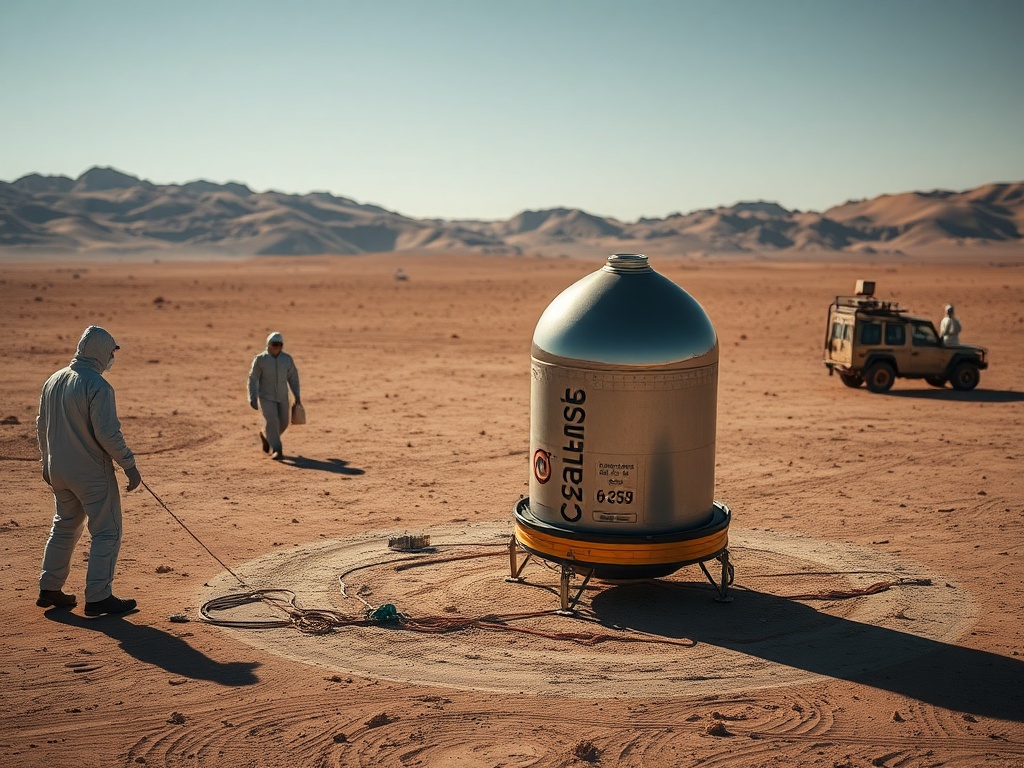
Lux Aeterna, a Denver-based space startup founded by former SpaceX engineer Brian Taylor, has boldly stated something the industry tends to overlook: the typical satellite is bought and treated as disposable. It is launched, completes its mission, and ends up burning up in the atmosphere or becoming space debris in so-called graveyard orbits. The company raised $10 million in an oversubscribed seed round to build Delphi, which they describe as a reusable satellite platform. A demonstration mission is scheduled for the first quarter of 2027 aboard a SpaceX Falcon 9. This mission involves orbital operations with third-party payloads, controlled re-entry, recovery on Earth, and preparation for a new flight. Reportedly, this first mission is entirely sold out to commercial and defense customers.
The interesting fact is not the funding, which often dissipates quickly in the aerospace sector, nor the SpaceX affiliation of its founder, which no longer guarantees success. What stands out is the product focus: reusability is centered on the satellite, not just the rocket. This shifts who pays, when they pay, and what can be learned between flights.
Reusability Moves from the Rocket to the Client Asset
Over the last decade, the economic breakthrough in the sector has come from the launching side: SpaceX recovers and reuses stages of the Falcon 9, cutting costs and increasing launch frequency. However, satellites have essentially remained "one-use" assets. Even when discussing extending lifetimes with in-orbit services, the dominant model is to stretch the same hardware, not to recover it.
Lux Aeterna attempts to shift the reusability logic to the component that has the most financial impact on the customer: the satellite as a platform. Delphi, according to available information, combines a modular bus that folds for protection and a "flight-proven" conical thermal shield inspired by NASA sample-return mission designs. This technical choice is more than just engineering; it is a commercial positioning. In re-entry, the “exotic” can ruin companies. Choosing architecture based on proven historical designs reduces the number of unknowns that need funding simultaneously.
The business objective is easily understood: if a company manages to bring the satellite back, it can recover payloads, inspect failings, refurbish, and re-fly. This opens up a different class of customer compared to the typical satellite with a lifespan of 7 to 10 years designed never to return. It resembles more a lab wanting to iterate on hardware, or defense needing to test and adjust rapidly, or companies wanting on-orbit computing without betting everything on a single campaign.
There’s a secondary effect: the recoverable satellite can function as a “container” for multiple hosted payloads. It is not just competing to sell a satellite; it is competing to capture recurring budgets for experimentation.
The Best Indicator of Validation is Not the Press, but Sold Capacity
Space is full of beautiful presentations with heroic dates. What separates ambition from business is the economic commitment before demonstration. In this case, TechCrunch reports two useful signals.
The first is the funding: Lux Aeterna went from $4 million pre-seed (June 2025) to $10 million seed (announced in early 2026). This is not a huge amount for space hardware, but it is enough to build a testing path and reach a demo if the company remains disciplined.
The second signal, stronger, is that the Q1 2027 mission is completely booked by commercial and defense customers. This is the closest thing to validation of a willingness to pay that exists in a market where the final product has yet to fly. It does not mean the product is validated. It signifies that the problem exists and that buyers are ready to take risks to access capacity.
Now, it is wise to be skeptical: “sold out” without names, prices, or specifications of mass, volume, energy, or reuse cycles disclosed is also a gray area. It could be capacity limited by design or prudence. It could represent a small manifesto. It could be a handful of contracts with flexible clauses. No inferences can be made beyond what has been published.
Still, from a product perspective, reserving capacity before the flight forces a mindset focused on the customer rather than on the ego in the laboratory. The pressure to meet third-party payloads tends to organize priorities: interfaces, integration, schedules, tolerances, and recovery procedures.
The Unit Economics Depends on What Has Yet to Be Revealed
Lux Aeterna’s thesis stands if the reusable satellite reduces costs per campaign for the customer while allowing the company to capture margins from refurbishment and re-flight. The problem is that the critical figures are still not available.
Available sources do not detail refurbishment costs, payload capacity, or expected cycles per satellite. Without these figures, the unit economics remain a hypothesis.
Nonetheless, it is possible to map where the breaking points are.
First, re-entry and recovery. It is insufficient to survive the plasma; the satellite must return in a condition that allows for repeatable refurbishment. If each return involves months of artisanal engineering, reusability becomes an expensive slogan. The business demands an industrial process, even if initially at a small scale.
Secondly, the logistics of re-entry. Lux Aeterna announced a partnership with Southern Launch for re-entries and recoveries in southern Australia. This suggests the company is building a full operational chain, not just a vehicle. The return to Earth is a system product: permits, drop zones, tracking, recovery, transport, inspection.
Thirdly, payload integration. Exolaunch is participating in integration support for the first flight. For a “satellite as platform” model, integration friction can kill scale. An experienced integrator helps but also sets a quality standard that must be maintained internally.
Lastly, the price effect. Coverage mentions that avoiding full satellite rebuilds could reduce costs and that custom satellites may cost tens of millions. Still, there are no figures for Delphi. Without pricing, the market cannot be dimensioned. The typical risk is that the product turns out to be so expensive and specific that it serves only for demonstrations and special programs without volume.
The Important Market is for Rapid Iteration and Evidence Recovery
The space industry lives in tension: more satellites, more orbital congestion, and more pressure for sustainability. The briefing notes over 36,000 tracked objects in orbit by 2025, a reminder that the “use and toss” approach is becoming costly in terms of risk and sector reputation. But sustainability, by itself, rarely pays bills in space. What pays is time.
The returning satellite creates a shortcut for learning cycles. In defense, it translates to more frequent testing, iteration of payloads, and performance validation without waiting years. In microgravity manufacturing or applied research, it means recovering samples or prototypes with physical evidence, not just telemetry. In on-orbit computing, it enables hardware changes and degradation measurement.
This market looks less like traditional telecom and more like “missions as a service,” where value lies in repetition. Hence the phrase attributed to the founder about fleets returning to Earth for rapid re-launch speaks to the heart of the model: cadence.
The competitive risk is also unique. It is not just about other startups; it also concerns alternatives that solve part of the problem without re-entry: hosted satellites, life extension, or dedicated return capsules. Lux Aeterna differentiates by integrating platform + return, but this also compels precise execution across multiple fronts simultaneously.
And there’s a meta-risk: the timeline. Q1 2027 is a date close enough to impose discipline, yet far enough for hardware surprises to arise. In space, delays are not exceptions; they are part of the cost.
Executive Discipline is About Turning the 2027 Demo into a Repeatable Product
Lux Aeterna’s experiment hinges on a simple sequence: fly, re-enter, recover, refurbish, and fly again. The key word is again. Many companies can achieve a one-time demonstration; few convert that into an operation that repeats with minimal variation.
From a product strategy angle, success is not “having survived re-entry.” Success is demonstrating that the return produces an asset that retains economic value. This is proven through concrete operational indicators, even if they are not public: refurbishment time, failure rates by subsystem, logistics costs, payload integration time, and stability of interfaces so the customer does not have to redesign every time.
There is also a governance issue: when there is defense interest, the temptation is to become a project-based company with changing requirements and opaque margins. The platform model demands the opposite: standardization, repetition, and a controlled roadmap. If Delphi ends up being “one different per customer,” reusability loses its economic sense.
The best move read between the lines is that the mission is sold before the flight. This suggests that Lux Aeterna is not building blindly. Now they have the obligation to turn commitments into operational evidence.
Sustained business growth only appears when the illusion of the perfect plan is abandoned and operations are under constant validation with the actual customer.