
The Delay of the Steam Machine: A Brutal Audit of Promises
Valve is hinting that its Steam Machine—a console-shaped PC powered by SteamOS 3—will likely not meet the deadline the market had assumed. Instead of the previously suggested "early 2026," the language has shifted to a more cautious stance: "before the end of 2026, with no guarantees," leaving the possibility open for a slip to 2027. The reported reason is as cold and typical as it gets in hardware: supply restrictions on memory and storage.
The executive temptation is to classify this as mere operational noise. A supplier issue, a matter of component cycles, a physical world that resists the software narrative. However, the delay of a product like this isn't just a supply chain event; it’s a public audit of commitments. Above all, it’s a reflection of an organization’s maturity when the market begins to confuse ambition with a fixed timeline.
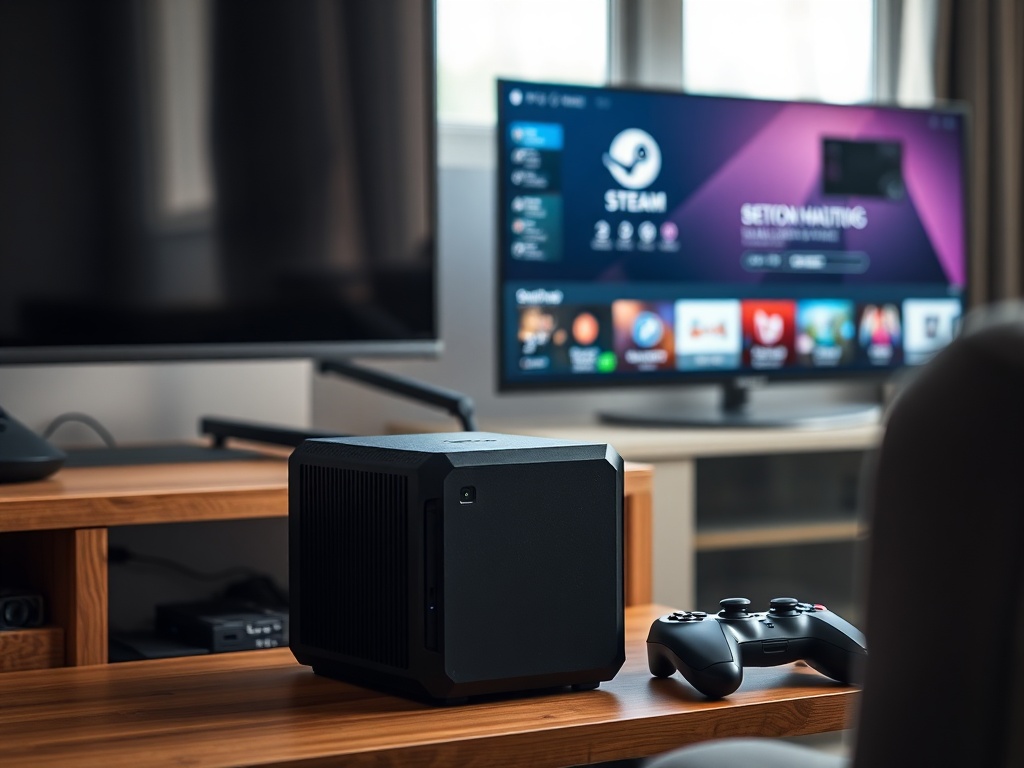
From what has been disclosed, the Steam Machine aims to fill an awkward yet appealing space: the living room. A compact, cube-like chassis weighing about 5.7 pounds, equipped with AMD Zen 4 six-core processors, RDNA 3 GPUs with 28 compute units, 8 GB GDDR6, expandable 16 GB DDR5, and NVMe SSD options of 512 GB or 2 TB, along with microSD capabilities, Wi-Fi 6E, Gigabit Ethernet, DisplayPort 1.4, HDMI 2.0, and running SteamOS 3 on Linux with KDE Plasma. Performance is targeted at 4K at 60 FPS using FSR 3 scaling in compatible titles, boasting a jump of “up to six times” over the Steam Deck, presented more as a rough benchmark than a precise metric.
The broader picture depicts a company eager to capitalize on the success of the Steam Deck, returning to the living room: as a primary machine, a new Steam Controller, and a streaming device. What’s interesting for any C-Level executive is not the catalog of specifications, but what the delay reveals about the relationship between strategy, promises, and control.
A Living Room Product Turns Logistics into Reputation
In the living room, it’s not a PC that’s being sold; it’s a ritual. It’s about continuity: powering it on, playing, updating effortlessly, living with the device as if it were a premium appliance. That kind of promise alters the nature of risk. A delay in a peripheral is an inconvenience. A delay in "the living room machine" sends a message.
The cited reason—the shortage of DDR5, GDDR6, and high-capacity NVMe SSDs—may be accurate and sufficient to explain the date. However, it doesn’t explain why an organization allowed an "early 2026" expectation to consolidate in previews and technical rounds, only to retract to conditional statements later. That’s where the silent cost appears: each time a company adjusts the timeline, it rewrites its credibility.
Valve is not a manufacturer without a history: the Steam Deck changed the conversation about portable PC hardware and proved its capability to execute. Precisely for that reason, the market pays attention when Valve appears conservative. The point isn't whether the delay is "normal"; it’s that the “console-style PC” segment punishes uncertainty because it competes against consoles with mass production schedules and supply agreements locked in years in advance.
Furthermore, the Steam Machine is positioned in a directly comparative space: performance between the Xbox Series S and PlayStation 5 for 1080p–1440p, and 4K with scaling. It’s a technical promise and an experience promise. When the cause of the delay is memory and storage, the executive translation becomes uncomfortable: the components defining the cost and margin are precisely those that cannot be secured right now.
In hardware, the timeline isn’t marketing; it’s a derivative of inventory, wafer allocation, module availability, line performance, and, above all, the ability to sustain a target price. If supply tightens, the real dilemma is binary: you either raise the price, lower the specifications, or delay. Choosing to delay is, in branding terms, the most defensible option; in business terms, it can be the most costly.
The Trap Isn’t Supply: It’s Promising Without Governing the Promise
I've seen too many organizations retreat to external arguments to avoid internal conversations. "The supply chain." "The market." "The components." That’s partially true, yet it’s rarely the core issue. The core issue is the governance of the promise.
A release promise is not a date on a slide. It’s a network of commitments: engineering with operations, purchasing with finance, marketing with product, and product with the user. When something slips a year, the failure is rarely a miscalculation; it’s often a conversation that was never held with the necessary bluntness.
In this case, the mentioned restrictions hit the heart of the BOM: RAM, VRAM, and SSD. Anyone who has attempted to build a "console-like" device within a controlled budget understands that memory and storage are often where margins are won or lost. What the delay suggests is that Valve is prioritizing sustaining a target configuration—and likely a price consistent with that positioning—over releasing at any cost. That’s the virtuous side.
However, virtue doesn’t erase the organizational question that remains open, even without a question mark: if the plan was early 2026, then the planning system either underestimated the fragility of supply or overestimated the company’s negotiating power with vendors and allocations. In both cases, the lesson is the same: strategy without control over critical constraints becomes narrative.
There’s another layer: Valve operates with the muscle of Steam as a platform, which may induce a bias of "software thinking" in hardware decisions. Software allows for iteration with the customer involved. Hardware demands earlier iteration, up-front payments, and more expensive mistakes. The Steam Machine, with its ambition of being a "PC with console ease," must be stable from day one. If supply doesn’t allow for stability, delay is a defensive choice.
The signal, therefore, isn’t technical weakness. It’s a strategic warning for any company attempting to transition from the platform world to the device world: physics punishes ego. And ego, in corporations, manifests as the need to maintain a linear narrative, even when reality is probabilistic.
Three Scenarios and a Common Denominator: The Price of Maintaining the Narrative
When a company "hopes" to launch before year-end "without promises," it’s attempting a delicate balance: not cooling demand, not activating cynicism, not missing the competitive window. Such language exists because, internally, there is more than one possible future.
Scenario One: Valve secures sufficient supply and arrives by late 2026. The costs here are often invisible to the public but real for the P&L: more expensive contracts, committed inventory, prioritization of SKUs, and likely a lower initial margin to protect the entry price. In a living room product, price matters because it competes with subsidized consoles or those with tremendous economies of scale.
Scenario Two: The launch moves to 2027. The cost shifts elsewhere: opportunity. The Steam Deck continues to sell, yes, but the plan described as a "three-device push" loses synchronization. In hardware, the portfolio functions as a cohesive conversation: the controller, the streaming device, the main machine. If the machine is delayed, the rest become pieces without a center of gravity.
Scenario Three: Valve adjusts specifications or storage configurations to unlock production. Here lies the risk of identity. If the product is sold as a "console-style PC" with aspirations of 4K/60 FPS with FSR 3, altering memory or storage can affect perceptions of fluidity and "future-proofing." The living room doesn’t just care about performance; it cares about frictionless experience.
All three scenarios share a common denominator: the organization pays for the narrative it chose. If the narrative was "triumphant return to the living room with console-level power," then memory and SSD are not just components; they are symbols of the standard. And when those symbols are absent, leadership faces its classic test: maintaining the standard and explaining the cost, or degrading the standard and explaining the compromise.
Here’s a detail that often goes unnoticed: in the available sources, there are no direct quotes from executives attributing the decision to named individuals; it’s generically assigned to "Valve." That protects individuals but also dilutes the emotional contract with the market. In small crises, impersonality serves. In bets aiming to establish themselves in the living room, impersonality incurs costs.
Real Innovation Isn’t Just Launching Hardware: It’s Sustaining Painful Conversations
The gaming industry is filled with canceled, delayed, or "reimagined" products. What differentiates the companies that endure is not the avoidance of delay but how they metabolize it internally.
A supply delay, when looked at closely, is a conversation about priorities: margin vs. share, specification vs. price, volume vs. quality, date vs. reputation. Each of those dilemmas has a technical component, but their resolution is political. And politics, in companies, is the sophisticated form of fear: fear of contradicting previous narratives, fear of admitting that the plan was overly optimistic, fear of disappointing teams.
Reportedly, Valve isn’t discussing cancellation. It’s doing the opposite: creating space for less fragile execution. That deserves recognition, not romanticism. In markets where consumers pre-purchase emotionally, temporary honesty can be a competitive advantage. Not because the delay is "good," but because it reduces the risk of launching a product that turns into support debt, returns, and experience patches.
The lesson for C-Level executives isn’t to memorize the Steam Machine case. It’s to accept that each public target is a commitment that inherits across the organization. When the target becomes unreachable, the company doesn’t face a deviation from the plan; it faces a mirror. What that mirror reflects is whether leadership governs promises or merely manages expectations.
The culture of any organization is merely the natural outcome of pursuing an authentic purpose, or the inevitable symptom of all the difficult conversations that an executive’s ego doesn’t allow them to have.