
The Problem No Hospital Could Solve Alone
During the most difficult months of the pandemic, hospitals worldwide faced the same operational contradiction: they had enough data to train AI models to predict which patients would deteriorate, but they could not share this data. HIPAA in the U.S., GDPR in Europe, and equivalent regulations in dozens of other countries turned every transfer of medical records into a legal risk with potential liabilities in the tens of millions of dollars. The result was absurd fragmentation: each institution trained its own models with small samples, generating tools that worked well within their walls but faltered when faced with data from other hospitals.
EXAM—the model developed collaboratively among 20 hospitals—tackled this contradiction from its architecture. It did not request data; it requested something more intelligent: the lessons that those data had generated.
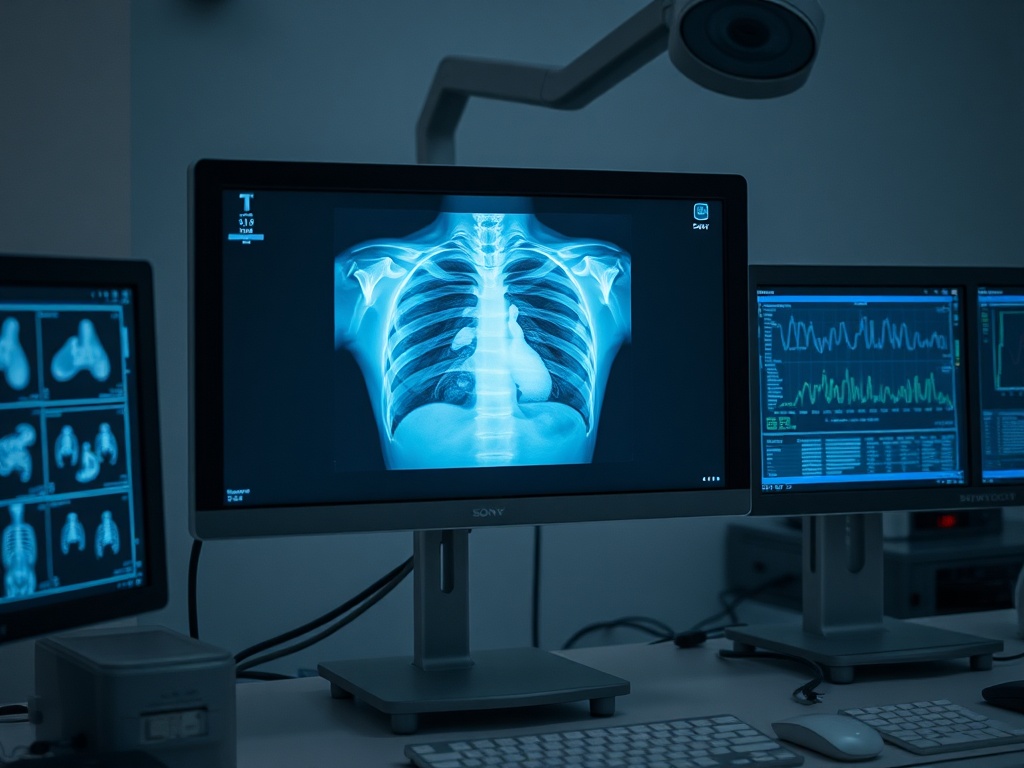
Utilizing federated learning, each hospital trained the model locally on its own chest X-rays and clinical histories, then shared only the mathematical updates of the model, not the patient records. The global model absorbed distributed learning from 20 distinct sources without any data crossing institutional borders. The result was a 16% jump in accuracy and 38% in generalization compared to models trained centrally with homogeneous datasets. This difference is not statistically marginal: in intensive care triage, every percentage point of accuracy has a specific name and a specific patient associated with it.
Why Generalization Matters More Than Local Accuracy
The indicator I find most interesting about EXAM is not the 16% improvement in accuracy; it is the 38% improvement in generalization. This is the strategic argument that most analyses of this tool overlook.
An AI model in healthcare that performs well in the hospital where it was trained but fails in another center has a commercial value close to zero outside that context. Practically speaking, it is a non-transferable asset. When NYU Langone developed its own model using 5,200 X-rays and achieved up to 80% accuracy in predicting severe COVID-19 progression, it built a powerful tool for itself. The unanswered question is how much of that performance survives when the patient demographics, imaging protocols, or radiological equipment change.
EXAM, having been trained simultaneously on the heterogeneity of 20 distinct institutions with diverse populations, builds a model that has already seen variability. It does not need to generalize afterward because it absorbed that variability during training. This has a direct implication for any hospital evaluating whether to adopt such tools: a model with 38% more generalization substantially reduces the cost of local retraining, which in medical AI projects can represent between 30% and 60% of the implementation budget.
Federated architecture is not just a privacy mechanism; it is a variable cost reduction mechanism for each participating node.
The Economy of Trustless Collaboration
What EXAM built, in terms of incentive structure, is something the pharmaceutical industry has been trying to achieve for decades without success: competitive collaboration without relinquishing strategic assets. Each hospital gave up learning but retained the data, which are the proprietary raw materials that sustain their position in future models.
This architecture solves a governance problem that has paralyzed dozens of similar initiatives. University hospitals do not share clinical data with competing institutions, not because they are malicious organizations, but because patient data is simultaneously a regulated asset, a research asset, and a legal liability. Any collaborative model that demands relinquishing that asset faces an institutional barrier that no good-will contract can overcome.
Federated learning eliminates that barrier. By doing so, it opens the possibility of building models on a global scale using data that would otherwise remain in perpetual silos. Massachusetts General Hospital developed its own severity scoring system pre-trained on over 224,000 X-rays from Stanford's CheXpert dataset and fine-tuned on 314 COVID cases—a considerable data engineering effort for a sample that, in the context of EXAM, would be just another node in the network.
The difference in scale is not merely technical; it is a difference in the type of questions each model can reliably answer. Models trained on tens of thousands of X-rays from a single source answer well questions about that source. Models trained on the heterogeneity of 20 different hospital systems answer questions about the human condition in general.
A meta-analysis of nine studies on AI applied to chest X-rays for COVID-19 reported an area under the curve of 0.98—an extraordinary number in any other diagnostic context. The same analysis noted that only 22% of the reviewed studies used external validation. The remaining 78% built tools that have not been tested outside the context in which they were born.
The Model the Healthcare Sector Needs to Copy
There is a structural pattern in how healthcare digitization tends to fail that EXAM directly disrupts. The usual inertia creates an industry where each major hospital center develops its own AI tool, typically with non-recoverable research funding, lacking monetization architecture, and with little capacity for post-publication maintenance. The result is a graveyard of academically solid but operationally dead models.
The federated architecture opens a different logic. A consortium of hospitals sharing updates of the model—not data—can maintain a collective asset whose maintenance cost is distributed among all participants while its benefit scales with each additional node. This is a cost model with very different properties than isolated proprietary development.
For healthcare executives evaluating investments in clinical AI, the operational question is not whether to adopt these tools. It is whether their institution is designing those tools to remain trapped within its own walls or to become more accurate with each new partner joining the network. A model that improves over time without compromising patient privacy is not just a technological advantage; it is the only financially sustainable architecture for medical AI in the long term.
Today's leaders making technology architecture decisions in healthcare are choosing between building assets that depreciate in isolation or building assets that appreciate through collaboration. The evidence from EXAM is that the latter option yields more, costs less to maintain, and does not require sacrificing any sensitive assets to achieve it. That is the audit every C-Level executive in the industry should conduct before signing the next AI contract: whether their technological investment model uses their patients' data as an extractive raw material that gets locked away or whether it possesses the architecture to convert that same information into fuel that elevates the diagnostic capacity of the entire network surrounding it.