
Udaipur Turned Its Landfill into an Energy Factory, and the Model Reveals Something Deeper
In February 2021, a city in Rajasthan transformed an abandoned dump into a biomethanization plant capable of processing 20 tonnes of organic waste per day. The result was not merely compressed gas for kitchens and vehicles. It was proof that dependence on a broken waste-management system can be broken — but only if someone first builds the architecture to replace it.
Udaipur was generating around 220 tonnes of waste per day in 2021. Some 68% of it was biodegradable material, and a large share ended up at the Balicha landfill, 20 kilometres from the city centre. Costly transport, rising emissions, sustained contamination. The city did not have a problem of political will: it had a problem of systemic design. No one had built the infrastructure that would allow anything else to be done with that material.
What happened next deserves more careful analysis than the usual enthusiasm with which such initiatives are celebrated.
From Pilot to System, Not the Other Way Around
The decision to build the 20-tonne-per-day plant did not come from a blind bet. It came from a lesson learned at small scale.
Under the CapaCITIES programme — driven by ICLEI South Asia with support from the Swiss Agency for Development and Cooperation — Udaipur had first installed a 2-tonne-per-day pilot plant at the Madri fire station. That installation processed 293 tonnes of wet waste during 2020 and 2021, produced 8,838 cubic metres of biogas, and generated 13,313 kWh of electricity for the facility itself. The numbers were not spectacular. But they demonstrated something more important: that the technology worked under local conditions, that the municipality could operate it, and that the model was scalable.
This detail — that the large plant came after the pilot, not before — is not a technicality of project management. It is the structural difference between a system that learns and one that bets. Many cities buy the complete solution without having understood the problem. Udaipur invested in understanding first.
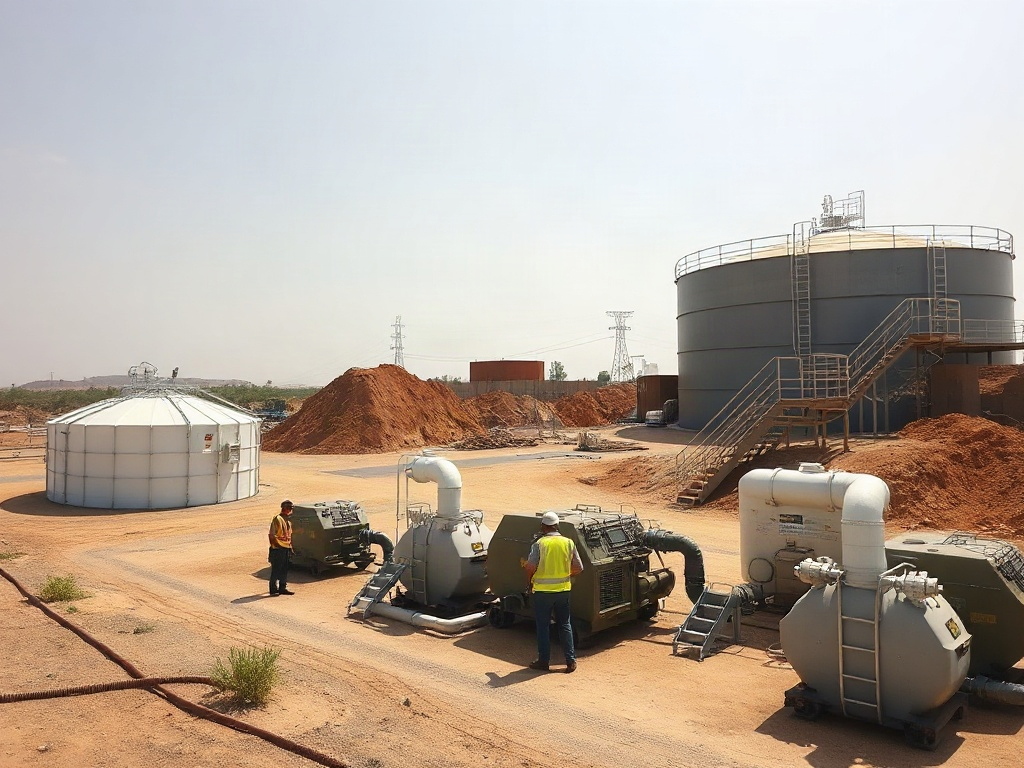
The 20-tonne-per-day plant was developed by Mahindra Waste to Energy Solutions Ltd under a Design, Build, Operate and Transfer model, with an operation and maintenance contract of 15 years. The site chosen was the Balicha landfill itself, already bioremediated, which transformed the problem into the solution. On the same site, a material recovery facility for dry waste with a capacity of 60 tonnes per day was also built.
The operational results: the plant generates around 1,600 cubic metres of raw biogas per day, produces approximately 600 kilograms of Compressed Bio-Gas daily — with a methane purity of between 93% and 96% — and generates around 8 tonnes of biofertilizer per day. Zero demand for fresh water in the process: the digester effluent is recycled within the system. Estimated reduction potential of 4,000 tonnes of CO2 equivalent annually at full capacity.
The Financial Architecture That Is Rarely Analysed
The contracting model chosen by the Udaipur Municipality was not accidental. By opting for a scheme in which the private partner finances, builds and operates, the municipality transferred technical risk and capital-intensive investment to the party that has the right incentives for the plant to function. This is not corporate philanthropy. It is a deliberate distribution of incentives.
This matters because the recurring problem with similar projects in medium-sized cities is not the technology. It is that the public operator ends up being responsible for maintaining an asset it does not know how to operate, with budgets that do not account for real maintenance costs, and with staff that turns over every time the administration changes. The 15-year contract with the private operator is, in that sense, an organisational design decision as much as a business decision.
What is not publicly available — and it is worth saying so — are the specific economic terms of the contract: gas sale prices, revenue-sharing structure, profitability thresholds. The ICLEI South Asia case studies describe the model and its outputs, but do not disclose the project's unit economics. That does not invalidate what the plant does; it does limit the ability to assess whether the model is replicable without implicit subsidies or site-specific conditions particular to Udaipur.
What is known is that the Compressed Bio-Gas is sold on the open market — including to hoteliers and compressed natural gas distributors — and that there is a recognised demand challenge. The operator itself sells below market price in order to build that demand, which affects financial sustainability in the short term. This is not a minor problem: it is the precise point at which the most promising circular-economy projects tend to lose momentum. Producing well is not enough if the market for the product does not yet exist with sufficient depth.
What Udaipur Reveals About Systemic Maturity in Urban Management
There is an easy reading of this story: an Indian city did things right and that deserves celebration. That reading is true but insufficient.
The more demanding reading observes that Udaipur processed around 12 tonnes of biodegradable waste per day in 2021 at its 20-tonne-capacity plant. That amounts to approximately 19% of the city's total waste. It is a concrete advance, but also a reminder that the remaining 81% remained without a solution within that same system. The plant did not solve Udaipur's problem. It opened a route.
The difference matters because the tendency in communications about projects of this kind — from ICLEI reports to media coverage — is to present the component that has been resolved as though it were the complete system. And that generates a specific organisational risk: that the plant functions as a signal of legitimacy outward, while the fragility of the source-segregation system, the dependence on a constant volume of well-separated wet waste, and the absence of consolidated demand for the gas produce vulnerabilities that go unnamed.
The case report states explicitly that the plant requires a continuous supply of correctly separated organic waste, and that mixing with dry waste reduces efficiency. This is not a minor technical detail. It is the most fragile link in the system: the behaviour of thousands of households and businesses that must separate waste consistently for the plant to function. No 15-year contract with a private operator solves that problem. It is solved — or not solved — by the municipality's capacity to sustain source-segregation programmes over years, across all the changes in administration that entails.
Udaipur's structural maturity is not measured in the plant. It is measured in whether the waste-separation system survives the next municipal election.
The Model Matters More Than the Technology
The Indian Compressed Bio-Gas market had an estimated size of around 1.6 billion dollars in 2024, with projections placing it between 3.5 and 4.9 billion dollars by 2032. The national government's SATAT programme — launched in 2018 — aimed for 5,000 biogas plants and 15 million metric tonnes of CBG annually. In the 2024–2025 fiscal year, 94 plants under that scheme sold 31,422 tonnes in total, an average of 0.91 tonnes per plant per day. The gap between political ambition and operational reality is enormous and deserves more attention than it receives.
What makes the Udaipur case relevant to this conversation is that it did not enter the market with an ideological bet. It arrived with a pilot, learned from the pilot, structured a contract that transfers technical risk to the party best able to manage it, chose to produce gas rather than electricity because there was no state-level policy for purchasing electricity from waste, and built the plant on the remediated ground of the previous problem. Each of those decisions was a design decision, not an ideological one.
The structural lesson this case offers is not that cities should build biomethanization plants. It is that urban systems that advance in a sustained way do so because someone, at some point, took the trouble to understand the difference between what the system says it wants to be and what the system actually does. In Udaipur, that gap was partially closed. What remains open — the demand for gas, source segregation, financial sustainability without implicit subsidies — is not a failure of the project. It is the work that no contract can do for a city.