
The Lab Wins. The Market, Not Yet
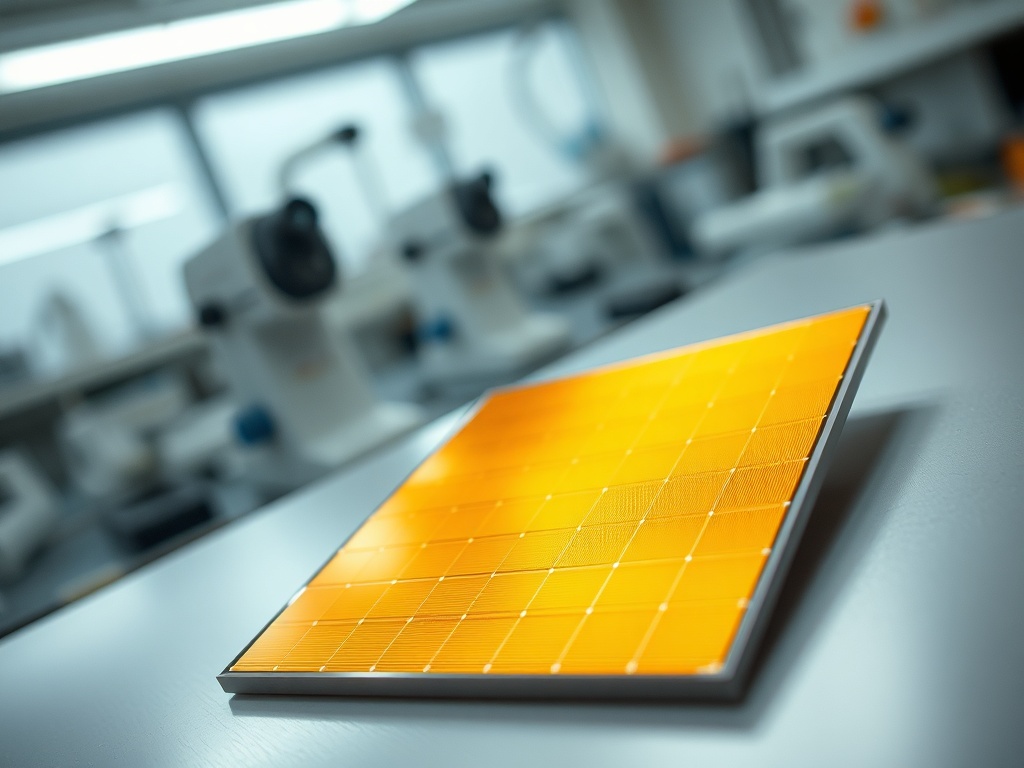
In mid-March 2026, Japan's National Institute of Advanced Industrial Science and Technology (AIST) published a result in Science Advances that immediately garnered attention in photovoltaic energy circles: a solar cell made from copper gallium selenide (CGS) achieved an energy conversion efficiency of 12.28%, certified under standard test conditions. The open circuit voltage reached 0.996 volts, with a short-circuit current of 17.90 milliamperes per square centimeter. For its material class, this sets a world record.
The device's architecture combines a molybdenum back contact on glass substrate, the CGS absorbing layer, a cadmium sulfide buffer, a zinc oxide window layer, and a front electrode. The decisive improvement from the previous 2024 design, which achieved 12.25%, came from incorporating aluminum in the rear region of the absorber to create a back surface field, enhancing carrier collection and increasing voltage. These may seem like minor increments, but they represent years of effort.
The most critical detail to understand the strategic context is not the efficiency itself, but what makes it significant: this cell contains no indium. This factor, in a thin-film photovoltaic technology market valued at $3.89 billion in 2025 and projected to grow to $14.42 billion by 2033 at an annual rate of 17.8%, shifts the conversation about supply chain bottlenecks.
Why Indium Matters More Than Efficiency
Copper indium gallium selenide (CIGS) cells are currently the efficiency benchmark in thin film technology. Uppsala University set a record in 2024 with a certified 23.64% efficiency by the Fraunhofer ISE, using high-concentration silver alloy and graded gallium. In tandem configurations, the Helmholtz-Zentrum Berlin and Humboldt University reported 24.6% efficiency in a CIGS-perovskite tandem cell, also certified by Fraunhofer. Against those numbers, the 12.28% from CGS seems modest.
However, this comparative analysis confuses the podium with a long-distance race. Indium, the central element of CIGS, faces structural supply restrictions that manufacturers have acknowledged for over a decade. This isn’t a speculative risk; it’s a physical limitation that ties the scalability of the market's most efficient technology to the availability of a resource whose global production cannot increase at the same rate as projected photovoltaic demand.
CGS precisely resolves that supply chain friction. By eliminating indium from the process, AIST researchers are addressing a systemic vulnerability of CIGS rather than competing on efficiency. The proposal is not to be better in the same arena; it is to be viable in an area where CIGS begins to falter. For next-generation tandem cells, targeting over 30% efficiency, a superior wide-bandgap cell that operates without cost-pressuring materials is required. CGS fulfills that role with a direct bandgap and a high absorption coefficient making it technically suited for that position in tandem architecture.
That said, AIST's team is explicit that the technology is not ready for mass production, and an industrial cost analysis does not yet exist. This is fundamental research. And this is where the industry’s most costly behavioral problem begins.
The Investor's Mental Map That Still Won't Buy This
There exists a predictable gap between the moment a technology achieves a certified record and when it attracts capital at scale. Engineers celebrate efficiency. Investors inquire about margins. And between these two conversations lies a cognitive friction that no press release can resolve alone.
What AIST's team presented is a lab achievement with a long-term narrative: CGS as a component of tandem cells that could exceed 30% efficiency in a market where indium becomes the bottleneck. This narrative is coherent and technically supported. The challenge is that it requires financial decision-makers to build a four-step logical chain before committing capital: indium scarcity → CIGS vulnerability → need for indium-free alternative → CGS as a viable candidate. Each additional link in that chain presents an opportunity for investment habits to say, "I’d rather wait for someone else to validate this first."
The habit of energy capital does not move by technical potential; it is driven by evidence of demonstrated scalability. The 17.81% efficiency achieved in 2025 by South Korean researchers in CIGS on ultrathin glass substrate, with flexible 60 cm² modules exceeding 10%, was celebrated precisely because it combined the record with a signal of scalability. That combination directly reduces investor anxiety: it not only shows that it works, but it also demonstrates that it can be manufactured at a size approaching a product.
CGS does not yet have that second element. What it does have is the first, well-constructed, with an incremental yet consistent improvement over the previous iteration. The question that AIST leaders and their potential industrial allies must now answer is not a technical one: it is behavioral. What is the minimum demonstrable result that a strategy director of a Japanese solar company needs to see to include CGS in their five-year R&D roadmap, without the weight of the status quo and perceived risk pushing them back to the known CIGS?
The Mistake Research Teams Make When Communicating a Record
Scientific teams that achieve efficiency milestones tend to make a systematic error in their market communication strategy: they invest almost all their energy in proving that the technology works, and almost none in defusing the fears that prevent someone from taking a chance on it.
The 12.28% of CGS is, by definition, inferior to the 23.64% of the benchmark CIGS. This immediately creates an unfavorable comparison in the mind of decision-makers that no argument about indium scarcity automatically erases. The magnetism of the absolute efficiency number works against CGS in that direct comparison. For CGS to gain the attention it deserves, its narrative needs to be built differently: not as a less efficient cell without indium, but as the only piece that addresses the supply problem threatening the scalability of the leading segment.
This reconfiguration of the message is not cosmetic. It is the difference between a technology waiting in line for the market to discover it and one that enters through the door of urgency. The researchers in Berlin who reported the 24.6% tandem expressed that they are "confident" in exceeding 30%. That is the right narrative lever: position CGS as the missing ingredient in a recipe already promising 30%, not as a second-tier competitor to CIGS.
Capital decisions in solar energy are not made in a scientific congress. They are made in boardrooms where executives are calculating supply risk, raw material costs, and return times. Each of those calculations carries an emotional weight: fear of betting on a platform that the market might abandon, the habit of continuing to fund what already works despite known vulnerabilities, and the institutional inertia of approval processes that prefer the tried and tested.
AIST’s record deserves strategic attention. But leaders wishing to capitalize on it face a task not found in any Science Advances paper: to construct the cognitive pathway leading the investor from technical admiration to resource allocation decisions. No efficiency metric, however historic, does that work alone. Executives who continue to place all bets on making their product shine, trusting that technical excellence sells itself, are overlooking the market’s most powerful force: the human mind preferring the known over the best.