
The ISS Extension Reveals Orbital Bottleneck
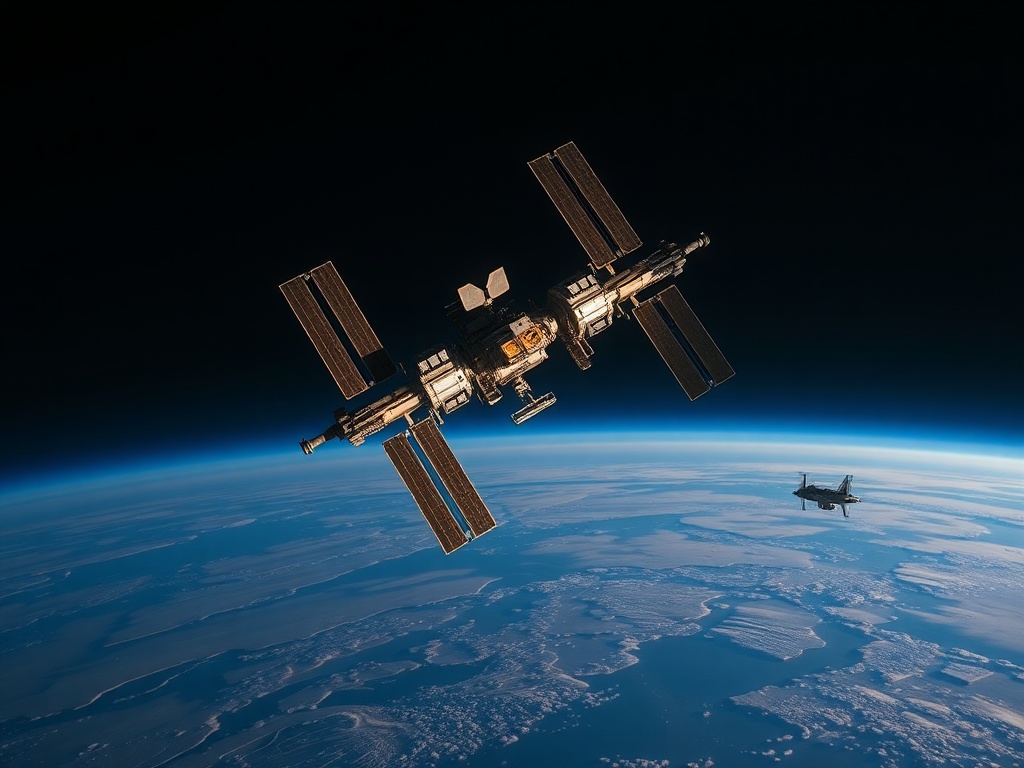
The U.S. Congress's decision to extend the operation of the International Space Station (ISS) until September 30, 2032, rather than retiring it in 2030, may seem like a mere calendar adjustment. In reality, it signals stress within the system: the commercial handoff in low Earth orbit is still not prepared to take on the role that the ISS has filled since November 2000 with a permanent crew.
This move comes through the NASA Authorization Act for 2026, which allocates $24.7 billion for 2026 and $25.3 billion for 2027, rejecting a proposed 24% cut that would have reduced the budget to $18.8 billion. The same legislative package ties the withdrawal of the ISS to an operational condition: NASA must not begin the shutdown until one or more commercial stations can provide services, ensuring continuous human presence.
As a futurist and impact analyst, I am less interested in symbolism and more in mechanics. The ISS is critical infrastructure. When critical infrastructure is extended by law, the message is clear: the market is still not offering enough redundancy. That lack of redundancy has costs, in contracts, geopolitical power, and the pace of innovation.
Congress Bought Time to Avoid an Operational Gap
The extension to 2032 is, first and foremost, an insurance policy against a specific scenario: that the ISS is retired in 2030 and commercial platforms are not ready to sustain research, training, and continuous human operations in low Earth orbit.
The law introduces a discipline that many technological transitions lack: it conditions the dismantling of the old on the functional capability of the new. Put in management terms, Congress is preventing the kind of “failed migration” that often occurs in businesses when legacy systems are shut down before the replacement has passed testing under real-world conditions.
The reason is not abstract. The very coverage of this news notes that an insider described the station as being “in its last legs,” with cracks and hardware failures associated with age. The ISS was designed for a shorter lifespan than the over 30 years that its first module will accumulate by 2032. Keeping it flying does not mean it magically rejuvenates; it means that the cost of an operational gap would be worse than the cost of squeezing an aging asset with additional oversight.
This nuance matters for C-level executives because there is an immediate parallel: when an organization stretches a critical asset beyond its original horizon, there are two possible explanations. Either the asset remains superior to alternatives, or the transition is underperforming. Here, it is the latter. The legislation explicitly states that the concern is the readiness of the commercial replacement, not an infatuation with the status quo.
There is also a portfolio element. The authorization protects programs that would have been affected by cuts, such as the Chandra X-ray Observatory, while other initiatives are being reconfigured, like Mars Sample Return, which is effectively canceled as originally conceived and pushed toward lower-cost alternative approaches. The financial signal is pragmatic: sustaining continuity in low Earth orbit is treated as an operational priority.
Commercial Stations Are Still in the Promise Phase, Not Service
NASA has been pushing the Commercial LEO Destinations program since 2021, with over $500 million awarded, mostly to Blue Origin and Voyager Technologies, to develop Orbital Reef and Starlab. Two relevant players have joined this map: Vast, which raised $500 million for its Haven-2 station, and Axiom Space, which is developing a commercial outpost with modules designed for the ISS.
The problem is not a lack of actors or seed capital. The problem lies in the difference between “having a station plan” and “operating a station service.” The ISS is not a prototype: it is a living system with life support, procedures, logistics, supply chains, corrective maintenance in microgravity, and operational governance. By tying the withdrawal to the availability of equivalent services, Congress is defining the minimum standard: the replacement should not be a technology mock-up but a platform capable of functioning.
In market terms, this represents a clash between two clocks. The public clock demands continuity: research, training, human presence. The private clock tends to promise before being ready because it competes for contracts, funding rounds, and attention. When these clocks become misaligned, the state often does what it has here: extend the bridge.
This extension also rewrites incentives. On one hand, it reduces the risk of a “cliff” for NASA and ISS users, as it avoids a rigid date without backing. On the other, it may lower competitive pressure on some providers if they interpret the margin as comfort. The law tries to neutralize that effect with a phrase that is tougher than it seems: it mandates an “orderly and managed” transition to commercial providers when they are ready. Orderly does not mean slow; it means uninterrupted.
From a business perspective, the critical operational question for commercial providers is not whether they can launch modules. It is whether they can build a sustainable unit economics model when the anchoring customer, NASA, begins to migrate demand. The commercial station that wins will not necessarily be the most ambitious; it will be the one that turns orbital capacity into repeatable services reliably.
The Geopolitical Landscape Requires Sustaining Presence in Low Earth Orbit
The ISS extension does not happen in a vacuum. China placed the core module of Tiangong in orbit in 2021, completed the setting up of three modules in 2022, and plans to operate it until the mid-2030s. In the legislative narrative, maintaining American leadership in low Earth orbit appears as an explicit goal, and committee chair Senator Ted Cruz framed it as part of sustaining leadership while driving Artemis.
Here it is useful to be cold. Geopolitical competition in low Earth orbit is not won through statements; it is won through operational continuity. Continuous human presence generates experience, procedures, training, mission cadence, and a critical mass of scientific and industrial data. If that continuity is cut, the cost is not just symbolic: it is the loss of organizational practice.
The extension to 2032 serves as a buffer at a moment when the U.S. wants to do two things simultaneously: maintain a platform in low Earth orbit and, according to the same law, advance toward a permanent lunar base capable of long-term habitation and robotic and human-assisted industrial operations. This dual front stresses budgets, talent, and supplier infrastructure. Hence, the numbers matter: the $24.7 billion and $25.3 billion are a signal that Congress did not accept the scenario of drastic cuts while a cycle of intensive investments opens up.
For companies and funds, the operational message is that low Earth orbit remains a space of political priority, and thus a relatively stable demand in the short term. That does not guarantee private profitability but decreases the risk of the “market” vanishing due to a lack of an anchor buyer.
This also rearranges power. When there is only one platform (ISS), the negotiating power is concentrated in the public operator and a limited set of contractors. When multiple commercial stations exist, power shifts towards modular architectures, specialized providers, and new service models. The extension is a reminder that this shift has not yet consolidated.
The Real Impact Lies in the Contractual Transition and System Discipline
There is an immediate consequence that reveals the cost of moving calendars in infrastructure: SpaceX received in 2024 a contract to build a deorbiting tug for the ISS with an objective for retirement by the end of 2030. With the new date of 2032, that contract will have to be adjusted. We do not know numbers from available sources, but the pattern is unmistakable: when the calendar changes, the administrative and technical invoice appears.
This type of readjustment has two interpretations for executives. The first is financial: an extension can turn a planned capital cost into a sustained operating cost, with maintenance and risk management on an aging asset. The second is systems engineering-oriented: extending the useful life requires inspections, replacements, redundancies, and stricter safety standards. When the station is “in its last legs,” every extra year is not linear.
Meanwhile, the commercial industry receives a window of two additional years to reach operation. That window is valuable only if used to close specific gaps: life support capacity, logistics, certifications, procedures, training, and service agreements. In other words, to move from hardware to operation.
From my lens of abundance, the point is not to romanticize the privatization of space but to understand the shifting structure of costs. If low Earth orbit transitions from a single public station to multiple private platforms, the marginal cost of accessing certain services may decrease over time: more capacity, more competition, more standardization. But that demonetization will only arrive when the operation is reliable, repeatable, and auditable.
There is a silent risk if acceleration occurs without discernment: automating maintenance, security, or resource allocation decisions with opaque models can escalate errors. The pressure to meet deadlines before 2030 already existed; with 2032 comes both fresh air and added responsibility. In human life infrastructure, efficiency without awareness is not courage, it is misdirection.
Low Earth Orbit Enters Its Managed Transition Phase
Extending the ISS until 2032 is an institutional admission that low Earth orbit remains a strategic asset and that the market for commercial stations is still maturing. The next few years will be decided by operational execution, not by announcements.
In the framework of the 6Ds, this industry is moving out of digitization and initial promise to enter into a productive disappointment: deadlines are adjusted, conditions are hardened, and continuity is prioritized over narrative. This process opens the door to disruption when commercial stations demonstrate stable services and begin to lower costs through competition and standardization. Technology must empower the human while maintaining continuous presence and responsibly expanding access.