
South Korea Builds Its Own Eye in the Sky, Changing Defense Market Rules
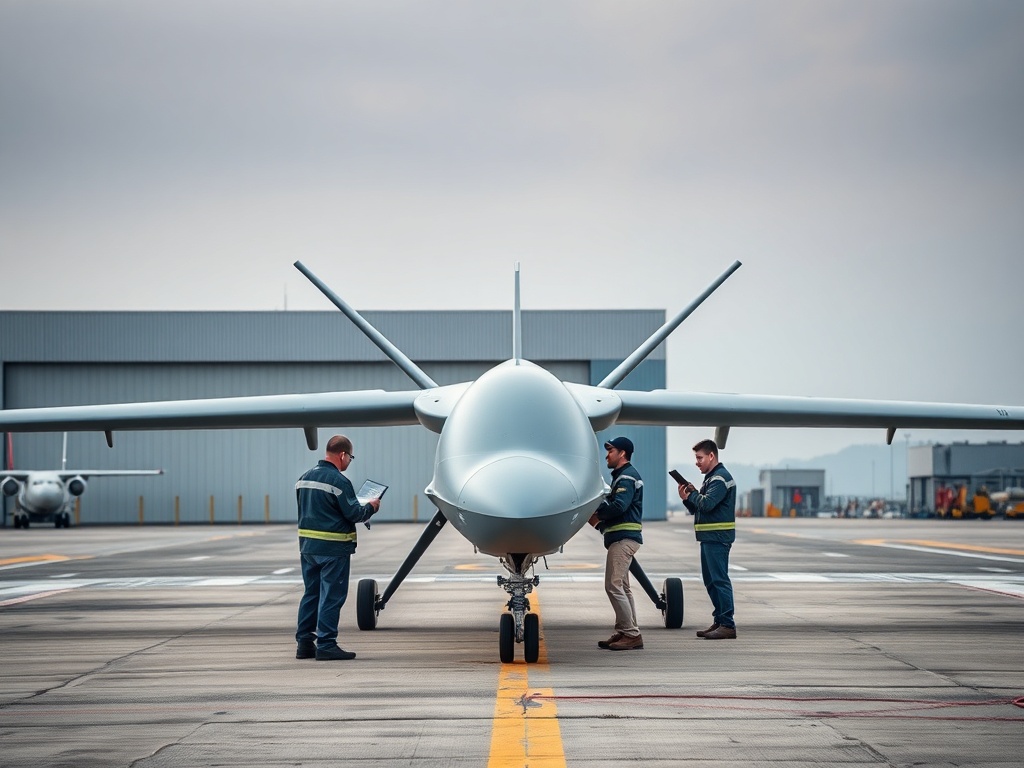
On April 8, 2026, at the Korean Air Tech Center in Busan, South Korea publicly presented its first domestically manufactured strategic reconnaissance drone. The aircraft measures 13 meters in length, has a wingspan of 26 meters, operates between 10 and 12 kilometers in altitude, and can detect targets within a radius of 100 kilometers. However, none of these specifications is the most significant aspect of the story.
What truly stands out is that 90% of its components are South Korean-made, backed by a budget of 980 billion won (approximately 726 million dollars) allocated until 2028. This achievement extends beyond aerospace engineering; it represents a conscious decision regarding how value is distributed within the defense industrial chain.
Korea’s Strategic Choice Over Cost
For decades, South Korea's defense architecture has relied on foreign systems, especially American ones. The MQ-9 Reaper is the most cited example: a reconnaissance and attack drone that South Korea could have continued purchasing under cooperation agreements with Washington. The decision to forgo that avenue comes with both visible and invisible costs.
The visible cost refers to development expenses. Creating a system of this scale from scratch—integrating ground control subsystems, data links, advanced sensors, and avionics into a cohesive platform—is not a project that breaks even with the first contract. Korean Air took the lead in system integration while LIG D&A and Hanwha Systems developed critical components. Three industrial players with distinct capabilities coordinated under the supervision of the Defense Acquisition Program Administration (DAPA) and the Agency for Defense Development (ADD). This structure was no accident.
The invisible cost, however, is what South Korea would continue to pay by not developing the system: every dollar spent on a foreign system is a dollar that does not generate local industrial capability, does not train specialized engineers, does not build local intellectual property, and does not position the nation as a supplier in future markets. For years, that cost was politically acceptable. Now, it is not.
Focusing 90% of production on domestic suppliers has a direct impact on value distribution: the 726 million dollars do not flow out of the Korean system to foreign contractors, but circulate among Korean Air, LIG D&A, Hanwha Systems, and the ecosystem of subcontractors that support them. This is industrial policy executed through a defense contract.
Why the 10% Matters as Much as the 90%
The statistic regarding 90% domestic production also reveals something that the official statements do not explicitly state: there is a 10% that still cannot be manufactured in South Korea. In systems of this complexity, that residual percentage typically concentrates on the highest technological density components: certain types of electro-optical sensors, specialized chips, or propulsion elements with extreme tolerances.
Paradoxically, that 10% is where the greatest strategic dependence resides. A foreign supplier controlling a non-replaceable component holds a disproportionate negotiating leverage over the entire supply chain. It does not matter that the remaining 90% is Korean if the critical link is subject to export restrictions, technological sanctions, or simply a price renegotiation when the buyer has no alternatives.
The recent history of the semiconductor industry taught East Asia precisely this lesson. South Korea learned it with chips; now, it is applying it to defense systems. The journey from 90% to 100% is neither linear nor swift, but the direction is clear. Each additional percentage point of local production in that residual 10% represents a reduction in the exposure of the entire chain to decisions made outside of Seoul.
The Market Opening Behind the Parade
The MUAV —the official designation of the system— is designed solely as a reconnaissance platform. Unlike the MQ-9 Reaper, it lacks offensive capabilities. This technical decision has direct commercial implications that extend beyond South Korea's military use.
There exists a segment of the international defense market comprised of countries needing persistent surveillance capabilities but incapable or unwilling to acquire armed platforms. Reasons range from internal political restrictions to conditions imposed by multilateral bodies or regional treaties. For this segment, a strategic reconnaissance drone devoid of attack capacity represents exactly the profile they seek: high operational autonomy, 24-hour surveillance, advanced sensor technology, without the geopolitical implications of operating an integrated weapons system.
South Korea is already one of the fastest-growing defense exporters in the world. The MUAV adds a product category that was previously absent from its export portfolio. The 726 million dollars invested in domestic production not only finances the operational capacity of the South Korean Air Force but also builds the industrial platform from which third countries can be offered competitive delivery times, prices, and technology transfer conditions that no Western supplier can match under their own regulatory constraints.
General Son Seok-rak, Chief of Staff of the Air Force, described the MUAV as an asset that will determine the outcome of conflicts, specifically citing the war in Ukraine and clashes in the Middle East as evidence of the role of unmanned systems in modern operations. This framing is not rhetorical; it’s a sales argument for any defense ministry evaluating its surveillance needs over the next decade.
The Lesson That Distributes Value Forward
What South Korea built in Busan is not merely a drone. It’s a value-capture model that puts domestic industrial actors at the center of the chain and transforms the defense budget into an investment in exportable capacity. Korean Air gains as a systems integrator. LIG D&A and Hanwha Systems prosper as component developers. Korean engineers benefit as specialized human capital, now equipped with intellectual property they can negotiate. The state wins by reducing its reliance on suppliers with which it negotiates from a structurally weak position.
The contrast with the opposite model is instructive. A country that procures the same operational capacity from a foreign supplier pays once for the hardware and multiple times for maintenance, upgrades, spare parts, and training. Each of these payments exits the system and strengthens the original supplier's position. Over time, dependence does not diminish; it deepens because replacing an integrated system comes with a transition cost that makes continued payment the cheapest option in the short term.
South Korea chose to incur the short-term cost of development rather than purchasing to eliminate that cumulative dependency mechanism. The result is an industrial asset that will continue generating value long after the last won from the 726 million dollar budget has been spent. The actors remaining in this model do so not because they lack alternatives, but because it offers them more than any other option can provide.