
Small Business Saturday Reveals Something Deeper Than Holiday Cheer
Every year, the last Saturday of November repeats the same ritual: American Express fires up its public relations machinery, municipalities print their "buy local" posters, and thousands of independent businesses hope that one day will make up for weeks of sparse foot traffic. In 2026, the tension between hope and arithmetic is more visible than ever.
The Chicago-area businesses the Sun-Times interviewed in the days before the event expressed something that is difficult to package into an optimistic headline: Small Business Saturday is not a demand engine — it is a mirror. It reflects, with considerable precision, what is already happening in the minds and wallets of consumers, and in this cycle that image has very pronounced contrasts.
The starting figure is uncomfortable. Estimated spending on Small Business Saturday in 2025 was $18 billion, according to American Express, down from $22 billion in 2024. A 19% drop in a single year. The fact that the Conference Board's consumer confidence index rose 11.4 points in November 2026, surpassing the 100 threshold for the first time since January 2025, is a positive signal — but it does not resolve the underlying question: what is the consumer really "contracting for" when they choose, or choose not, to patronize an independent business?
When the Problem Is Not Sentiment but Friction
The answer emerging from Chicago testimonies has nothing to do with the holiday spirit. It has to do with friction, cost structure, and behavioral shifts that have been consolidating for years.
Samantha Frontera, owner of Holly House in Lincoln Park, described November as a month without a pulse. October had been the best sales month of the year for her Lincoln Park shop, which sells holiday ornaments, handcrafted accessories, and mystery books. But in the weeks that followed, foot traffic dried up. Her diagnosis: customers are not buying — not because they lack declared purchasing power, but because something in the value equation is not adding up for them yet.
That is the first thing I find analytically relevant. A business like Holly House operates in a bracket where the purchase is entirely discretionary and depends on the consumer activating a specific mental state: festive anticipation. When that state does not arrive with sufficient intensity, or when uncertainty about the cost of living suppresses it, the physical store loses ground before any digital platform does, because a digital platform does not require the buyer to leave home, brave the cold, and spend time commuting.
Frontera mentioned that the Lincoln Park Chamber of Commerce is running promotional campaigns for Small Business Saturday. That helps, but it does not change the underlying mechanics: a single day of concentrated visibility does not substitute for a value proposition that permanently reduces the friction of buying. The risk facing stores like Holly House is not that consumers are unaware of them, but that the act of buying from them demands an effort that Amazon or any online retailer does not demand.
Koval Distillery illustrates another layer of the problem. Sonat Birnecker Hart, its president and co-founder, noted that the business depends increasingly on the final stretch of the year, and that the last four months can determine whether a craft distillery survives or not. Koval launched special holiday releases, including its Cranberry Gin and Thresh and Winnow whiskey, and organized the Ravenswood Makers Market at its facility. All of that is smart execution within a narrow margin.
But Hart was also direct about structural headwinds: the wellness movement that encourages moderate alcohol consumption, the growth of GLP-1 weight-loss medications that reduce appetite for alcohol, recreational cannabis as an alternative, and the fact that people have been going out to socialize less since the pandemic. These are not cyclical factors. They are behavioral changes that take hold and stay. The craft distillery sector in the United States, which counts approximately 2,100 active units, expects more businesses to close in 2026 than will open — something that had not occurred since the American Craft Spirits Association began tracking the figure in 2016.
No local shopping Saturday reverses that trend. What Koval can do — and is doing intelligently — is use the event as a community catalyst: turning the distillery into a gathering point, generating traffic through a producers' market, and capturing high-differentiation gift sales. That does have economic logic. It converts the physical space into an experiential asset that justifies the visit, rather than competing with the grocery store on the sale of a bottle.
The Structure That Holds and the Structure That Does Not
The most revealing contrast in the entire Chicago landscape is between businesses that depend on spontaneous foot traffic and businesses that control demand in advance.
Kouklas Greek Eatery, the Greek restaurant in Niles that opened on New Year's Eve and was one of the two Illinois restaurants included in the New York Times' list of the 50 best restaurants of the year, arrived at Small Business Saturday with 300 confirmed reservations. It is not waiting for people to show up. It already knows who is coming, when, and how much they will spend. That is an entirely different operational architecture from a retail business waiting for pedestrian traffic.
The difference is not just the type of business. It is the level of differentiation that allows an establishment to convert its reputation into predictable demand. A restaurant with recognition of that magnitude does not compete for attention on Small Business Saturday: it already has that attention reserved. For everyone else, the event is a visibility opportunity in a saturated context.
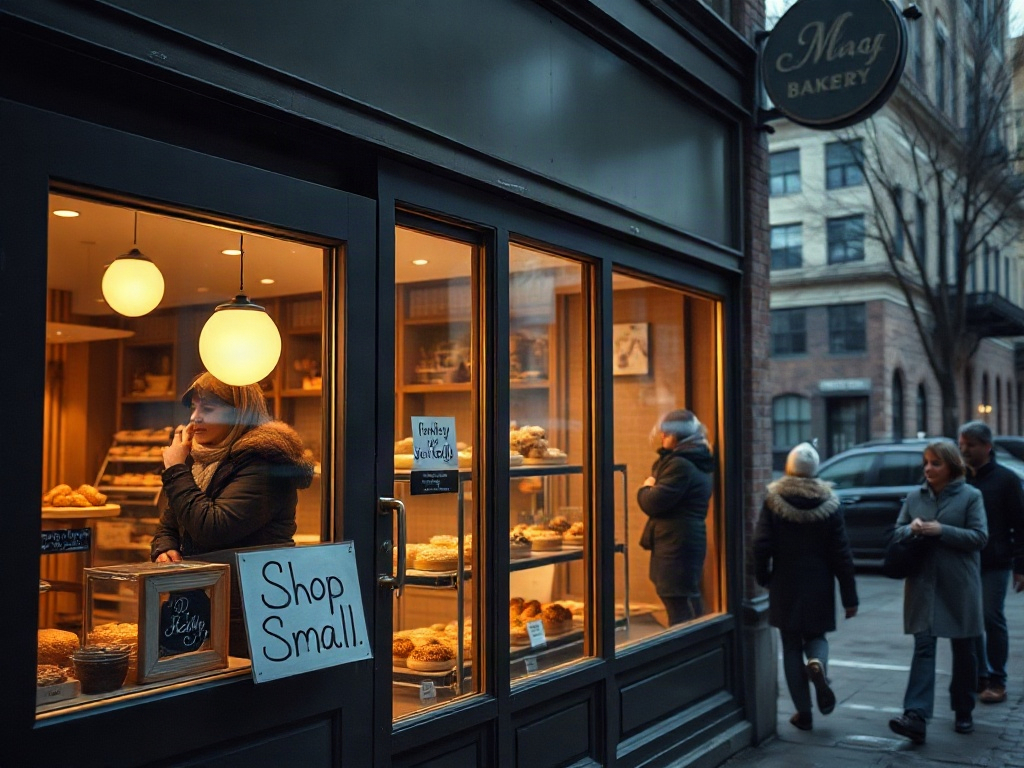
Guillotine, the French bakery in West Town that Alizé Bikard opened in June, occupies an interesting place on this map. Bikard left her consulting job in Paris to open a business selling products that the average American consumer cannot find on every street corner: kouign-amann, chouquettes, artisanally crafted croissants. She is not competing with Amazon because what she sells does not exist on Amazon. That is the most sustainable form of differentiation for a small physical business: doing something that convenience platforms cannot replicate.
The bakery reported a successful opening, with the normal adjustments to inventory and staffing. Small Business Saturday gives it additional exposure, but what drives traffic in this case is the singularity of the product. An artisan croissant that the consumer cannot find anywhere else has a competitive protection that no marketing campaign can buy.
Werk Force Brewing Co., the Plainfield brewery, operates under a different kind of pressure. Brandon Wright, its owner, has spent more than a year absorbing tariffs on German malts and materials from Canada, from which it imports most of the aluminum for its cans and the bottles for its flagship stout. The business has no control over those variables. It can only adjust, pivot, and anticipate — in Wright's own words — "what can change." Thanksgiving week is one of its highest revenue-generating moments, with the launch of its barrel-aged stout and additional variants in the days that follow.
What Werk Force does illustrates something worth naming: when input costs are uncontrollable, the only lever available is managing the launch calendar. Concentrating special releases in the week of highest consumer willingness to spend is not marketing — it is cash-flow management with the instruments available to a small business. It is not glamorous, but it is precisely what distinguishes the small and medium-sized enterprises (SMEs) that survive from those that do not.
Martha Wade, curator of Local Soul at Navy Pier, chose a different model: rather than betting on a single business, she decided to amplify many. After closing her own gallery in 2025, she took charge of a collective that groups local brands of clothing, art, food, and other products by Chicago creators. The stated objective is to represent brands from all 77 of the city's neighborhoods. The economic logic of this model is sound: it distributes visibility risk among many producers, generates a more varied proposition for visitors, and creates a more accessible entry point to local art — including postcards by local artists at $10 each that have become one of the best-selling products.
The Consumer Is Not Waiting to Be Reminded That SMEs Exist
What runs through this entire story, if one reads it carefully, is that Small Business Saturday is a useful instrument but one with very concrete limits.
The event was created by American Express in 2010 with a clear rationale: concentrate attention on independent retail during the highest-spending week of the year, when large chains and digital platforms absorb the largest share of available budgets. Since 2012, cumulative spending attributed to the event has approached $241 billion in the United States, according to the Small Business Administration. But the 19% drop between 2024 and 2025 signals that awareness of the event does not automatically convert into spending.
JJ Salazar, founder of Bangin Brows + Skin in Lincoln Park, framed it with a concrete image: "When you buy from a small business, you're not buying a service. You're backing a mother of three who built this business eyebrow by eyebrow." That narrative is powerful and authentic. It is also the kind of argument that works to convert an already-convinced customer, but carries very little force in moving someone who that day is choosing between going out in the cold or making three clicks from the couch.
According to a study by American Express cited by the Small Business Administration, 70% of small business owners say that holiday spending affects their ability to grow in the following year. That quantifies the stakes. One weekend can fund hiring, supplier payments, inventory investment, and expansion decisions for the next twelve months. Or it may not — and force cutbacks that are felt throughout the following year.
What separates the businesses that come out of this weekend well from those that do not has less to do with Small Business Saturday itself and more to do with decisions made much earlier: whether the business built a genuine reason for the consumer to make the trip, whether it activated its customer base with enough lead time, whether it has a product that cannot be found elsewhere, or whether it managed to make the visit itself worth the journey.
Restaurants with confirmed reservations, bakeries with specialties impossible to replicate industrially, distilleries that turn their space into a producers' market, and collective platforms that reduce the friction of access to local commerce do not depend on Small Business Saturday to justify their existence. They use the event as an amplifier of something that already works. Businesses that expect the event to solve November's traffic problem will likely discover that one day of visibility does not replace the preceding months of relationship-building with customers.
The consumer of 2026 does not need to be reminded that small and medium-sized enterprises (SMEs) exist. What they need is a reason concrete enough to choose them over the more convenient option. That reason has to be built before the third Saturday of November — not on that very day.