
A Rhode Island Factory and the Uncomfortable Mirror It Holds Up to Boston
The Building That Did Not Become an Amazon Warehouse
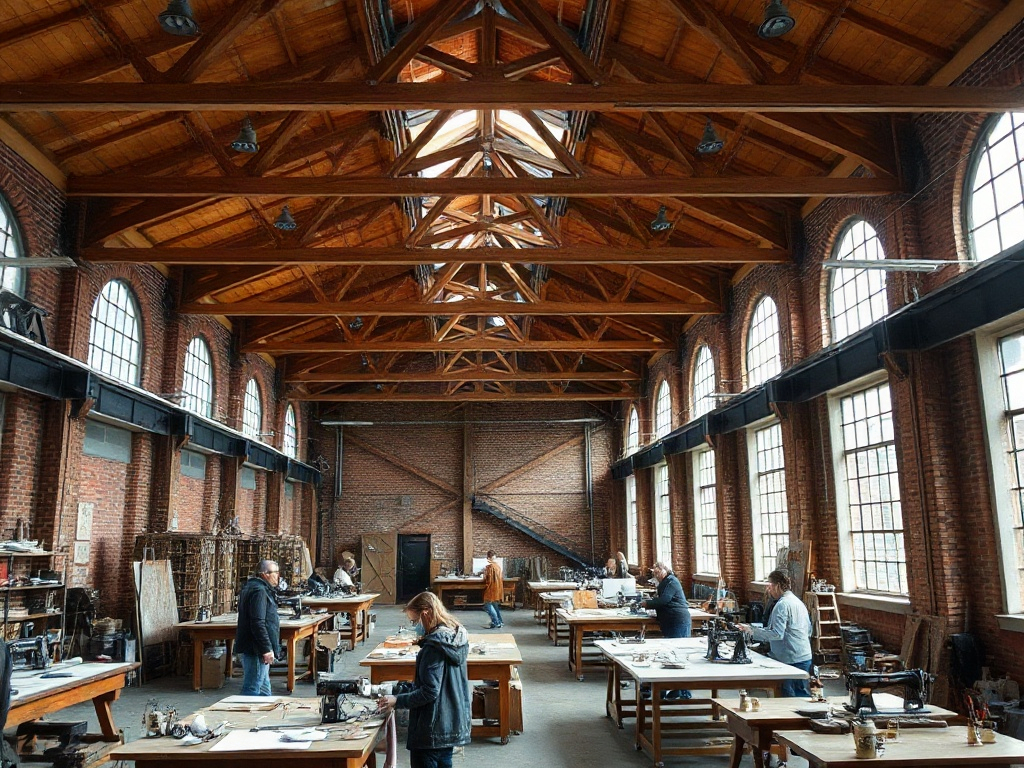
In Providence's Valley neighborhood, a former textile plant of 113,000 square feet today houses artists who manufacture materials from oyster shells, ceramic murals for neighborhood parks, and welding training programs. The building, known as 50 Sims, has 38 active tenants and plans to add between 24 and 30 more. There is a brewery. There is a courtyard featuring invited graffiti. The firm responsible for the transformation, Scout, works in collaboration with the Providence Redevelopment Agency and estimates that in December 2026 it will begin converting a whiskey barrel storage space into two additional floors with 28 studios and workshops capable of housing approximately 60 cultural producers.
That is what is visible. What makes the case interesting is not the building itself, but what it is responding to.
Less than two hours to the north, Boston spent a decade building one of the largest concentrations of laboratory space in the world. Current vacancy figures range, depending on methodology, between 21% and 33%, according to various real estate firms. The Boston Planning and Development Agency recorded that vacancy in Boston-Cambridge laboratories rose from 2.5% in 2021 to 28% in 2026. MassBio documented an even steeper trajectory for Massachusetts: from 2.7% in 2021 to 31.1% by mid-2026. The inventory of life sciences space in the state nearly doubled between 2015 and 2021, going from 21.5 to 40 million square feet. A substantial fraction of that stock is now empty, with rents that have fallen more than 20% from their 2022 peak.
Someone in Providence is filling a building. Someone in Boston is looking at empty plants. The question that emerges is not whether the 50 Sims model is replicable, but why the conversation about alternative uses takes so long to become operational.
What Everett Abitbol Is Not Saying and What He Is Saying
Scout's director of development has a quote that circulated with considerable energy: "Boston built all that lab space because it promised jobs and benefits for the city, and now half of it is empty." That is the part that gets repeated. The part that matters most for analytical purposes is what precedes it: "The arts are infrastructure, and arts infrastructure generates an enormous economic benefit for cities."
The argument is not sentimental. It is a theory of land use. A building with 38 tenants of small size, heterogeneous profiles, and modest space requirements generates distributed occupancy, foot traffic, and a community of users that sustains itself mutually. The brewery attracts visitors. The creative reuse center attracts donated materials and artists in residence. The manufacturing and welding training program attracts public funding and workers in training. None of these tenants could occupy the building on their own. Together, they create a critical mass sufficient to make the building function.
That architecture of occupancy has a concrete commercial logic: it diversifies vacancy risk, reduces dependence on a single sector cycle, and turns tenant heterogeneity into an attraction advantage. A space with only laboratories becomes exposed when the biotech cycle contracts. A space with artists, small businesses, job training, and hospitality has a more stable basket of demand, albeit with lower rents per square foot.
The problem is that this logic works well in a last-century textile plant. The analysis becomes complicated when applied to a wet laboratory building constructed in 2019.
The Gap Between the Model and Its Adoption Cost
Specialized laboratories are not converted textile factories. They are buildings with ventilation systems designed to handle biological agents, reinforced plumbing for chemical waste, floor loads higher than residential standards, electrical systems for precision equipment, and regulatory compliance protocols that do not disappear with the tenant. Converting one of those buildings into artists' studios or artisanal manufacturing workshops is not a real estate marketing exercise: it involves dismantling costly infrastructure, resolving code compliance for new uses, and absorbing the transition cost without certainty that the resulting rents will cover the original debt service.
The Greater Boston inventory is around 51 million square feet, according to JLL. Net absorption was negative in the third quarter of 2026, with CBRE reporting negative 168,430 square feet. Average asking rents were $77.97 per square foot. That figure is structurally incompatible with the rental income of a multi-tenant creative hub of small tenants, whose sustainability logic operates with significantly lower rents and a higher cost of administration per leased square meter.
This does not invalidate the conversation about alternative uses. It invalidates it as a universal solution. For the subset of properties with the worst recovery prospects—Boston's Seaport, where vacancy hovered around 40% according to the Planning Agency—the alternative to exploring creative or mixed uses may be worse: waiting for a biotech cycle that no one knows when will return, while debt service accumulates. For properties in Kendall Square, with an inventory exceeding 14 million square feet and the lowest vacancy in the market, the 50 Sims model has no immediate relevance.
The Providence case, then, does not offer a template. It offers a demonstration that there is a third way between waiting and demolishing, although that path requires conditions that are not guaranteed in Boston: an acquisition or lease cost compatible with low rents, public partners willing to co-participate, and a community of prospective occupants—artists, small manufacturers, training programs—large enough to fill the space.
The Variable the Market Has Not Yet Fully Processed
CBRE leasing data for the third quarter of 2026 show a nuance worth extracting: cumulative annual activity was 20% above the prior year, but that improvement is explained largely by renewals, not by new occupations of vacant space. The active construction pipeline, at 924,000 square feet, was fully pre-leased, entirely by pharmaceutical companies. And some projects were already pivoting away from laboratory use before completion.
That describes a two-speed market. Institutional pharmaceutical demand remains real for a premium segment of the inventory. The rest is in a more difficult position: too costly for small tenants at accessible market rents, too specialized for cheap conversion, and too large to be filled by multiple low-volume tenants. The space the market is absorbing is the space that always had solid underlying demand. What is not being absorbed is what was built on the assumption that demand would keep expanding at the pace of 2020 and 2021.
That distinction between premium space with durable demand and speculative space with fictitious demand is the variable the market is still slow to recognize with precision. Part of the recovery narrative rests on the fact that the active pipeline is pre-leased, which is technically true, but says little about the millions of square feet of existing inventory that have no tenant and no clear horizon for conventional absorption.
The 50 Sims model is relevant precisely for that segment: the space that the prime market will not recover soon and that continues to accumulate cost without generating income. For that stock, the operational question is not whether artists can pay laboratory rents. It is how long an owner can sustain total vacancy before a low rent with distributed occupancy becomes financially superior to waiting.
The Limits of What a Providence Factory Can Teach a Laboratory Owner in Boston
50 Sims is a case study in organizational adaptability more than a replicable financial return model. What Scout demonstrated is that a large industrial property can find stable occupancy with a heterogeneous tenant base, provided the cost structure is compatible with modest rents and that public partners exist who are capable of absorbing part of the transition risk.
What it did not demonstrate, because there are no published data to confirm it, is the tenant retention rate, the total cost of the transformation, the level of subsidy received from the Providence Redevelopment Agency, or the return on investment comparable to that of a laboratory development. That absence of verifiable financial metrics is part of the profile of the case: it is a demonstration of operational viability, not evidence of equivalent or superior financial performance.
For a laboratory owner in Boston carrying debt from an expansionary cycle, the calculation is not ideological. It is arithmetic. The rent needed to service that debt probably exceeds what a creative hub can generate per square foot. That gap is not closed by a good story about artists and oyster shells. It is closed by a debt restructuring, a public partner with capital, a change of use that reduces the asset's book value, or some combination of the three.
The merit of the Providence case is that it puts that conversation on the table before the alternative becomes prolonged deterioration. For Boston's stock with the worst recovery prospects, the real friction does not lie in imagining the alternative use. It lies in determining who absorbs the accounting loss that makes a change of model possible, and under what structure that owner can reach that decision before accumulated vacancy brings them to the same place, but with far less room to maneuver.