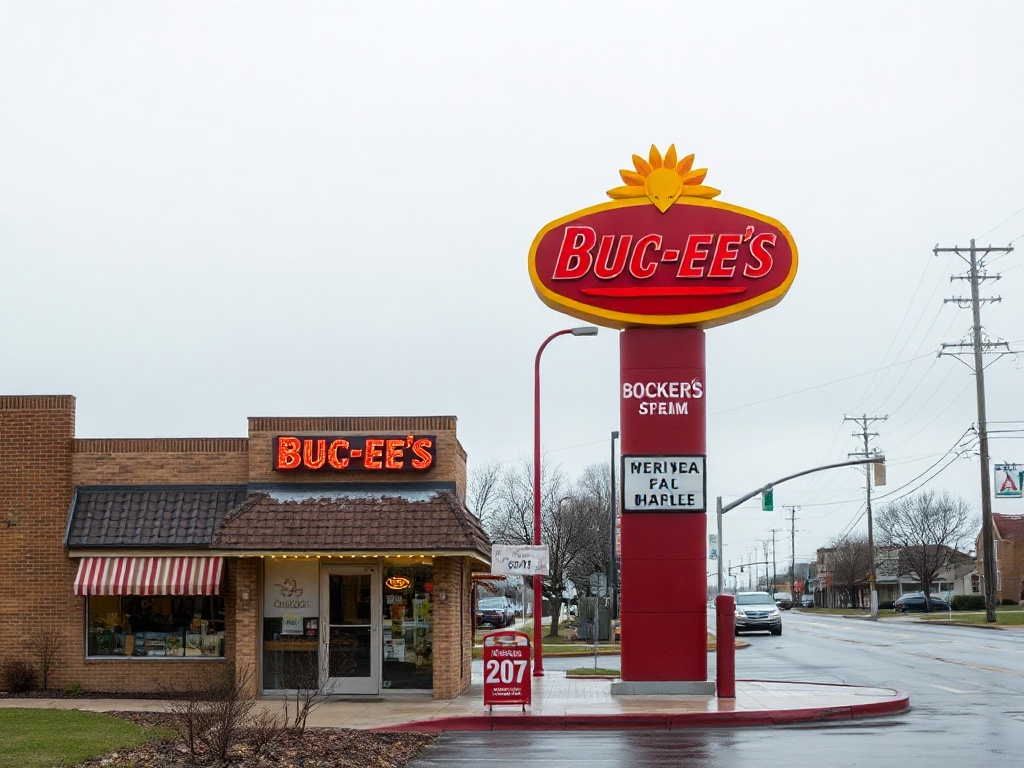

How Buc-ee's Turned Its Logo Into a Weapon of Territorial Expansion
There is something that happens when a large company enters a new market: the territory it comes to occupy is not only physical. It is also symbolic, legal, and in some cases, intimidating. The story of Buc-ee's in Ohio illustrates that process with a clarity that no brand strategy manual would dare to describe so openly.
In July 2026, Buc-ee's — the Texas chain of enormous gas stations known for its spotless bathrooms and its endless aisles of snacks — filed a federal lawsuit against Beaver's Mini Mart, a neighborhood store in Beavercreek, Ohio. The accusation: trademark infringement. The argument: the beaver mascot of Beaver's Mini Mart, with its large eyes and its smile, combined with the use of red as the predominant color, could confuse consumers and lead them to believe that some affiliation with Buc-ee's exists.
The store has been in the neighborhood for decades. It has no gas pumps. Buc-ee's opened its first location in Ohio only in April 2026, just 16 miles away.
That distance is the detail that matters most for understanding what this is really about.
The Brand as a Perimeter of Expansion
Buc-ee's did not invent trademark litigation as a tool for growth. What it has done with a certain degree of systematism is use it at the exact moment it enters a new regional market. Before opening in Ohio, it sued Mickey Mart in February 2026, a chain of gas stations in the state that was planning to change its name to Mickey's and that had already been using its mascot — a moose named Mickey — since at least 2020. Before that, in January 2026, it sued Super Fuels in Texas. Before that, in 2025, there were cases in Florida, Missouri, and South Carolina. In May 2026, it was Teddy's Market in Georgia.
The pattern is neither accidental nor random. Each lawsuit arrives during a period of active expansion. What the company is building is not only physical presence but a legal perimeter around its visual identity that functions as a deterrent signal for any business that, in the new market, happens to have something resembling a smiling animal on its storefront.
From a brand architecture perspective, this has an internally coherent logic: Buc-ee's has had its beaver registered for more than four decades and holds multiple federal registrations. Trademark law in the United States requires holders to demonstrate that they are actively defending their marks in order to keep them valid. A company that does not litigate when it detects similarities can, over time, weaken its own registration. In that sense, the aggressiveness is not only an offensive strategy: it is also an implicit legal obligation for anyone who wants to preserve exclusivity over their visual identity.
But what the legal logic does not resolve is the power asymmetry between the parties. Beaver's Mini Mart is not a regional chain with its own legal teams. It is a neighborhood store whose community has begun organizing fundraising events and GoFundMe campaigns to cover its legal expenses. Buc-ee's, for its part, has won the majority of the more than twelve lawsuits it has filed over the years, according to journalistic reports on the case.
That asymmetry is where the strategy begins to reveal its true cost.
What the Periphery Sees and the Center Fails to Calculate
There is a structural difference between winning a lawsuit and winning a market. Buc-ee's may obtain a court order compelling Beaver's Mini Mart to change its logo, and still emerge from that process with a perception problem that no verdict can resolve.
The coverage of this case — amplified by the segment of Last Week Tonight host John Oliver, who publicly challenged Buc-ee's to sue him and launched a merchandise line under the name "Buc-Off" with proceeds going to a hunger relief organization — transformed what was a standard trademark dispute into a narrative about corporate power versus small business. That is negative social capital accumulated at the most sensitive possible moment: when a company is trying to establish itself in a new territory where it still has no history and no locally built trust.
The consumers of Beavercreek who have spent decades shopping at Beaver's Mini Mart do not associate that store with Buc-ee's. There is no real confusion. What does exist now is a collective memory about who arrived first and who filed the lawsuit. That memory is the kind of social capital that does not appear in any legal risk analysis, but that does operate in the everyday purchasing decisions of those who live 16 miles from the new gas station.
Peripheral intelligence — the kind that circulates in local Facebook groups, in community solidarity events, in regional media coverage — rarely reaches the legal teams that design trademark litigation strategies. Those teams work with registrations, precedents, and probabilities of success in court. They do not work with the social texture of the markets where the company wants to build long-term loyalty.
That blind spot is not a moral one. It is structural. And it has concrete operational consequences.
Registered Trademark, Reputation Not Guaranteed
There is a distinction that companies in expansion frequently collapse: protecting the legal integrity of a brand is not the same as building the social legitimacy of that brand in a new territory. These are two processes with different logics, different timeframes, and different actors involved.
Buc-ee's has spent forty years building a brand identity that is genuinely recognizable across the South and Southeast of the United States. Its stations are destinations in their own right: enormous, clean, with a value proposition that travelers consistently appreciate. That reputation is a real asset. But it is an asset built in markets where the company has presence, history, and accumulated positive word of mouth.
Ohio is a new market. The first location opened in April 2026. In that context, every legal action against a local business is simultaneously a brand event, not merely a judicial proceeding. And when those events generate negative coverage, solidarity campaigns, and the attention of communicators with national audiences, the cost of protecting the brand can far exceed the benefit of eliminating a logo that shares the same animal species.
The Mickey Mart case adds another layer: that chain had been using its mascot since 2020, several years before Buc-ee's set foot in Ohio. In terms of temporal priority in the local market, the consumer confusion argument is difficult to sustain without acknowledging that the prior presence of the defendant in that territory directly contradicts the narrative that Buc-ee's is protecting something the local consumer already identified with it.
What this reveals is not legal bad faith. It is a decision-making model operating with incomplete information about the social fabric of the market it wants to conquer.
The Architecture That Litigation Exposes
When a large company enters a new region with a lawsuit as its first act of public visibility, it is revealing something about how its internal decision-making architecture is constructed. Legal departments have incentives to protect registrations and win cases. Expansion departments have incentives to open locations. Neither, by design, has incentives to monitor the social capital being eroded in each community where the company arrives as a plaintiff before arriving as a neighbor.
That disconnection is not a problem of corporate values. It is a problem of organizational design. The signals that arrive from the periphery — the community reaction, the local coverage, the organized solidarity around the defendant business — have no feedback channel back to those who make the litigation decisions. The team that decides to sue Beaver's Mini Mart is not in the same information circuit as the team that needs the residents of Beavercreek to choose Buc-ee's on the next Friday night.
Buc-ee's may win every one of its lawsuits. The history of corporate brands that won legal battles and lost markets has enough examples to take that scenario seriously. Legal protection of a brand is a necessary condition for its integrity, but it is not a sufficient condition for its adoption in territories where loyalty has not yet been built.
The beaver of Beavercreek has spent decades gazing out from a neighborhood storefront. The one that arrived four months ago, with federal lawyers in tow, still has to prove that it deserves something more than a court order.